358 posters, 97 topics, 122 sessions, 958 authors, 239 institutions
ePostersLive by SciGen Technologies S.A. All rights reserved.
79th PostGraduate Assembly in Anesthesiology 2025
December 12 - 15, 2025 | New York City

3110
Enhancing Anesthesia Training: Assessing Arterial Line Placement Skills Using Wearable Eye-Tracking Technology for Objective Feedback
Poster Presenter
Part of Topic
Cardiovascular - Medical Education
Assessing Arterial Line Placement Skills Using Wearable Eye-Tracking Technology for Objective Feedback
Nathan Keller BA 1 , Alexander Gherciuc 2 , Aidan Neher BS 3 , Enrique Vergara-Escudero MD 2 , Tjörvi Perry MD 2
University of Minnesota Medical School 1 ; University of Minnesota Department of Anesthesiology 2 ; University of Minnesota Division of Biostatistics and Health Data Science 3
INTRODUCTION
● Arterial line placement is a core skill for anesthesiologists, and technical inefficiencies contribute to complications (1).
● Traditional evaluations of procedural skill rely on subjective assessments.
● Eye-tracking provides objective gaze metrics that can characterize visual focus and may complement traditional assessment methods (2).
● Saccades (rapid eye movements) and fixations (stationary gaze) may offer insight into cognitive load and attentional allocation during arterial line procedures (3). ● We compare adjusted saccade and fixation counts between CA-2 and CA-3's during arterial line placement to detect experience-related differences in gaze behavior and inform efforts to enhance procedural safety and performance.
METHODS
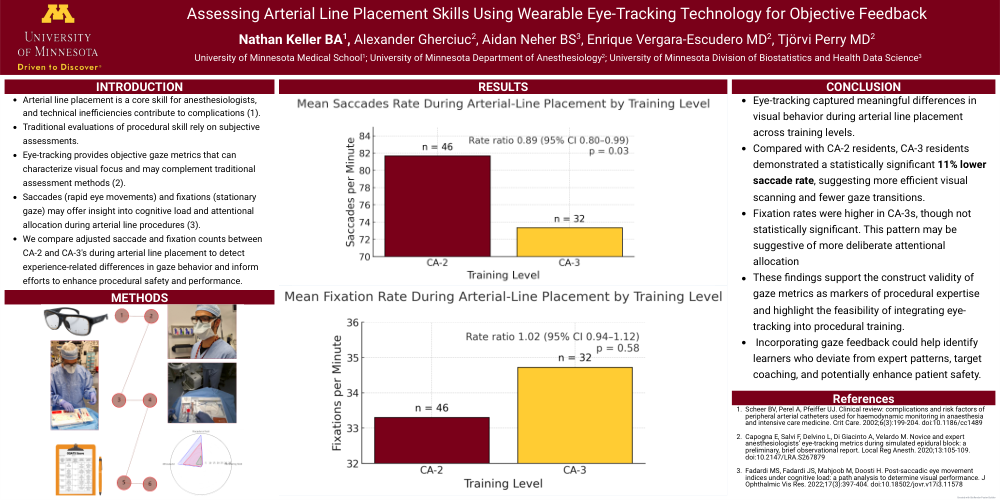
After institutional review board approval, anesthesia residents in categorical years 1-3 (CA-1–CA-3) at a single academic cardiac operating suite were invited to wear eye‑tracking smart‑glasses (Tobii Pro Glasses 3; Tobii AB, Danderyd, Sweden) immediately before A-line placement. A study assistant ensured proper device fit. Point‑of‑view video streams were imported into Tobii Pro Analyzer, where the A-line procedure start (“gloving start”) and A-line procedure conclusion (“drape off”) were time‑stamped. Saccades (rapid, ballistic eye movements [20–200 ms] that shift the line of sight from one point to another) and fixations (brief intervals [100–600 ms] in which the eyes remain relatively still on a single location) occurring between these markers were automatically quantified.
Primary endpoints were procedure‑adjusted rates of saccades and fixations. Visual metrics for CA-2 and CA-3 residents were compared with separate mixed‑effects Poisson regressions: total fixations or saccades served as dependent variables, procedural duration (milliseconds) was included as an offset, and resident identifier was modeled as a random intercept to account for repeated measures. Rate ratios (RRs) with 95 % confidence intervals are reported; two‑sided p < 0.05 denoted statistical significance.
78 arterial‑line insertions from 20 residents were examined. One CA‑1 recording was reclassified as CA‑2, leaving 46 recordings from thirteen CA‑2 and 32 from nine CA‑3 trainees for analysis across progressive training levels. During placement, CA‑3s displayed 11.1 % fewer saccades/min, rate ratio 0.889 (95 % CI 0.800–0.988; p = 0.028), confirming a statistically significant reduction.
CA-2 mean saccades rate = 81.680 ± 54.406 saccades/min
CA-3 mean saccades rate = 73.359 ± 30.706 saccades/min
CA-2 mean fixation rate = 33.300 ± 17.751 fixations/min
CA-3 mean fixation rate = 34.720 ± 14.003 fixations/min - rate ratio 1.024 (95 % CI 0.941–1.115; p = 0.5771)
CONCLUSION
● Eye-tracking captured meaningful differences in visual behavior during arterial line placement across training levels.
● Compared with CA-2 residents, CA-3 residents demonstrated a statistically significant 11% lower saccade rate, suggesting more efficient visual scanning and fewer gaze transitions.
● Fixation rates were higher in CA-3s, though not statistically significant. This pattern may be suggestive of more deliberate attentional allocation
● These findings support the construct validity of gaze metrics as markers of procedural expertise and highlight the feasibility of integrating eyetracking into procedural training.
● Incorporating gaze feedback could help identify learners who deviate from expert patterns, target coaching, and potentially enhance patient safety.
References
1. Scheer BV, Perel A, Pfeiffer UJ. Clinical review: complications and risk factors of peripheral arterial catheters used for haemodynamic monitoring in anaesthesia and intensive care medicine. Crit Care. 2002;6(3):199-204. doi:10.1186/cc1489
2. Capogna E, Salvi F, Delvino L, Di Giacinto A, Velardo M. Novice and expert anesthesiologists’ eye-tracking metrics during simulated epidural block: a preliminary, brief observational report. Local Reg Anesth. 2020;13:105-109. doi:10.2147/LRA.S267879
3. Fadardi MS, Fadardi JS, Mahjoob M, Doosti H. Post-saccadic eye movement indices under cognitive load: a path analysis to determine visual performance. J Ophthalmic Vis Res. 2022;17(3):397-404. doi:10.18502/jovr.v17i3.11578