358 posters, 97 topics, 122 sessions, 958 authors, 239 institutions
ePostersLive by SciGen Technologies S.A. All rights reserved.
79th PostGraduate Assembly in Anesthesiology 2025
December 12 - 15, 2025 | New York City

3105
Title: Yours to Use: The Pain Registry Biobank
Poster Presenter
Authors
Affiliations
Part of Topic
Basic Research - Pain Medicine
Yours to Use: The Pain Registry Biobank
McDuffie, Bedocs, Papay, Rojas, Barrett
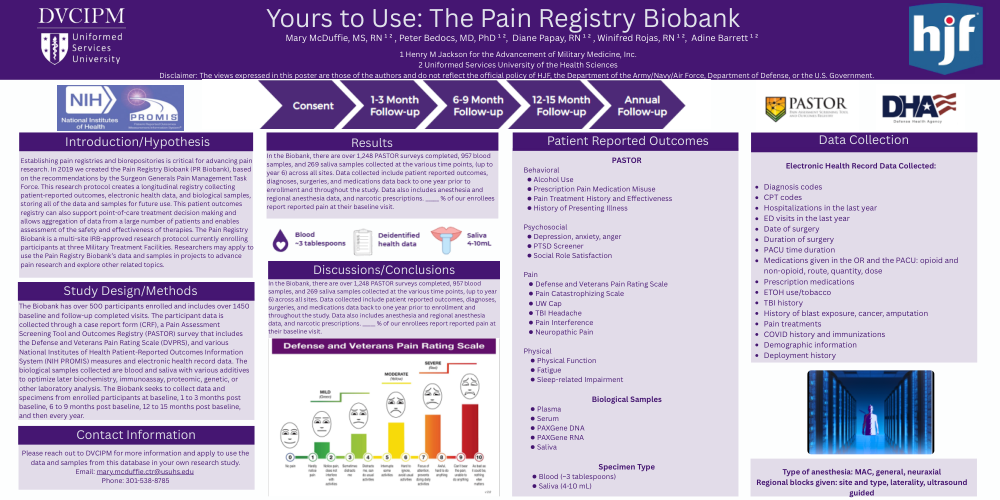
Introduction/Hypothesis:
Establishing pain registries and biorepositories is critical for advancing
pain research. In 2019 we created the Pain Registry Biobank (PR
Biobank), based on the recommendations by the Surgeon Generals Pain
Management Task Force. This research protocol creates a longitudinal
registry collecting patient-reported outcomes, electronic health data,
and biological samples, storing all of the data and samples for future
use. This patient outcomes registry can also support point-of-care
treatment decision making and allows aggregation of data from a large
number of patients and enables assessment of the safety and effectiveness of therapies. The Pain Registry Biobank is a multi-site IRB-approved research protocol currently enrolling participants at three Military Treatment Facilities. Researchers may apply to use the Pain Registry Biobank’s data and samples in projects to advance pain research and explore other related topics.
Study Design/Methods:
The Biobank has over 500 participants enrolled and includes over
1450 baseline and follow-up completed visits. The participant data
is collected through a case report form (CRF), a Pain Assessment
Screening Tool and Outcomes Registry (PASTOR) survey that
includes the Defense and Veterans Pain Rating Scale (DVPRS), and
various National Institutes of Health Patient-Reported Outcomes
Information System (NIH PROMIS) measures and electronic health
record data. The biological samples collected are blood and saliva
with various additives to optimize later biochemistry, immunoassay,
proteomic, genetic, or other laboratory analysis. The Biobank seeks
to collect data and specimens from enrolled participants at baseline,
1 to 3 months post baseline, 6 to 9 months post baseline, 12 to 15
months post baseline, and then every year.
Results:
In the Biobank, there are over 1,248 PASTOR surveys completed, 957
blood samples, and 269 saliva samples collected at the various time
points, (up to year 6) across all sites. Data collected include patient
reported outcomes, diagnoses, surgeries, and medications data back to
one year prior to enrollment and throughout the study. Data also
includes anesthesia and regional anesthesia data, and narcotic
prescriptions. 306 enrollees report pain at their baseline visit.
Discussions/Conclusions:
The Pain Registry Biobank has collected samples and data from over
500 participants experiencing various levels of pain throughout the
study. Data have been collected from a diverse set of participants within
the military population to include information about their pain scores,
biopsychosocial outcomes, treatments, and medical history over time.
To date we have received eight inquiries for use of the Biobank’s data
and samples. Two of the requests are complete and those projects are in
data analysis. We are currently accepting applications to use these
resources. This rich collection of data and specimens is available to
advance your pain research and to help answer your questions about
pain and its management.
Patient Reported Outcomes:
PASTOR
Behavioral
● Alcohol Use
● Prescription Pain Medication Misuse
● Pain Treatment History and Effectiveness
● History of Presenting Illness
Psychosocial
● Depression, anxiety, anger
● PTSD Screener
● Social Role Satisfaction
Pain
● Defense and Veterans Pain Rating Scale
● Pain Catastrophizing Scale
● UW Cap
● TBI Headache
● Pain Interference
● Neuropathic Pain
Physical
● Physical Function
● Fatigue
● Sleep-related Impairment
Biological Samples
● Plasma
● Serum
● PAXGene DNA
● PAXGene RNA
● Saliva
Specimen Type
● Blood (~3 tablespoons)
● Saliva (4-10 mL)
Data Collection:
Electronic Health Record Data Collected:
Diagnosis codes
CPT codes
Hospitalizations in the last year
ED visits in the last year
Date of surgery
Duration of surgery
PACU time duration
Medications given in the OR and the PACU: opioid and
non-opioid, route, quantity, dose
Prescription medications
ETOH use/tobacco
TBI history
History of blast exposure, cancer, amputation
Pain treatments
COVID history and immunizations
Demographic information
Deployment history
Type of anesthesia:
MAC, General, Neuraxial
Regional blocks given, site and type, laterality, ultrasound guided