358 posters, 97 topics, 122 sessions, 958 authors, 239 institutions
ePostersLive by SciGen Technologies S.A. All rights reserved.
79th PostGraduate Assembly in Anesthesiology 2025
December 12 - 15, 2025 | New York City

3091
Evaluating the patterns of use of persistent post-operative opioid use after cardiothoracic surgery in regional Queensland.
Poster Presenter
Authors
Affiliations
Part of Topic
Pain Medicine
Background
62% increase in opioid-related-deaths.
25% rise in hospitalisations between 2007 - 2016 in Australia alone. This is driven
mainly by prescription use, not illicit drugs.
These trends highlight the need to better understand how opioid use evolves after
surgery, particularly in rural settings.
Opioid use is common after surgery, but for some patients, short-term prescribing
can lead to extended use and dependence.
Rural and regional areas face unique challenges, with higher opioid prescribing rates
and limited access to alternative pain care.
There is little research exploring postoperative opioid patterns following major
surgeries like cardiothoracic procedures in regional settings.
Indigenous patients are often underrepresented in surgical research, despite having
distinct health risks and care experiences.
Aims
- To calculate how many patients continue opioid use at 3, 6, and 12 months
post-discharge
- To examine the types of opioids prescribed, including frequency, dose, and
release formulation
- To explore whether persistent use differs between Indigenous and non-
Indigenous patients
- To assess the influence of rurality, type of surgery, and comorbidities on long-
term use
- To identify patient and system-level risk factors that may contribute to ongoing
prescribing
- To identify if opioid naivety affects dosages of opioids prescribed and
persistent usage
Methodology
Study design: Retrospective observational cohort study at TUH
Patient Selection: Adults >= 18 yrs who underwent cardiothoracic surgery between
Oct’21 - Mar’23. Identified using ICD-10-PC5 procedural codes.
Inclusion: Age >= 18 years old. Discharged home post-operative.
Exclusion: Discharged elsewhere. Prescribed methadone or fentanyl lozenges. Redo
operations
Data Sources: iEMR, Metavision, Q-script.
Data variables: Demographics: age, sex, Indigenous status, rurality. Clinical data:
creatinine, comorbidities, alcohol, substance and tobacco use, BMI. Surgical details:
procedure type, length of stay. Opioid prescribing patterns: type, dose, formulation
Current status: Data collection and synthesis completed. Full analysis completed.
Ethics: Approved by Human Research Ethics Committee with waiver of consent
(low-risk, retrospective). Public Health Act application approved.
Results
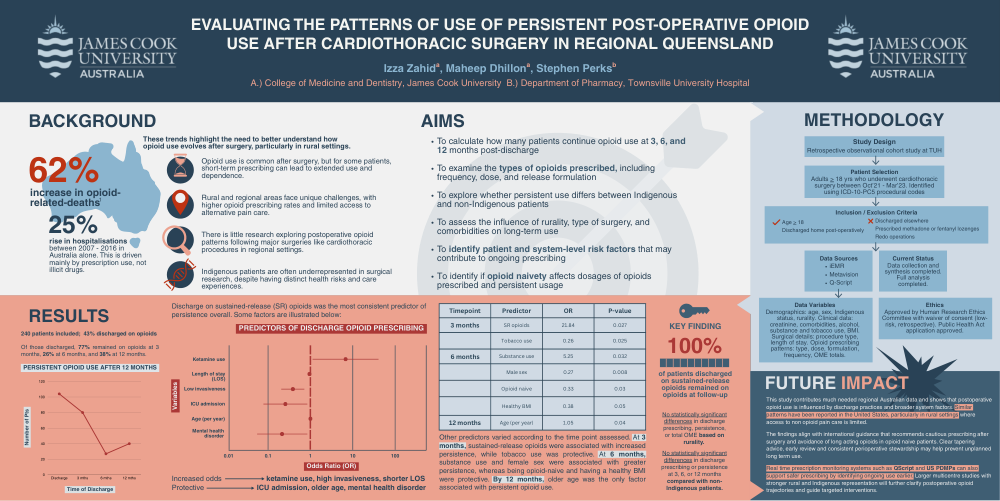
240 patients included; 43% discharged on opioids
Of those discharged, 77% remained on opioids at 3 months, 26% at 6 months, and
38% at 12 months.
Discharge on sustained-release (SR) opioids was the most consistent predictor of
persistence overall. Some factors are illustrated below:
Increased odds: ketamine use, high invasiveness, shorter LOS
Protective: ICU admission, older age, mental health disorder
Other predictors varied according to the time point assessed. At 3 months,
sustained-release opioids were associated with increased persistence, while tobacco
use was protective. At 6 months, substance use and female sex were associated
with greater persistence, whereas being opioid-naive and having a healthy BMI were
protective. By 12 months, older age was the only factor associated with persistent
opioid use.
Key finding: 100% of patients discharged on sustained-release opioids remained on
opioids at follow-up
No statistically significant differences in discharge prescribing, persistence, or total
OME based on rurality.
No statistically significant differences in discharge prescribing or persistence at 3, 6,
or 12 months compared with non-Indigenous patients.
Future Impact
This study contributes much needed regional Australian data and shows that
postoperative opioid use is influenced by discharge practices and broader system
factors. Similar patterns have been reported in the United States, particularly in rural
settings where access to non opioid pain care is limited.
The findings align with international guidance that recommends cautious prescribing
after surgery and avoidance of long acting opioids in opioid naive patients. Clear
tapering advice, early review and consistent perioperative stewardship may help
prevent unplanned long term use.
Real time prescription monitoring systems such as QScript and US PDMPs can also
support safer prescribing by identifying ongoing use earlier. Larger multicentre
studies with stronger rural and Indigenous representation will further clarify
postoperative opioid trajectories and guide targeted interventions.