358 posters, 97 topics, 122 sessions, 958 authors, 239 institutions
ePostersLive by SciGen Technologies S.A. All rights reserved.
79th PostGraduate Assembly in Anesthesiology 2025
December 12 - 15, 2025 | New York City

3077
Modulatory Effects of Anesthetic Antagonists on the Rate of Mandibular Movement in Anesthetized Larval Zebrafish
Poster Presenter
Part of Topic
Basic Research - Fundamentals of Anesthesiology
Influence of Anesthetic Antagonists on the Mandibular Movement Rate in Anesthetized Larval Zebrafish
Introduction
•While modern anesthetics are widely well-tolerated and safe especially when administered by skilled providers, airway and respiratory complications remain the leading cause of anesthetic-related adverse events.
•Traditional mammalian respiratory depression models are limited by cost, technical complexity, and the morbidity of inducing respiratory depression.
•Zebrafish larvae (Danio rerio) provide an alternative for studying respiratory depression; by 12 days post-fertilization (dpf), they display a developed respiratory drive network with conserved neural circuitry but do not yet require aquatic respiration for survival due to their small size.
•This makes them an ideal model to observe respiratory rate (mandibular movement), including complete abolishment of respiration, without causing morbidity or mortality.
•Prior studies of respiratory depression in zebrafish have relied on restraints (such as capillary tubes) that can introduce stress, which can elevate respiratory rate.
•While originally established for studying opioid-induced respiratory depression, a “free-swimming” model is adapted here to explore the effects of co-administering caffeine and other novel antagonists to determine their ability to modulate respiratory depression and shift EC50 values.
Methods
•Wildtype (Tübingen longfin, TLF) zebrafish at 12-14 dpf (5 fish x 3 biological replicates, n = 15) were placed into a freshly made solution of E3 medium containing anesthetic, anesthetic + antagonist, or vector control (1% DMSO).
•Four antagonists were tested for modulation of respiratory rate (RR) measured by mandibular movement: caffeine (5 μg/mL), propofluor (30 μM), PFAL 10 (30 μM), PEARL 6 (30 μM), or hydrocarbon control compound (30 μM).
•Each fish was transferred into custom-made, round, PVC wells (7 mm width x 2.8 mm depth) tailored to allow some freedom of movement to prevent significant stress.
•The fish were equilibrated for 15 minutes in drug and under the lights of the microscope (for behavioral acclimation).
•The RR was then observed with an AmScope SM-1 Series Zoom Trinocular Stereo Microscope (25x magnification) and recorded in 4K high-definition video for 30-second segments using a Z CAM E2-M4 camera. Mandible movements were manually counted by video to quantify RR per minute.
Discussion
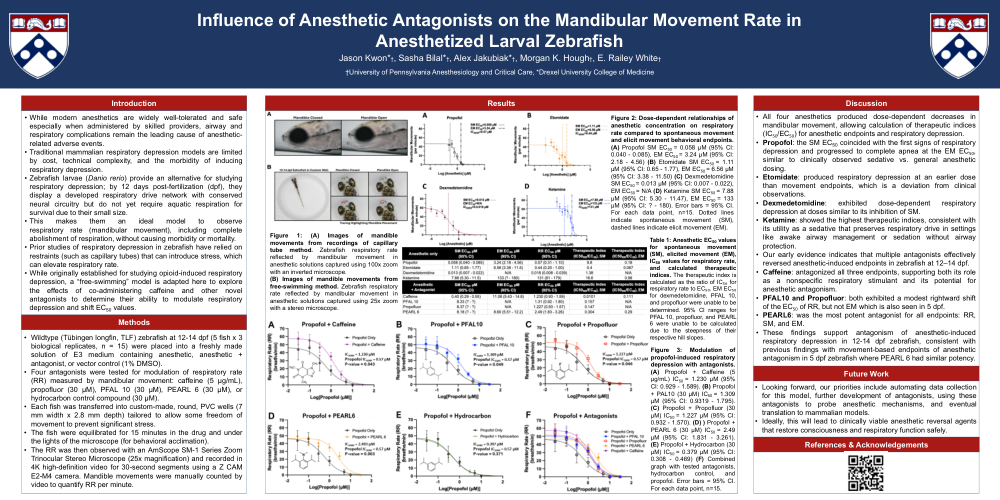
•All four anesthetics produced dose-dependent decreases in mandibular movement, allowing calculation of therapeutic indices (IC50/EC50) for anesthetic endpoints and respiratory depression.
•Propofol: the SM EC50 coincided with the first signs of respiratory depression and progressed to complete apnea at the EM EC50, similar to clinically observed sedative vs. general anesthetic dosing.
•Etomidate: produced respiratory depression at an earlier dose than movement endpoints, which is a deviation from clinical observations.
•Dexmedetomidine: exhibited dose-dependent respiratory depression at doses similar to its inhibition of SM.
•Ketamine: showed the highest therapeutic indices, consistent with its utility as a sedative that preserves respiratory drive in settings like awake airway management or sedation without airway protection.
•Our early evidence indicates that multiple antagonists effectively reversed anesthetic-induced endpoints in zebrafish at 12–14 dpf.
•Caffeine: antagonized all three endpoints, supporting both its role as a nonspecific respiratory stimulant and its potential for anesthetic antagonism.
•PFAL10 and Propofluor: both exhibited a modest rightward shift of the EC50 of RR, but not EM which is also seen in 5 dpf.
•PEARL6: was the most potent antagonist for all endpoints: RR, SM, and EM.
•These findings support antagonism of anesthetic-induced respiratory depression in 12-14 dpf zebrafish, consistent with previous findings with movement-based endpoints of anesthetic antagonism in 5 dpf zebrafish where PEARL 6 had similar potency.
Future Work
•Looking forward, our priorities include automating data collection for this model, further development of antagonists, using these antagonists to probe anesthetic mechanisms, and eventual translation to mammalian models.
•Ideally, this will lead to clinically viable anesthetic reversal agents that restore consciousness and respiratory function safely.