358 posters, 97 topics, 122 sessions, 958 authors, 239 institutions
ePostersLive by SciGen Technologies S.A. All rights reserved.
79th PostGraduate Assembly in Anesthesiology 2025
December 12 - 15, 2025 | New York City

3046
Improved Post Operative Outcomes In Geriatric Patients Undergoing Hip Fracture Surgery. Subsequent retrospective chart review suggest that changes initiated from earlier study improved mortality and morbidity.
Poster Presenter
Authors
Alexander Mohtadi, Feras Alhourani, Piyush Gupta, Dennis Feierman, Mark Kronenfeld
Affiliations
Part of Topic
Geriatric - Perioperative Management
Improved Post-operative Outcomes in Geriatric Patients Undergoing Hip Fracture Surgery. Subsequent retrospective chart review suggests that changes initiated from earlier study improved mortality and morbidity.
A. Mohtadi, DO; F. Alhourani, MD; P. Gupta, MD; D. Feierman, MD; M. Kronenfeld, MD; K. Tyagaraj, MD Department of Anesthesiology. Maimonides Medical Center, Brooklyn, NY
Introduction / Hypothesis:
● Hip fractures are a common injury with an annual incidence of approximately 300,000 in the United States [1].
● These fractures account for the majority of osteoporotic-related injuries, significantly impacting Medicare-related expenditures [2].
● Retrospective studies have indicated that delaying surgery is associated with increased morbidity, mortality, and length of stay [3]. Additionally, delays in transfusion may further contribute to worsened outcomes.
● To address these concerns, various interventions, including early optimization and reduced time from diagnosis to surgery, have been implemented to improve perioperative care.
● This study aims to evaluate the impact of protocol changes, continued education in anesthetic care, and expedited surgical procedures on morbidity and mortality rates in geriatric patients undergoing hip fracture surgery.
● We hypothesize that targeted interventions, including early anesthetic optimization, streamlined perioperative management, and reduced time from diagnosis to surgery, have contributed to improved post-operative outcomes.
Study Design / Methods:
● After IRB approval, data were collected retrospectively on 875 patients who underwent hip surgery between January 2015 and December 2018.
● These data were compared with a historical cohort of 841 patients from January 2008 to December 2010.
● Patient characteristics, including age and sex, were analyzed using a t-test and Fisher exact tests. Outcome variables, including pre-operative days, post-operative days, and length of stay (LOS), were summarized with median and interquartile range (IQR) and compared using the Mann-Whitney U test. Categorical variables were analyzed using the Fisher exact test.
Results:
● There were no significant differences in age (p=0.515) or sex (p=0.33) between the two groups.
● Notably, the proportion of ASA 1&2 patients was significantly lower in the new cohort (17.4%) compared to the old cohort (24.9%) (p<0.001), suggesting an increase in comorbidities among the more recent patients.
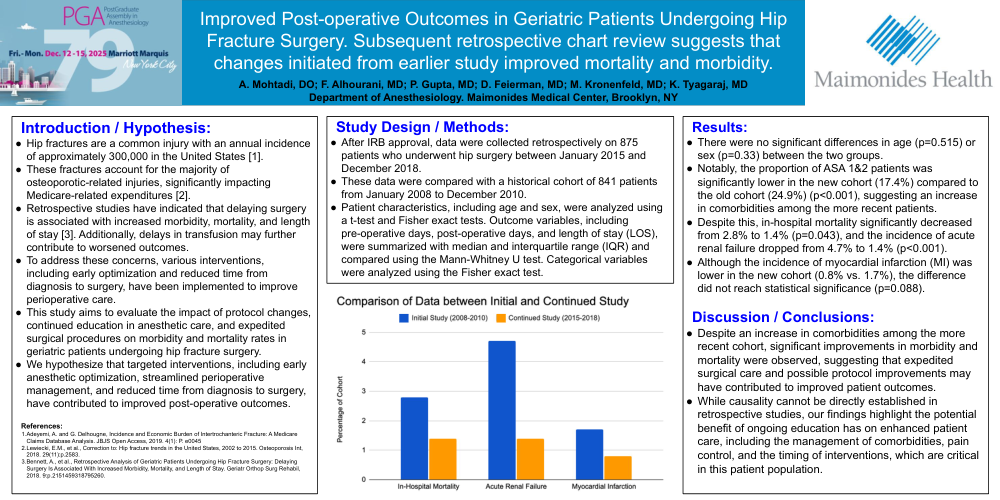
● Despite this, in-hospital mortality significantly decreased from 2.8% to 1.4% (p=0.043), and the incidence of acute renal failure dropped from 4.7% to 1.4% (p<0.001).
● Although the incidence of myocardial infarction (MI) was lower in the new cohort (0.8% vs. 1.7%), the difference did not reach statistical significance (p=0.088).
Discussion / Conclusions:
● Despite an increase in comorbidities among the more recent cohort, significant improvements in morbidity and mortality were observed, suggesting that expedited surgical care and possible protocol improvements may have contributed to improved patient outcomes.
● While causality cannot be directly established in retrospective studies, our findings highlight the potential benefit of ongoing education has on enhanced patient care, including the management of comorbidities, pain control, and the timing of interventions, which are critical in this patient population.
References:
1.Adeyemi, A. and G. Delhougne, Incidence and Economic Burden of Intertrochanteric Fracture: A Medicare Claims Database Analysis. JBJS Open Access, 2019. 4(1): P. e0045
2.Lewiecki, E.M., et al., Correction to: Hip fracture trends in the United States, 2002 to 2015. Osteoporosis Int, 2018. 29(11):p.2583.
3.Bennett, A., et al., Retrospective Analysis of Geriatric Patients Undergoing Hip Fracture Surgery: Delaying Surgery Is Associated With Increased Morbidity, Mortality, and Length of Stay. Geriatr Orthop Surg Rehabil, 2018. 9:p.2151459318795260.