358 posters, 97 topics, 122 sessions, 958 authors, 239 institutions
ePostersLive by SciGen Technologies S.A. All rights reserved.
79th PostGraduate Assembly in Anesthesiology 2025
December 12 - 15, 2025 | New York City

3039
Public Interest in Opioid Use and Pain Management: A Decade of U.S. Google Trends Data (2015–2025)
Poster Presenter
Authors
Affiliations
Part of Topic
Global Health - Pain Medicine
Public Interest in Opioid Use and Pain Management: A Decade of U.S. Google Trends Data (2015-2025)
Background
The opioid epidemic is a significant public health issue in the United States. The most recent waves of the epidemic included the emergence of illicit synthetic opioids and an increase in overdose deaths among young adults. Public search activity may provide useful information since younger individuals gather health-related information online. In this study, we hypothesized that public interest related to opioid search terms would reflect major events in the opioid epidemic's trajectory, including the COVID pandemic and recent changes in CDC prescribing guidelines. The current study intends to assess public interest in opioid use holistically with five domains which include medications, withdrawal, side effects, harm reduction, and alternatives, from Google search trends in the U.S from 2015 to 2025.
Methods
We performed a retrospective longitudinal study analyzing U.S. Google Trends data from July 2015 to June 2025 using the Relative Search Volume (RSV) metric. RSV is a normalized score from 0 to 100 assigned by Google to represent how frequently a search term is entered relative to all other searches over a specific time and location. A value of 100 corresponds to the highest observed search frequency for that term in the time period, while 0 represents little to no interest. This normalization allows comparison across terms and controls for fluctuations in overall search volume and seasonality.
Fifty opioid-related terms were selected based on a combination of clinical expertise led by a pain management specialist and artificial intelligence. This expert guided the inclusion of clinically relevant terms spanning five categories: prescription opioids, withdrawal symptoms, side effects, harm reduction, and non-opioid alternatives.
Only terms with ≥100 monthly data points were included. Monthly RSV values were compared across years and topics to evaluate shifts in public interest over time.
Results
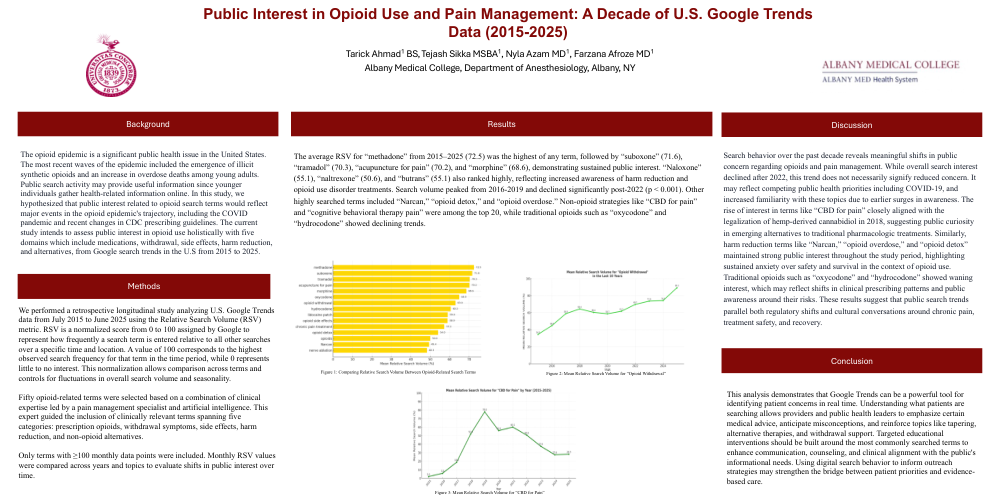
The average RSV for “methadone” from 2015–2025 (72.5) was the highest of any term, followed by “suboxone” (71.6), “tramadol” (70.3), “acupuncture for pain” (70.2), and “morphine” (68.6), demonstrating sustained public interest. “Naloxone” (55.1), “naltrexone” (50.6), and “butrans” (55.1) also ranked highly, reflecting increased awareness of harm reduction and opioid use disorder treatments. Search volume peaked from 2016-2019 and declined significantly post-2022 (p < 0.001). Other highly searched terms included “Narcan,” “opioid detox,” and “opioid overdose.” Non-opioid strategies like “CBD for pain” and “cognitive behavioral therapy pain” were among the top 20, while traditional opioids such as “oxycodone” and “hydrocodone” showed declining trends.
Discussion
Search behavior over the past decade reveals meaningful shifts in public concern regarding opioids and pain management. While overall search interest declined after 2022, this trend does not necessarily signify reduced concern. It may reflect competing public health priorities including COVID-19, and increased familiarity with these topics due to earlier surges in awareness. The rise of interest in terms like “CBD for pain” closely aligned with the legalization of hemp-derived cannabidiol in 2018, suggesting public curiosity in emerging alternatives to traditional pharmacologic treatments. Similarly, harm reduction terms like “Narcan,” “opioid overdose,” and “opioid detox” maintained strong public interest throughout the study period, highlighting sustained anxiety over safety and survival in the context of opioid use. Traditional opioids such as “oxycodone” and “hydrocodone” showed waning interest, which may reflect shifts in clinical prescribing patterns and public awareness around their risks. These results suggest that public search trends parallel both regulatory shifts and cultural conversations around chronic pain, treatment safety, and recovery.
Conclusion
This analysis demonstrates that Google Trends can be a powerful tool for identifying patient concerns in real time. Understanding what patients are searching allows providers and public health leaders to emphasize certain medical advice, anticipate misconceptions, and reinforce topics like tapering, alternative therapies, and withdrawal support. Targeted educational interventions should be built around the most commonly searched terms to enhance communication, counseling, and clinical alignment with the public's informational needs. Using digital search behavior to inform outreach strategies may strengthen the bridge between patient priorities and evidence-based care.