358 posters, 97 topics, 122 sessions, 958 authors, 239 institutions
ePostersLive by SciGen Technologies S.A. All rights reserved.
79th PostGraduate Assembly in Anesthesiology 2025
December 12 - 15, 2025 | New York City

3023
Perceived Erosion of Foundational Airway Management Skills in the Era of Video Laryngoscopy: A Cross-Sectional Survey of Anesthesiology Clinicians
Poster Presenter
Authors
Affiliations
Part of Topic
Airway - Medical Education
Title
Perceived Erosion of Foundational Airway Management Skills in the Era of Video Laryngoscopy: A Cross-Sectional Survey of Anesthesiology Clinicians
Video laryngoscopy (VL) has revolutionized airway management by improving glottic visualization and first-pass success rates. Yet, as VL becomes the default approach, concerns have emerged that foundational manual skills such as direct laryngoscopy with the Miller blade are being neglected. Similar trends have been observed in other procedural fields, where reliance on advanced technologies can lead to “deskilling” and loss of critical fallback abilities when technology fails.1,2 In anesthesiology, this raises an important question: are we preserving the manual competence required to manage an airway when the screen goes dark?
This study aimed to explore how anesthesiology residents and attendings perceive the current state of foundational airway management training. Specifically, it examined their exposure to, confidence in, and use of the Miller blade, their beliefs about the importance of maintaining these skills, and whether they perceive a decline in teaching traditional techniques.
A cross-sectional survey was distributed via REDCap to anesthesiology residents and attending physicians at a single academic medical center (IRB# Pro2025001199). The survey collected information about respondents’ frequency of Miller blade use, confidence with the device, perceived importance of maintaining this skill, and attitudes toward the decline of traditional airway teaching. Attendings were additionally asked about the frequency with which they teach manual airway techniques. Descriptive statistics were calculated, and Spearman correlation coefficients were used to evaluate relationships between variables among residents. All analyses were performed using JMP® Pro Student Edition (SAS Institute Inc., Cary, NC).
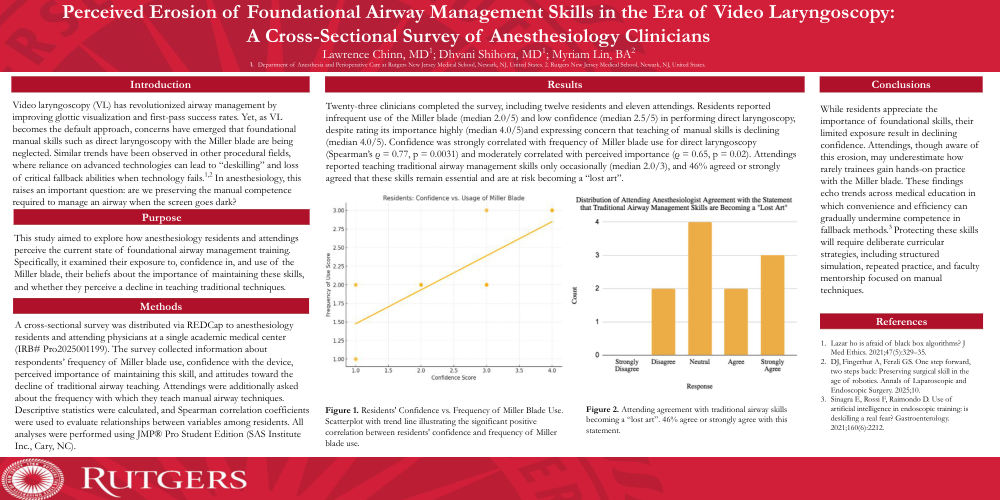
Twenty-three clinicians completed the survey, including twelve residents and eleven attendings. Residents reported infrequent use of the Miller blade (median 2.0/5) and low confidence (median 2.5/5) in performing direct laryngoscopy, despite rating its importance highly (median 4.0/5)and expressing concern that teaching of manual skills is declining (median 4.0/5). Confidence was strongly correlated with frequency of use (Spearman’s ρ = 0.77, p = 0.0031) and moderately correlated with perceived importance (ρ = 0.65, p = 0.02). Attendings reported teaching traditional airway management skills only occasionally (median 2.0/3), and 46% agreed or strongly agreed that these skills remain essential and are at risk becoming a “lost art”.
This pilot study highlights an emerging disconnect between values and training practices in airway management. While residents appreciate the importance of foundational skills, their limited exposure and declining confidence reflect a broader shift toward dependence on technology. Attendings, though aware of this erosion, may underestimate how rarely trainees gain hands-on practice with the Miller blade. These findings echo trends across medical education in which convenience and efficiency can gradually undermine competence in fallback methods.3 Protecting these skills will require deliberate curricular strategies, including structured simulation, repeated practice, and faculty mentorship focused on manual techniques.