358 posters, 97 topics, 122 sessions, 958 authors, 239 institutions
ePostersLive by SciGen Technologies S.A. All rights reserved.
79th PostGraduate Assembly in Anesthesiology 2025
December 12 - 15, 2025 | New York City

3014
Diabetes Mellitus Increases the Risk of Post-Dural Puncture Neuralgia After Spinal Anesthesia for Cesarean Delivery: A Retrospective Cohort Study
Poster Presenter
Part of Topic
Fundamentals of Anesthesiology - Obstetrics
Diabetes Mellitus Increases the Risk of Post-Dural Puncture Neuralgia After Spinal Anesthesia for Cesarean Delivery: A Retrospective Cohort Study
Introduction:
Post-dural puncture neuralgia (PDPN) is a debilitating and underrecognized complication of spinal anesthesia, clinically distinct from post-dural puncture headache. Diabetes mellitus (DM) may predispose patients to PDPN through mechanisms such as microvascular ischemia, connective tissue fibrosis, and systemic inflammation. Pregnant women with DM represent a particularly high-risk population due to impaired tissue healing and increased neural vulnerability. Despite these risks, few studies have specifically examined the association between diabetes and PDPN in the obstetric population. We hypothesized that diabetic women undergoing cesarean delivery under spinal anesthesia would exhibit a higher incidence of PDPN compared to non-diabetic controls, and that poor glycemic control and multiple puncture attempts would serve as additional risk factors. This study aims to characterize this relationship using both clinical and radiological endpoints and to identify potentially modifiable predictors of PDPN.
Study Design:
We conducted a retrospective cohort study involving 600 women aged 18 to 45 years who underwent cesarean delivery under spinal anesthesia between 2015 and 2023. Participants were categorized into two groups: those with pre-existing diabetes mellitus (n = 300) and a matched cohort of non-diabetic controls (n = 300), matched 1:1 based on age (±5 years) and body mass index (±3 kg/m²) to reduce baseline confounding. The primary outcome was the incidence of post-dural puncture neuralgia (PDPN), defined as new-onset radicular pain or focal neurological deficits occurring within six weeks following delivery, confirmed by a board-certified neurologist. Radiologic confirmation of PDPN was based on lumbar spine MRI showing
ligamentum flavum (LF) thickening greater than 3 mm and T2-weighted hyperintensity. Exclusion criteria included prior spinal surgery, autoimmune disease, general or epidural anesthesia, and incomplete records. Covariates analyzed included HbA1c levels, number of puncture attempts, needle gauge, chronic back pain history, and gestational diabetes. Multivariate logistic regression was used to identify independent predictors of PDPN. The study received ethical approval from an institutional review board and was conducted following the Strengthening the Reporting of Observational Studies in Epidemiology (STROBE) guidelines to ensure transparency and methodological rigor.
Results:
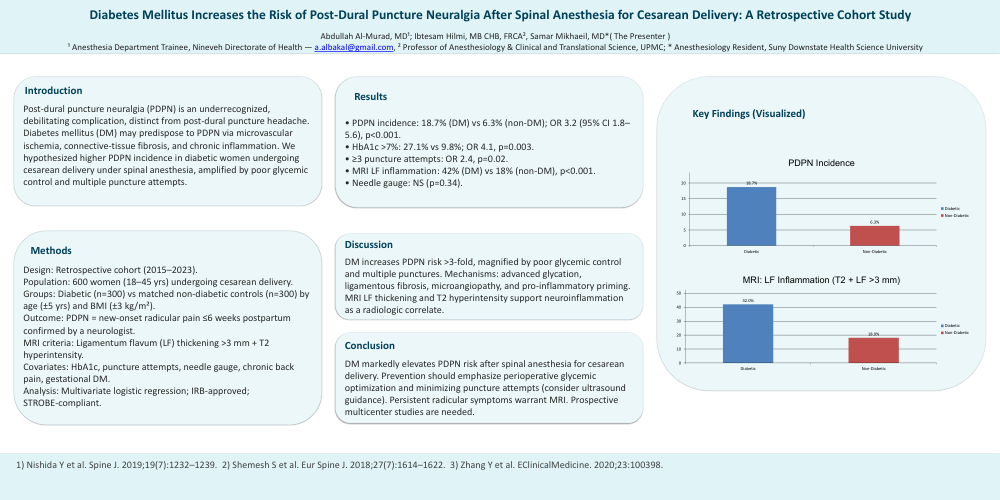
The incidence of post-dural puncture neuralgia (PDPN) was significantly higher in the diabetic cohort (18.7%) compared to non-diabetic controls (6.3%) (OR 3.2, 95% CI: 1.8–5.6; p < 0.001). Among diabetic patients, those with HbA1c >7% had a substantially higher risk (27.1% vs. 9.8%; OR 4.1; p = 0.003). Three or more spinal puncture attempts were also associated with increased PDPN risk (OR 2.4; p = 0.02). MRI-confirmed ligamentum flavum inflammation was more prevalent in diabetics (42% vs. 18%; p < 0.001). Needle gauge was not significantly associated with PDPN (p = 0.34).
Discussion:
Diabetes mellitus significantly elevates the risk of PDPN following spinal anesthesia in cesarean delivery, especially among patients with poor glycemic control and those undergoing multiple puncture attempts. These findings support a multifactorial pathophysiologic model involving advanced glycation end-product deposition, ligamentous fibrosis, microangiopathy, and pro-inflammatory cytokine priming, which collectively heighten neural vulnerability to mechanical trauma. MRI findings of LF thickening and T2 hyperintensity provide radiologic evidence of underlying neuroinflammation. Clinically, optimizing perioperative glycemic control and minimizing the number of needle punctures—ideally using ultrasound-guided techniques—may reduce the risk of PDPN in diabetic parturients. MRI should be considered in cases of persistent radicular symptoms to facilitate early diagnosis and management. This study underscores the need for heightened vigilance and individualized perioperative strategies for diabetic patients undergoing spinal anesthesia. Prospective, multicenter studies are warranted to validate these findings and to develop targeted preventive interventions.
References:
- Nishida Y et al. Spine J. 2019;19(7):1232–1239.
- Shemesh S et al. Eur Spine J. 2018;27(7):1614–1622.
- Zhang Y et al. EClinicalMedicine. 2020;23:100398.