358 posters, 97 topics, 122 sessions, 958 authors, 239 institutions
ePostersLive by SciGen Technologies S.A. All rights reserved.
79th PostGraduate Assembly in Anesthesiology 2025
December 12 - 15, 2025 | New York City

3013
Bi-National Perspectives on Hospital Hemodynamic Monitoring
Poster Presenter
Part of Topic
OTHER Patient Centered Monitoring, Patient centered outcomes.
Bi-National Sentiments on Hospital Hemodynamic Monitoring
Wael Saasouh MD1,2, Mariam Ahmed MD2, Ardalan Oraee MD2, Francesco DeSalvio MD1
1. Wayne State University, Detroit, MI, USA
2. NorthStar Anesthesia, Irving, TX, USA
Introduction
Patient-centered care, introduced in the late 1980s, shifted the clinical perspective from “what is the matter with the patient” to “what matters to the patient” (1). This approach prioritizes outcomes that patients find personally meaningful, evaluated through patient-centered outcome measures (PCOMs). While prior research has explored PCOMs in the context of specific conditions such as stroke, diabetes, and communication (2), broader investigations remain limited. Notably, no studies to date have examined patient-centered outcomes in relation to in-hospital monitoring. Despite its ubiquitous presence in acute care, physiologic monitoring is rarely evaluated from the patient’s perspective. It remains unclear how patients perceive monitoring, whether they understand its role in their care, and how it aligns with their preferences and values. This study aims to explore patient experiences with in-hospital monitoring, focusing on outcomes that are meaningful to them and evaluating whether increased patient awareness of monitoring practices contributes to greater satisfaction with care.
Design / Method
In 2024, we conducted a cross-sectional survey utilizing the Clinician and Patient Experience Registry (CaPER, https://riwi.com/caper) to investigate patient preferences regarding in-hospital monitoring and communication. CaPER is an anonymized, web-based platform designed to collect patient and clinician perspectives on care delivery, with a particular focus on patient-centered practices. A total of 2,000 adult patients—equally distributed between the United States and the United Kingdom—participated in the survey.
Participants completed the voluntary, non-incentivized survey via an anonymous online interface, ensuring confidentiality and ease of access. The full survey consisted of 15 items; however, for the purpose of this analysis, we focused on three key questions relevant to patients' perceptions of physiologic monitoring and communication preferences. The qualifying question identified respondents’ perceptions if they were to be hospitalized for a medical condition.
Specifically, respondents were asked:
(1) Whether they would like explanations about the machines/monitors around their hospital bed,
(2) Whether they would prefer to be informed when vital sign measurements such as blood pressure or heart rate deviate from normal ranges,
(3) How frequently they would like to receive updates on their cardiovascular status during a multi-day hospitalization.
These targeted questions were designed to assess patients' desire for transparency, understanding, and engagement in their care—key components of a patient-centered monitoring approach.
The analysis of response distributions in each country and combined data used descriptive statistics.
Results
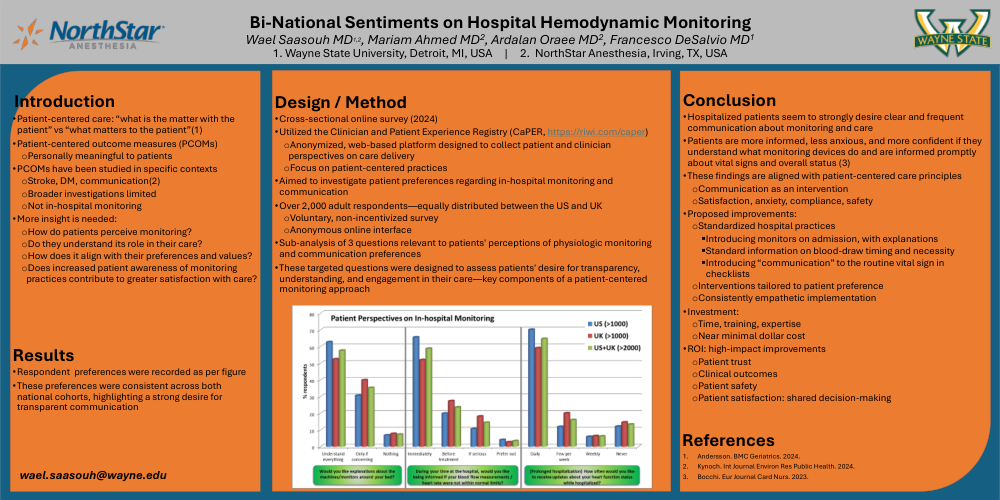
In the CaPER 2024 survey, 60% of respondents from the U.S. and U.K. preferred full explanations of all hospital monitors, 30% wanted explanations only if concerns arose, and 5–10% declined information. Regarding abnormal vital signs, 66% desired immediate notification, most others preferred notification before treatment, and fewer than 10% only if serious. Nearly all wanted to be informed in some capacity. For update frequency, 66% preferred daily updates on health status, 20–25% several times weekly, and very few accepted weekly or no updates. These preferences were consistent across both national cohorts, highlighting a strong desire for transparent communication.
Conclusion
Hospitalized patients seem to strongly desire clear and frequent communication about monitoring and care. Patients are more informed, less anxious, and more confident if they understand what monitoring devices do and are informed promptly about vital signs and overall status (3). These findings are aligned with patient‑centered care principles, illustrating that communication can be one of those core interventions that improve satisfaction, reduce anxiety, and enhance compliance and safety. To accomplish this, hospitals need standardized practices—introducing monitors on admission, a brief tutorial explaining those monitors, along with information on blood‑draw timing, perhaps making “communication” a vital sign in checklists. They need to be tailored to patient preference and underpinned by staff training to deliver consistently empathetic implementation. Though roll‑out can require minimal investment of resources, these interventions achieve high‑impact improvements in patient trust, clinical outcomes, and safety of hospitalization and promote shared decision‑making.
References
1-Andersson, Å. G., Dahlkvist, L., & Kurland, L. (2024). Patient-centered outcomes and outcome measurements for people aged 65 years and older—a scoping review. BMC Geriatrics, 24(1), 528. https://doi.org/10.1186/s12877-024-05134-7
2-Kynoch, K., Ameen, M., Ramis, M.-A., & Khalil, H. (2022). Use of patient-reported data within the acute healthcare context: A scoping review. International Journal of Environmental Research and Public Health, 19(18), 11160. https://doi.org/10.3390/ijerph191811160
3-Bocchi, E. A., Moura, L. Z., Costa, L. R., Villela, A. R., & Lopes, J. A. (2023). Heart failure in South America: The Brazilian experience. European Journal of Cardiovascular Nursing, 23(3), 258–261. https://doi.org/10.1093/eurjcn/zvad022