358 posters, 97 topics, 122 sessions, 958 authors, 239 institutions
ePostersLive by SciGen Technologies S.A. All rights reserved.
79th PostGraduate Assembly in Anesthesiology 2025
December 12 - 15, 2025 | New York City

2249
Spinal Cord Stimulator Percutaneous Lead Trial in Patient with VP Shunt: A Medically Challenging Case
Poster Presenter
Authors
Affiliations
Part of Topic
Pain Medicine
Title: Spinal Cord Stimulator Percutaneous Lead Trial in Patient with VP Shunt: A Medically Challenging Case
Learning Objectives: This case report aims to demonstrate the special considerations and recommendations that clinicians should follow when safely pursuing spinal cord stimulation as a treatment modality for patients with neurosurgical-implanted devices.
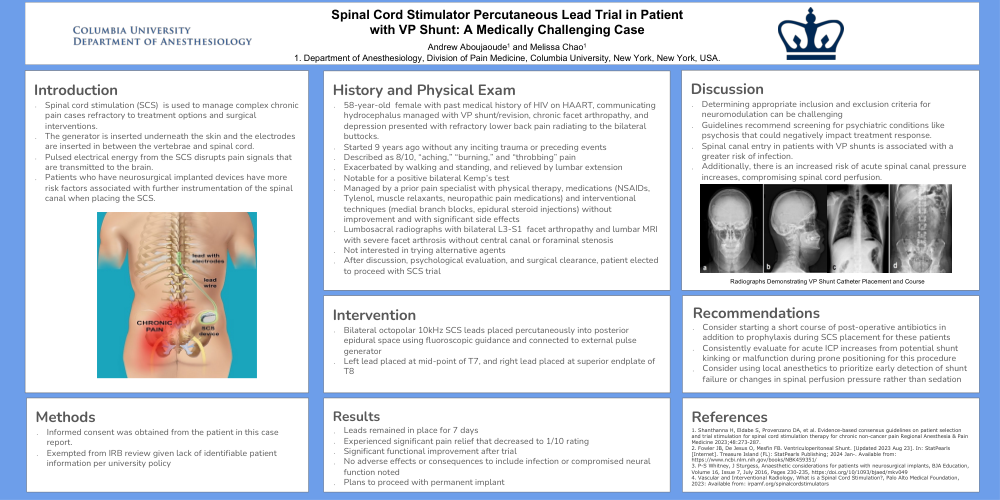
Case Description: Patient is a 58-year-old female with HIV on HAART and communicating hydrocephalus status-post VP shunt/revision who presented with refractory lower back pain radiating to the bilateral buttocks. The pain was described as a constant 8/10 “aching," “burning” pain. Walking and standing exacerbated it, while lumbar extension relieved it. Lumbar MRI showed severe facet arthrosis. The patient had bilateral positive Kemp’s test. She was treated previously with physical therapy, medications, and interventional techniques without relief and with significant side effects. She was averse to trying alternative agents and was told that there were no additional treatment options due to her VP shunt. After discussion, she elected to proceed with SCS trial.
Bilateral octopolar 10kHz SCS leads were placed into the posterior epidural space and connected to external pulse generator, remaining for 7 days. She reported significant pain relief with 1/10 rating and functional improvement. She is scheduled to undergo permanent implant.
Discussion: Patients present outpatient with refractory pain to multiple modalities. Although neuromodulation has been successfully utilized, identifying appropriate inclusion and exclusion criteria can be challenging. Guidelines recommend screening for psychiatric conditions that could negatively affect treatment response. There are few demographic-specific recommendations like smoking and obesity with guidelines recommending their inclusion for informed consent (1).
For patients with VP shunts, spinal canal entry carries significant risk. Infection, with potential to cause meningoencephalitis and shunt failure, are important when assessing risk-benefit analysis (2,3). Additionally, acute spinal canal pressure increases could occur, compromising spinal cord perfusion pressure (3). Furthermore, prone positioning for this procedure can cause shunt kinking, leading to acute ICP increases (3). This patient previously had shunt failure, requiring re-operation, which also poses significant risks.
While the procedure was performed without incident, it is important to remember key safety take-aways. While guidelines recommend anti-microbial prophylaxis during placement, a short course of post-operative antibiotics for patients with existing neurosurgical devices could be considered. Moreover, patient positioning is important to ensure VP shunt patency. Finally, local anesthetic techniques should be prioritized to allow for early detection of shunt failure or decreased spinal perfusion pressure and limit unfavorable hemodynamics that could increase these risks.
References:
1. Shanthanna H, Eldabe S, Provenzano DA, et al. Evidence-based consensus guidelines on patient selection and trial stimulation for spinal cord stimulation therapy for chronic non-cancer pain Regional Anesthesia & Pain Medicine 2023;48:273-287.
2. Fowler JB, De Jesus O, Mesfin FB. Ventriculoperitoneal Shunt. [Updated 2023 Aug 23]. In: StatPearls [Internet]. Treasure Island (FL): StatPearls Publishing; 2024 Jan-. Available from: https://www.ncbi.nlm.nih.gov/books/NBK459351/
3. P-S Whitney, J Sturgess, Anaesthetic considerations for patients with neurosurgical implants, BJA Education, Volume 16, Issue 7, July 2016, Pages 230–235, https://doi.org/10.1093/bjaed/mkv049