358 posters, 97 topics, 122 sessions, 958 authors, 239 institutions
ePostersLive by SciGen Technologies S.A. All rights reserved.
79th PostGraduate Assembly in Anesthesiology 2025
December 12 - 15, 2025 | New York City

2228
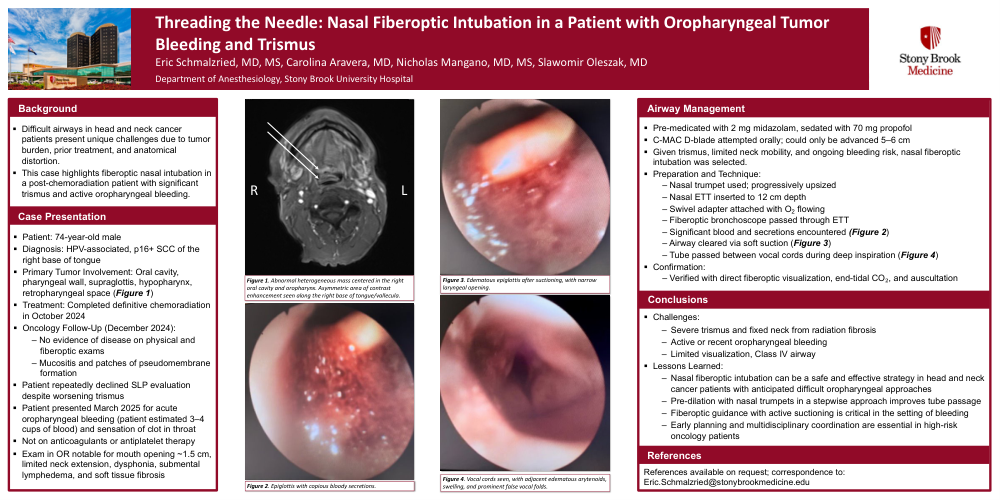
Threading the Needle: Nasal Fiberoptic Intubation in a Patient with Oropharyngeal Tumor Bleeding and Trismus
Poster Presenter
Part of Topic
Airway - Fundamentals of Anesthesiology
Threading the Needle: Nasal Fiberoptic Intubation in a Patient with Oropharyngeal Tumor Bleeding and Trismus
Eric Schmalzried, MD, MS, Carolina Aravera, MD, Nicholas Mangano, MD, MS, Slawomir Oleszak, MD
Department of Anesthesiology, Stony Brook University Hospital
Background
- Difficult airways in head and neck cancer patients present unique challenges due to tumor burden, prior treatment, and anatomical distortion.
- This case highlights fiberoptic nasal intubation in a post-chemoradiation patient with significant trismus and active oropharyngeal bleeding.
Case Presentation
- Patient: 74-year-old male
- Diagnosis: HPV-associated, p16+ SCC of the right base of tongue
- Primary Tumor Involvement: Oral cavity, pharyngeal wall, supraglottis, hypopharynx, retropharyngeal space (Figure 1. Abnormal heterogeneous mass centered in the right oral cavity and oropharynx. Asymmetric area of contrast enhancement seen along the right base of tongue/vallecula.)
- Treatment: Completed definitive chemoradiation in October 2024
- Oncology Follow-Up (December 2024):
– No evidence of disease on physical and fiberoptic exams
– Mucositis and patches of pseudomembrane formation
- Patient repeatedly declined SLP evaluation despite worsening trismus
- Patient presented March 2025 for acute oropharyngeal bleeding (patient estimated 3–4 cups of blood) and sensation of clot in throat
- Not on anticoagulants or antiplatelet therapy
- Exam in OR notable for mouth opening ~1.5 cm, limited neck extension, dysphonia, submental lymphedema, and soft tissue fibrosis
Airway Management
- Pre-medicated with 2 mg midazolam, sedated with 70 mg propofol
- C-MAC D-blade attempted orally; could only be advanced 5–6 cm
- Given trismus, limited neck mobility, and ongoing bleeding risk, nasal fiberoptic intubation was selected.
- Preparation and Technique:
– Nasal trumpet used; progressively upsized
– Nasal ETT inserted to 12 cm depth
– Swivel adapter attached with O2 flowing
– Fiberoptic bronchoscope passed through ETT
– Significant blood and secretions encountered (Figure 2. Epiglottis with copious bloody secretions.)
– Airway cleared via soft suction (Figure 3. Edematous epiglottis after suctioning, with narrow laryngeal opening.)
– Tube passed between vocal cords during deep inspiration (Figure 4. Vocal cords seen, with adjacent edematous arytenoids, swelling, and prominent false vocal folds.)
- Confirmation:
– Verified with direct fiberoptic visualization, end-tidal CO₂, and auscultation
Conclusions
- Challenges:
– Severe trismus and fixed neck from radiation fibrosis
– Active or recent oropharyngeal bleeding
– Limited visualization, Class IV airway
- Lessons Learned:
– Nasal fiberoptic intubation can be a safe and effective strategy in head and neck cancer patients with anticipated difficult oropharyngeal approaches
– Pre-dilation with nasal trumpets in a stepwise approach improves tube passage
– Fiberoptic guidance with active suctioning is critical in the setting of bleeding
– Early planning and multidisciplinary coordination are essential in high-risk oncology patients
References
References available on request; correspondence to: Eric.Schmalzried@stonybrookmedicine.edu