358 posters, 97 topics, 122 sessions, 958 authors, 239 institutions
ePostersLive by SciGen Technologies S.A. All rights reserved.
79th PostGraduate Assembly in Anesthesiology 2025
December 12 - 15, 2025 | New York City

2223
Unlocking Fertility: The Role of Trigger Point Therapy in Managing Vaginismus for Conception
Poster Presenter
Part of Topic
Pain Medicine
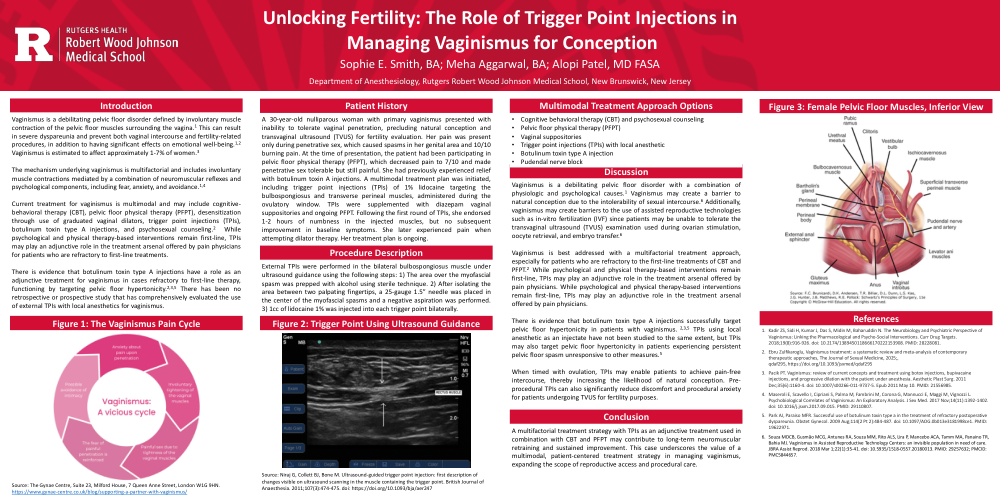
Unlocking Fertility: The Role of Trigger Point Injections in Managing Vaginismus for Conception
Sophie E. Smith, BA; Meha Aggarwal, BA; Alopi Patel, MD FASA Department of Anesthesiology, Rutgers Robert Wood Johnson Medical School, New Brunswick, New Jersey
Vaginismus is a debilitating pelvic floor disorder defined by involuntary muscle contraction of the pelvic floor muscles surrounding the vagina.1 This can result in severe dyspareunia and prevent both vaginal intercourse and fertility-related procedures, in addition to having significant effects on emotional well-being.1,2 Vaginismus is estimated to affect approximately 1-7% of women.3
The mechanism underlying vaginismus is multifactorial and includes involuntary muscle contractions mediated by a combination of neuromuscular reflexes and psychological components, including fear, anxiety, and avoidance.1,4
Current treatment for vaginismus is multimodal and may include cognitive- behavioral therapy (CBT), pelvic floor physical therapy (PFPT), desensitization through use of graduated vaginal dilators, trigger point injections (TPIs), botulinum toxin type A injections, and psychosexual counseling.2 While psychological and physical therapy-based interventions remain first-line, TPIs may play an adjunctive role in the treatment arsenal offered by pain physicians for patients who are refractory to first-line treatments.
There is evidence that botulinum toxin type A injections have a role as an adjunctive treatment for vaginismus in cases refractory to first-line therapy, functioning by targeting pelvic floor hypertonicity.2,3,5 There has been no retrospective or prospective study that has comprehensively evaluated the use of external TPIs with local anesthetics for vaginismus.
A 30-year-old nulliparous woman with primary vaginismus presented with inability to tolerate vaginal penetration, precluding natural conception and transvaginal ultrasound (TVUS) for fertility evaluation. Her pain was present only during penetrative sex, which caused spasms in her genital area and 10/10 burning pain. At the time of presentation, the patient had been participating in pelvic floor physical therapy (PFPT), which decreased pain to 7/10 and made penetrative sex tolerable but still painful. She had previously experienced relief with botulinum toxin A injections. A multimodal treatment plan was initiated, including trigger point injections (TPIs) of 1% lidocaine targeting the bulbospongiosus and transverse perineal muscles, administered during the ovulatory window. TPIs were supplemented with diazepam vaginal suppositories and ongoing PFPT. Following the first round of TPIs, she endorsed 1-2 hours of numbness in the injected muscles, but no subsequent improvement in baseline symptoms. She later experienced pain when attempting dilator therapy. Her treatment plan is ongoing.
External TPIs were performed in the bilateral bulbospongiosus muscle under ultrasound guidance using the following steps: 1) The area over the myofascial spasm was prepped with alcohol using sterile technique. 2) After isolating the area between two palpating fingertips, a 25-gauge 1.5” needle was placed in the center of the myofascial spasms and a negative aspiration was performed. 3) 1cc of lidocaine 1% was injected into each trigger point bilaterally.
Vaginismus is a debilitating pelvic floor disorder with a combination of physiologic and psychological causes.1 Vaginismus may create a barrier to natural conception due to the intolerability of sexual intercourse.6 Additionally, vaginismus may create barriers to the use of assisted reproductive technologies such as in-vitro fertilization (IVF) since patients may be unable to tolerate the transvaginal ultrasound (TVUS) examination used during ovarian stimulation, oocyte retrieval, and embryo transfer.6
Vaginismus is best addressed with a multifactorial treatment approach, especially for patients who are refractory to the first-line treatments of CBT and PFPT.2 While psychological and physical therapy-based interventions remain first-line, TPIs may play an adjunctive role in the treatment arsenal offered by pain physicians. While psychological and physical therapy-based interventions remain first-line, TPIs may play an adjunctive role in the treatment arsenal offered by pain physicians.
There is evidence that botulinum toxin type A injections successfully target pelvic floor hypertonicity in patients with vaginismus. 2,3,5 TPIs using local anesthetic as an injectate have not been studied to the same extent, but TPIs may also target pelvic floor hypertonicity in patients experiencing persistent pelvic floor spasm unresponsive to other measures.5
When timed with ovulation, TPIs may enable patients to achieve pain-free intercourse, thereby increasing the likelihood of natural conception. Pre- procedural TPIs can also significantly reduce discomfort and procedural anxiety for patients undergoing TVUS for fertility purposes.
A multifactorial treatment strategy with TPIs as an adjunctive treatment used in combination with CBT and PFPT may contribute to long-term neuromuscular retraining and sustained improvement. This case underscores the value of a multimodal, patient-centered treatment strategy in managing vaginismus, expanding the scope of reproductive access and procedural care.