358 posters, 97 topics, 122 sessions, 958 authors, 239 institutions
ePostersLive by SciGen Technologies S.A. All rights reserved.
79th PostGraduate Assembly in Anesthesiology 2025
December 12 - 15, 2025 | New York City

2215
Pain in the Butt: Managing Complex Gluteal Pelvic Pain Syndromes
Poster Presenter
Part of Topic
Pain Medicine
Learning Objective
•Recognize the role of diagnostic peripheral nerve blocks and targeted muscle injections in patients with refractory pelvic and gluteal pain.
Patient Background
•63-year-old woman presenting with severe burning and aching pelvic pain in the perineum, rectum, sacrum, right ischial tuberosity, and vulvar vestibule.
•Pain was preceded by a traumatic fall and use of boric acid suppositories. It is worsened by sitting and horseback riding and relieved by sitting on ice.
•17 years prior, at age 45, patient had been diagnosed with pudendal neuralgia which resolved with pelvic physical therapy and nerve blocks.
Treatment Timeline and Outcomes
•Pudendal, ganglion impar, and posterior femoral nerve blocks provided 50-80% relief for days at a time, but never for more than a week.
•Piriformis TPIs only provided relief when paired with nerve blocks, casting doubt on the efficacy of TPIs alone for this patient.
•Bilateral inferior cluneal nerve blocks were performed due to the expanded pain distribution with about 60% relief for 1 day.
•Later, bilateral middle cluneal nerve blocks provided significant relief: 75% pain reduction for several weeks.
•Given the efficacy of middle cluneal nerve blocks, a middle cluneal radiofrequency ablation (RFA) was performed, with 70% relief for several weeks.
•Patient experienced a traumatic fall 4 weeks after her RFA; this caused a recurrence of increased pain (4/10 to 7/10) in the coccyx, radiating to the rectum and sacrum. Using shared decision-making, patient opted for bilateral middle cluneal PNS. Sprint PNS was inserted bilaterally for a 60-day trial.
Discussion
•Gluteal pelvic pain syndromes are diagnostically complex due to overlapping innervation from the pudendal, cluneal, and other peripheral nerves.
•This patient had a history of pudendal neuralgia that resolved for nearly two decades before symptom recurrence following trauma and chemical irritation. Her new pain pattern included the perineum, rectum, sacrum, ischial tuberosity, and vulvar vestibule, with exacerbation during sitting—prompting reconsideration of additional contributing nerves.
•Pudendal, ganglion impar, and inferior cluneal nerve blocks yielded minimal sustained relief, and piriformis-targeted injections did not reliably improve pain symptoms.
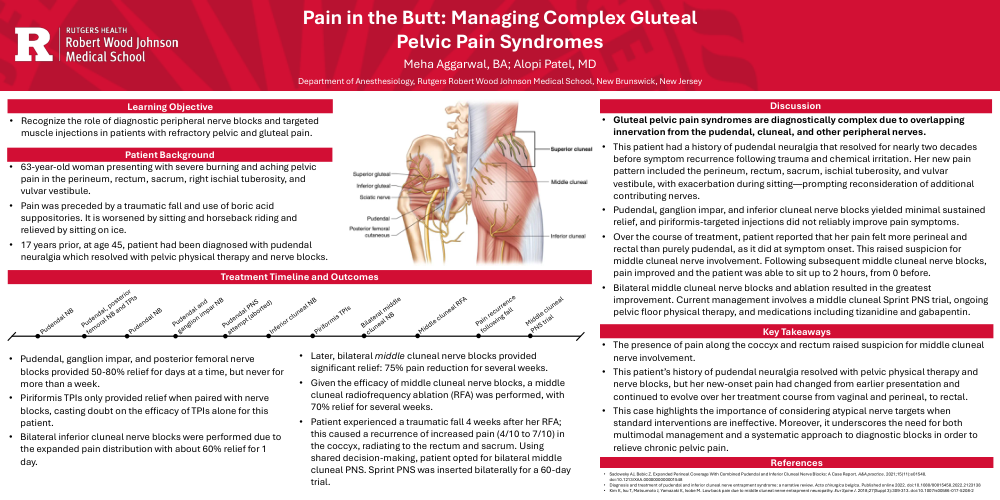
•Over the course of treatment, patient reported that her pain felt more perineal and rectal than purely pudendal, as it did at symptom onset. This raised suspicion for middle cluneal nerve involvement. Following subsequent middle cluneal nerve blocks, pain improved and the patient was able to sit up to 2 hours, from 0 before.
•Bilateral middle cluneal nerve blocks and ablation resulted in the greatest improvement. Current management involves a middle cluneal Sprint PNS trial, ongoing pelvic floor physical therapy, and medications including tizanidine and gabapentin.
Key Takeaways
•The presence of pain along the coccyx and rectum raised suspicion for middle cluneal nerve involvement.
•This patient’s history of pudendal neuralgia resolved with pelvic physical therapy and nerve blocks, but her new-onset pain had changed from earlier presentation and continued to evolve over her treatment course from vaginal and perineal, to rectal.
•This case highlights the importance of considering atypical nerve targets when standard interventions are ineffective. Moreover, it underscores the need for both multimodal management and a systematic approach to diagnostic blocks in order to relieve chronic pelvic pain.