Loading...

358 posters, 97 topics, 122 sessions, 958 authors, 239 institutions

ePostersLive by SciGen Technologies S.A. All rights reserved.

79th PostGraduate Assembly in Anesthesiology 2025

December 12 - 15, 2025 | New York City

79th PostGraduate Assembly in Anesthesiology 2025 banner

2198

Is Repair to Err? Unique Anatomical Considerations of the Submitral Apparatus in Hypertrophic Cardiomyopathy May Influence Mitral Valve Repair Versus Replacement
Part of Topic

Cardiovascular

Learning Objective:

Analyze the impact of mitral valve and subvalvular abnormalities on surgical decision-making in hypertrophic cardiomyopathy (HCM) using echocardiographic and intraoperative findings.

Case Presentation:

We present a 64-year-old male with hypertrophic cardiomyopathy (HCM), status post alcohol septal ablation nine years prior, who underwent elective mitral valve (MV) surgery for severe mitral regurgitation (MR). MV repair was planned.

Intraoperative Findings

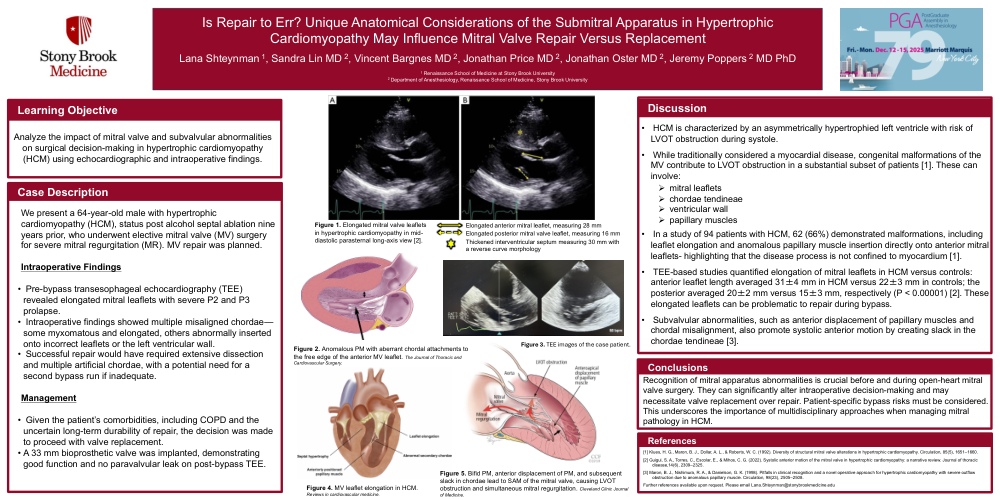
• Pre-bypass transesophageal echocardiography (TEE) revealed elongated mitral leaflets with severe P2 and P3 prolapse.
• Intraoperative findings showed multiple misaligned chordae— some myxomatous and elongated, others abnormally inserted onto incorrect leaflets or the left ventricular wall.
• Successful repair would have required extensive dissection and multiple artificial chordae, with a potential need for a second bypass run if inadequate.

Management

• Given the patient’s comorbidities, including COPD and the uncertain long-term durability of repair, the decision was made to proceed with valve replacement.

A 33 mm bioprosthetic valve was implanted, demonstrating good function and no paravalvular leak on post-bypass TEE.

•HCM is characterized by an asymmetrically hypertrophied left ventricle with risk of LVOT obstruction during systole.
 
Discussion:
 
•While traditionally considered a myocardial disease, congenital malformations of the MV contribute to LVOT obstruction in a substantial subset of patients [1]. These can involve:
- mitral leaflets
- chordae tendineae
- ventricular wall
- papillary muscles

 •In a study of 94 patients with HCM, 62 (66%) demonstrated malformations, including leaflet elongation and anomalous papillary muscle insertion directly onto anterior mitral leaflets- highlighting that the disease process is not confined to myocardium [1].

•TEE-based studies quantified elongation of mitral leaflets in HCM versus controls: anterior leaflet length averaged 31±4 mm in HCM versus 22±3 mm in controls; the posterior averaged 20±2 mm versus 15±3 mm, respectively (P < 0.00001) [2]. These elongated leaflets can be problematic to repair during bypass. 
 
•Subvalvular abnormalities, such as anterior displacement of papillary muscles and chordal misalignment, also promote systolic anterior motion by creating slack in the chordae tendineae [3].
 
Conclusions:

Recognition of mitral apparatus abnormalities is crucial before and during open-heart mitral valve surgery. They can significantly alter intraoperative decision-making and may necessitate valve replacement over repair. Patient-specific bypass risks must be considered. This underscores the importance of multidisciplinary approaches when managing mitral pathology in HCM.


pga2025 banner
Copyright © 2015-2026, ePostersLive® SciGen is a registered trademark of SciGen Technologies S.A. Patent pending.

This website and third-party tools we use rely on cookies for the best user experience. By selecting "I agree", you agree to cookie usage as described in our Privacy Policy.