358 posters, 97 topics, 122 sessions, 958 authors, 239 institutions
ePostersLive by SciGen Technologies S.A. All rights reserved.
79th PostGraduate Assembly in Anesthesiology 2025
December 12 - 15, 2025 | New York City

2172
Palliative Alcohol Neurolysis for Pain and Functional Restoration in a Multiple Myeloma Patient
Part of Topic
Pain Medicine
Palliative Alcohol Neurolysis for Pain Relief and Functional Restoration in a Multiple Myeloma Patient
Nathan French; Lucy Zhuo, MD; Christoffer Jakobsson, MD; Rajbala Thakur, MBBS
Introduction
Cancer-associated pain, especially from pathologic fractures, is often severe, multifactorial, and difficult to control. Patients with advanced malignancy frequently develop opioid tolerance and medication side effects impairing overall quality of life. When multimodal systemic analgesics are inadequate, interventional approaches such as peripheral nerve blocks and neurolysis may provide meaningful symptom relief. However, neurolysis risks motor weakness and resulting functional impairment. Staged neurolytic techniques may offer an alternative. This case presents a patient with refractory multiple myeloma and pathologic humeral fracture who underwent ultrasound-guided, staged peripheral nerve neurolysis, emphasizing an individualized pain management strategy aligned with her goals of care.
Case Presentation
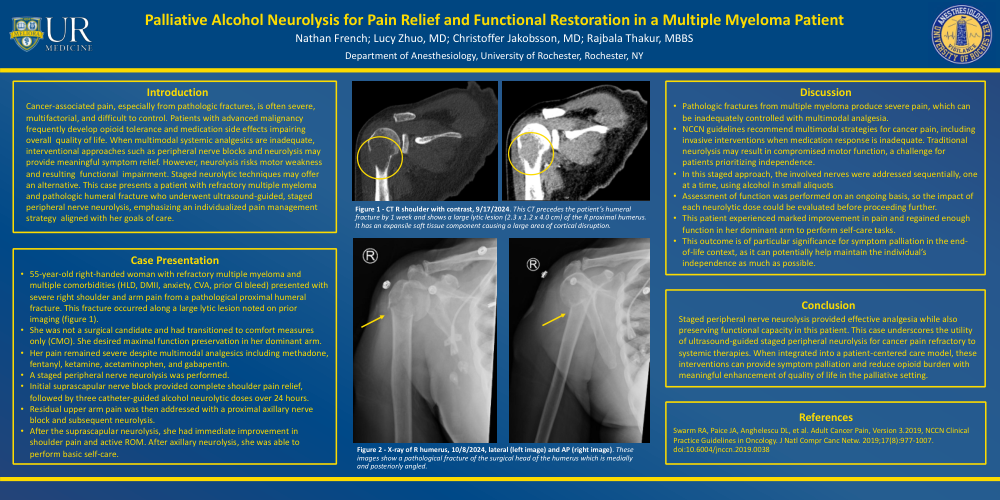
55-year-old right-handed woman with refractory multiple myeloma and multiple comorbidities (HLD, DMII, anxiety, CVA, prior GI bleed) presented with severe right shoulder and arm pain from a pathological proximal humeral fracture. This fracture occurred along a large lytic lesion noted on prior imaging (figure 1).
She was not a surgical candidate and had transitioned to comfort measures only (CMO). She desired maximal function preservation in her dominant arm.
Her pain remained severe despite multimodal analgesics including methadone, fentanyl, ketamine, acetaminophen, and gabapentin.
A staged peripheral nerve neurolysis was performed.
Initial suprascapular nerve block provided complete shoulder pain relief, followed by three catheter-guided alcohol neurolytic doses over 24 hours.
Residual upper arm pain was then addressed with a proximal axillary nerve block and subsequent neurolysis.
After the suprascapular neurolysis, she had immediate improvement in shoulder pain and active ROM. After axillary neurolysis, she was able to perform basic self-care.
Discussion
Pathologic fractures from multiple myeloma produce severe pain, which can be inadequately controlled with multimodal analgesia.
NCCN guidelines recommend multimodal strategies for cancer pain, including invasive interventions when medication response is inadequate. Traditional neurolysis may result in compromised motor function, a challenge for patients prioritizing independence.
In this staged approach, the involved nerves were addressed sequentially, one at a time, using alcohol in small aliquots.
Assessment of function was performed on an ongoing basis, so the impact of each neurolytic dose could be evaluated before proceeding further.
This patient experienced marked improvement in pain and regained enough function in her dominant arm to perform self-care tasks.
This outcome is of particular significance for symptom palliation in the end-of-life context, as it can potentially help maintain the individual’s independence as much as possible.
Conclusion
Staged peripheral nerve neurolysis provided effective analgesia while also preserving functional capacity in this patient. This case underscores the utility of ultrasound-guided staged peripheral neurolysis for cancer pain refractory to systemic therapies. When integrated into a patient-centered care model, these interventions can provide symptom palliation and reduce opioid burden with meaningful enhancement of quality of life in the palliative setting.