358 posters, 97 topics, 122 sessions, 958 authors, 239 institutions
ePostersLive by SciGen Technologies S.A. All rights reserved.
79th PostGraduate Assembly in Anesthesiology 2025
December 12 - 15, 2025 | New York City

2145
Prone and Precarious: One-Lung Ventilation in Complex Chest Wall Reconstruction
Poster Presenter
Authors
Affiliations
Donald and Barbara Zucker School of Medicine at Hofstra/Northwell
Part of Topic
Noncardiac Thoracic - Perioperative Management
Learning Objective
Case Presentation
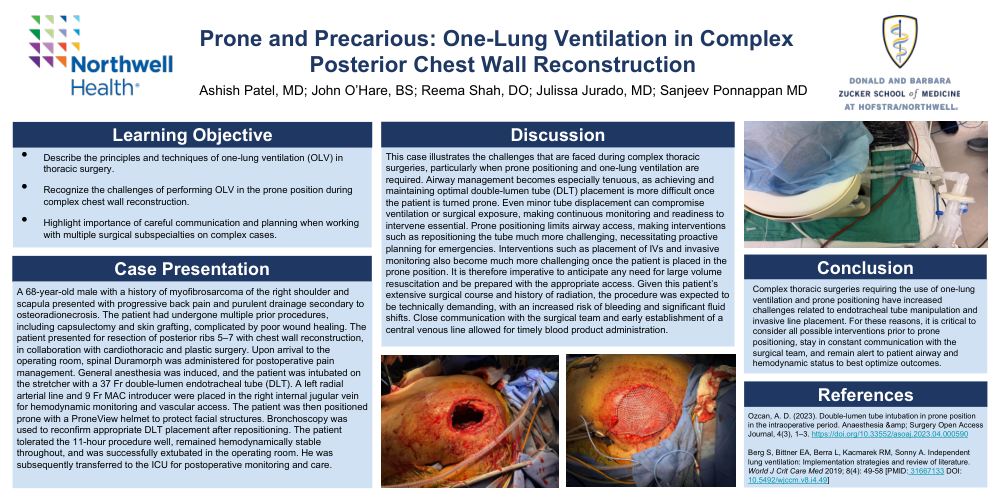
A 68-year-old male with a history of myofibrosarcoma of the right shoulder and scapula presented with progressive back pain and purulent drainage secondary to osteoradionecrosis. The patient had undergone multiple prior procedures, including capsulectomy and skin grafting, complicated by poor wound healing. The patient presented for resection of posterior ribs 5–7 with chest wall reconstruction, in collaboration with cardiothoracic and plastic surgery. Upon arrival to the operating room, spinal Duramorph was administered for postoperative pain management. General anesthesia was induced, and the patient was intubated on the stretcher with a 37 Fr double-lumen endotracheal tube (DLT). A left radial arterial line and 9 Fr MAC introducer were placed in the right internal jugular vein for hemodynamic monitoring and vascular access. The patient was then positioned prone with a ProneView helmet to protect facial structures. Bronchoscopy was used to reconfirm appropriate DLT placement after repositioning. The patient tolerated the 11-hour procedure well, remained hemodynamically stable throughout, and was successfully extubated in the operating room. He was subsequently transferred to the ICU for postoperative monitoring and care.
Discussion
This case illustrates the challenges that are faced during complex thoracic surgeries, particularly when prone positioning and one-lung ventilation are required. Airway management becomes especially tenuous, as achieving and maintaining optimal double-lumen tube (DLT) placement is more difficult once the patient is turned prone. Even minor tube displacement can compromise ventilation or surgical exposure, making continuous monitoring and readiness to intervene essential. Prone positioning limits airway access, making interventions such as repositioning the tube much more challenging, necessitating proactive planning for emergencies. Interventions such as placement of IVs and invasive monitoring also become much more challenging once the patient is placed in the prone position. It is therefore imperative to anticipate any need for large volume resuscitation and be prepared with the appropriate access. Given this patient’s extensive surgical course and history of radiation, the procedure was expected to be technically demanding, with an increased risk of bleeding and significant fluid shifts. Close communication with the surgical team and early establishment of a central venous line allowed for timely blood product administration.
Conclusion
Complex thoracic surgeries requiring the use of one-lung ventilation and prone positioning have increased challenges related to endotracheal tube manipulation and invasive line placement. For these reasons, it is critical to consider all possible interventions prior to prone positioning, stay in constant communication with the surgical team, and remain alert to patient airway and hemodynamic status to best optimize outcomes.