358 posters, 97 topics, 122 sessions, 958 authors, 239 institutions
ePostersLive by SciGen Technologies S.A. All rights reserved.
79th PostGraduate Assembly in Anesthesiology 2025
December 12 - 15, 2025 | New York City

2143
Complete Heart Block While Weaning from Cardiopulmonary Bypass due to Suspected Residual Cardioplegia- A Challenging Case Report
Poster Presenter
Authors
Affiliations
Part of Topic
Cardiovascular
Learning Objective
When complete heart block is unresponsive to pacing and other temporizing measures while weaning from cardiopulmonary bypass, consider allowing additional time for washout of possible residual cardioplegia.
Case Description
•A 79-year-old female presented for aortic valve replacement due to severe calcific aortic stenosis.
•Induction, initiation of cardiopulmonary bypass and aortic valve replacement were uneventful.
•Weaning from cardiopulmonary bypass began approximately 1.5 hours from last administration of cardioplegia.
•The patient proceeded to experience complete heart block, challenging the ability to wean cardiopulmonary bypass. Pacing, electrolyte correction, and temporizing medications were all unsuccessful.
•Suspicion was raised regarding the possibility of residual cardioplegia given the refractory nature of the heart block. Additional time was allowed for washout of possible residual cardioplegia.
•Approximately 30 minutes later, the patient's complete heart block resolved without additional intervention, allowing for the weaning of cardiopulmonary bypass.
Discusssion
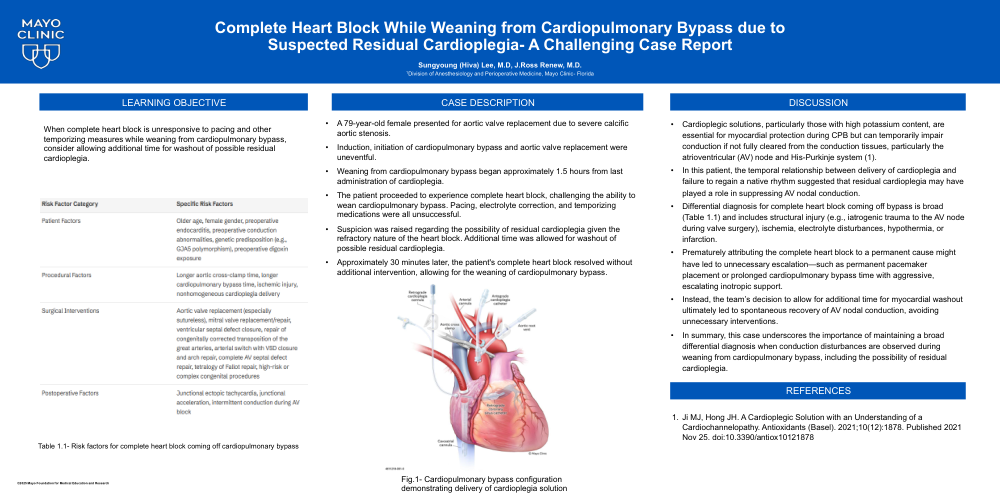
•Cardioplegic solutions, particularly those with high potassium content, are essential for myocardial protection during CPB but can temporarily impair conduction if not fully cleared from the conduction tissues, particularly the atrioventricular (AV) node and His-Purkinje system (1).
•In this patient, the temporal relationship between delivery of cardioplegia and failure to regain a native rhythm suggested that residual cardioplegia may have played a role in suppressing AV nodal conduction.
•Differential diagnosis for complete heart block coming off bypass is broad (Table 1.1) and includes structural injury (e.g., iatrogenic trauma to the AV node during valve surgery), ischemia, electrolyte disturbances, hypothermia, or infarction.
•Prematurely attributing the complete heart block to a permanent cause might have led to unnecessary escalation—such as permanent pacemaker placement or prolonged cardiopulmonary bypass time with aggressive, escalating inotropic support.
•Instead, the team’s decision to allow for additional time for myocardial washout ultimately led to spontaneous recovery of AV nodal conduction, avoiding unnecessary interventions.
•In summary, this case underscores the importance of maintaining a broad differential diagnosis when conduction disturbances are observed during weaning from cardiopulmonary bypass, including the possibility of residual cardioplegia.