358 posters, 97 topics, 122 sessions, 958 authors, 239 institutions
ePostersLive by SciGen Technologies S.A. All rights reserved.
79th PostGraduate Assembly in Anesthesiology 2025
December 12 - 15, 2025 | New York City

2142
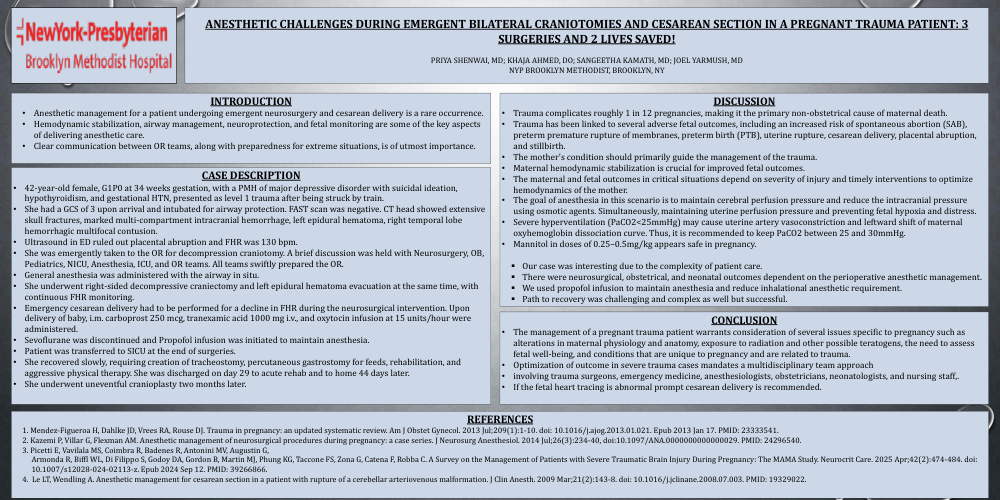
Anesthetic Challenges During Emergent Bilateral Craniotomies and Emergent Cesarean Section in a Pregnant Trauma Patient: 3 Surgeries and 2 Lives Saved!
Poster Presenter
Part of Topic
Neuroanesthesia - Obstetrics
INTRODUCTION • Anesthetic management for a patient undergoing emergent neurosurgery and cesarean delivery is a rare occurrence. • Hemodynamic stabilization, airway management, neuroprotection, and fetal monitoring are some of the key aspects of delivering anesthetic care. • Clear communication between OR teams, along with preparedness for extreme situations, is of utmost importance.
CASE DESCRIPTION • 42-year-old female, G1P0 at 34 weeks gestation, with a PMH of major depressive disorder with suicidal ideation, hypothyroidism, and gestational HTN, presented as level 1 trauma after being struck by train. • She had a GCS of 3 upon arrival and intubated for airway protection. FAST scan was negative. CT head showed extensive skull fractures, marked multi-compartment intracranial hemorrhage, left epidural hematoma, right temporal lobe hemorrhagic multifocal contusion. • Ultrasound in ED ruled out placental abruption and FHR was 130 bpm. • She was emergently taken to the OR for decompression craniotomy. A brief discussion was held with Neurosurgery, OB, Pediatrics, NICU, Anesthesia, ICU, and OR teams. All teams swiftly prepared the OR. • General anesthesia was administered with the airway in situ. • She underwent right-sided decompressive craniectomy and left epidural hematoma evacuation at the same time, with continuous FHR monitoring. • Emergency cesarean delivery had to be performed for a decline in FHR during the neurosurgical intervention. Upon delivery of baby, i.m. carboprost 250 mcg, tranexamic acid 1000 mg i.v., and oxytocin infusion at 15 units/hour were administered. • Sevoflurane was discontinued and Propofol infusion was initiated to maintain anesthesia. • Patient was transferred to SICU at the end of surgeries. • She recovered slowly, requiring creation of tracheostomy, percutaneous gastrostomy for feeds, rehabilitation, and aggressive physical therapy. She was discharged on day 29 to acute rehab and to home 44 days later. • She underwent uneventful cranioplasty two months later.
DISCUSSION • Trauma complicates roughly 1 in 12 pregnancies, making it the primary non-obstetrical cause of maternal death. • Trauma has been linked to several adverse fetal outcomes, including an increased risk of spontaneous abortion (SAB), preterm premature rupture of membranes, preterm birth (PTB), uterine rupture, cesarean delivery, placental abruption, and stillbirth. • The mother's condition should primarily guide the management of the trauma. • Maternal hemodynamic stabilization is crucial for improved fetal outcomes. • The maternal and fetal outcomes in critical situations depend on severity of injury and timely interventions to optimize hemodynamics of the mother. • The goal of anesthesia in this scenario is to maintain cerebral perfusion pressure and reduce the intracranial pressure using osmotic agents. Simultaneously, maintaining uterine perfusion pressure and preventing fetal hypoxia and distress. • Severe hyperventilation (PaCO2<25mmHg) may cause uterine artery vasoconstriction and leftward shift of maternal oxyhemoglobin dissociation curve. Thus, it is recommended to keep PaCO2 between 25 and 30mmHg. • Mannitol in doses of 0.25–0.5mg/kg appears safe in pregnancy. ▪ Our case was interesting due to the complexity of patient care. ▪ There were neurosurgical, obstetrical, and neonatal outcomes dependent on the perioperative anesthetic management. ▪ We used propofol infusion to maintain anesthesia and reduce inhalational anesthetic requirement. ▪ Path to recovery was challenging and complex as well but successful.
CONCLUSION • The management of a pregnant trauma patient warrants consideration of several issues specific to pregnancy such as alterations in maternal physiology and anatomy, exposure to radiation and other possible teratogens, the need to assess fetal well-being, and conditions that are unique to pregnancy and are related to trauma. • Optimization of outcome in severe trauma cases mandates a multidisciplinary team approach • involving trauma surgeons, emergency medicine, anesthesiologists, obstetricians, neonatologists, and nursing staff,. • If the fetal heart tracing is abnormal prompt cesarean delivery is recommended.
REFERENCES 1. Mendez-Figueroa H, Dahlke JD, Vrees RA, Rouse DJ. Trauma in pregnancy: an updated systematic review. Am J Obstet Gynecol. 2013 Jul;209(1):1-10. doi: 10.1016/j.ajog.2013.01.021. Epub 2013 Jan 17. PMID: 23333541. 2. Kazemi P, Villar G, Flexman AM. Anesthetic management of neurosurgical procedures during pregnancy: a case series. J Neurosurg Anesthesiol. 2014 Jul;26(3):234-40, doi:10.1097/ANA.0000000000000029. PMID: 24296540. 3. Picetti E, Vavilala MS, Coimbra R, Badenes R, Antonini MV, Augustin G, Armonda R, Biffl WL, Di Filippo S, Godoy DA, Gordon B, Martin MJ, Phung KG, Taccone FS, Zona G, Catena F, Robba C. A Survey on the Management of Patients with Severe Traumatic Brain Injury During Pregnancy: The MAMA Study. Neurocrit Care. 2025 Apr;42(2):474-484. doi: 10.1007/s12028-024-02113-z. Epub 2024 Sep 12. PMID: 39266866. 4. Le LT, Wendling A. Anesthetic management for cesarean section in a patient with rupture of a cerebellar arteriovenous malformation. J Clin Anesth. 2009 Mar;21(2):143-8. doi: 10.1016/j.jclinane.2008.07.003. PMID: 19329022.