197 posters, 15 videos, 31 sessions, 510 authors
ePostersLive by SciGen Technologies S.A. All rights reserved.
2026 AO Annual Meeting
Conference ePosters

P87
Performance Evaluation of Two Collagen Membranes: Histological Analysis
Poster Presenter
Part of Topic
Video
TITLE: Performance Evaluation of Two Collagen Membranes: Histological Analysis
AUTHORS: Mannina, Carolina; Malmquist, Jay; Cardoso, Ronald; Teixeira, Marcelo; Moy, Peter; Pelegrine, André.
Introduction: The placement of dental implants in cases involving bone loss compromises the achievement of an adequate three-dimensional positioning. In this context, guided bone regeneration provides an ideal framework that enables implant placement in the correct position. A wide variety of biomaterials are available for bone grafting, as well as membranes used to protect the graft, which may originate from different donor sources and be either resorbable or non-resorbable. In this study, we evaluated the performance of a novel bovine-derived collagen membrane.
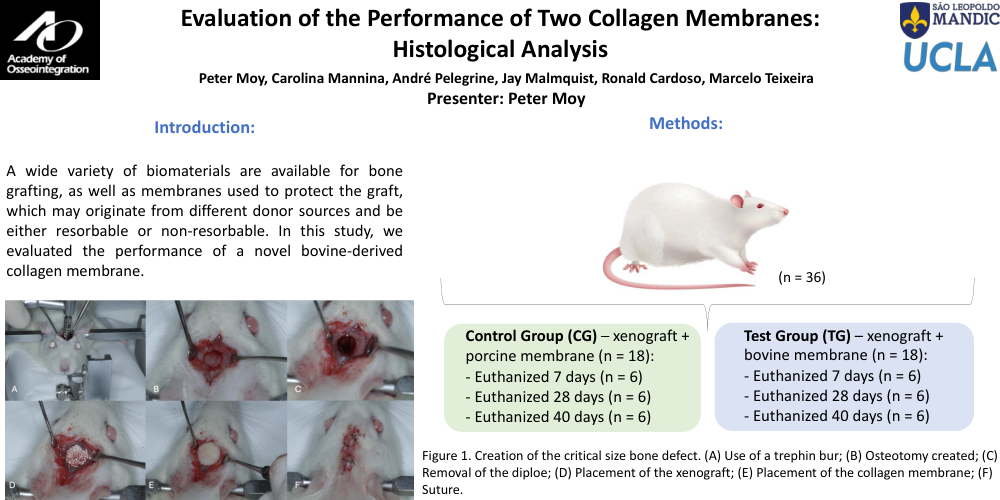
Method: Thirty-six Wistar rats had a 5-mm-diameter critical-size bone defect created in their calvaria and randomly divided in two groups: a control group (CG), in which the defects were filled with a xenograft and covered with a commercially available porcine membrane (Control Group, n = 18), and a test group (TG), in which the defects were filled with the same xenograft and covered with a newly developed bovine-derived collagen membrane (Test Group, n = 18). The animals were euthanized at 7, 28, and 40 days (six animals per group at each time point), and the specimens were processed for histological analysis.
Results: At the 7-day time point, a moderate inflammatory infiltrate was observed over the membranes in both groups. At 28 days, new bone formation was noted surrounding the xenograft particles in a similar manner between groups, with no evidence of inflammatory infiltrate. At 40 days, complete resorption of both membranes was observed, with remnants of the xenograft still present.
Conclusions: The use of both collagen membranes resulted in bone formation surrounding the xenograft particles, with an equivalent inflammatory and reabsorption profiles.