Loading...

197 posters, 15 videos, 31 sessions, 510 authors

ePostersLive by SciGen Technologies S.A. All rights reserved.

2026 AO Annual Meeting

Conference ePosters

2026 AO Annual Meeting banner

P205

Comparative Effect of Hyaluronic Acid Formulations on hBMSCs Proliferation In Vitro
Part of Topic

Comparative Effect of Hyaluronic Acid Formulations on hBMSCs Proliferation In Vitro

Xuesong Wang, Ph.D., Elnaz Ajami, Ph.D., Hai Bo Wen, Ph.D.

ZimVie, Palm Beach Gardens, FL, USA

Background

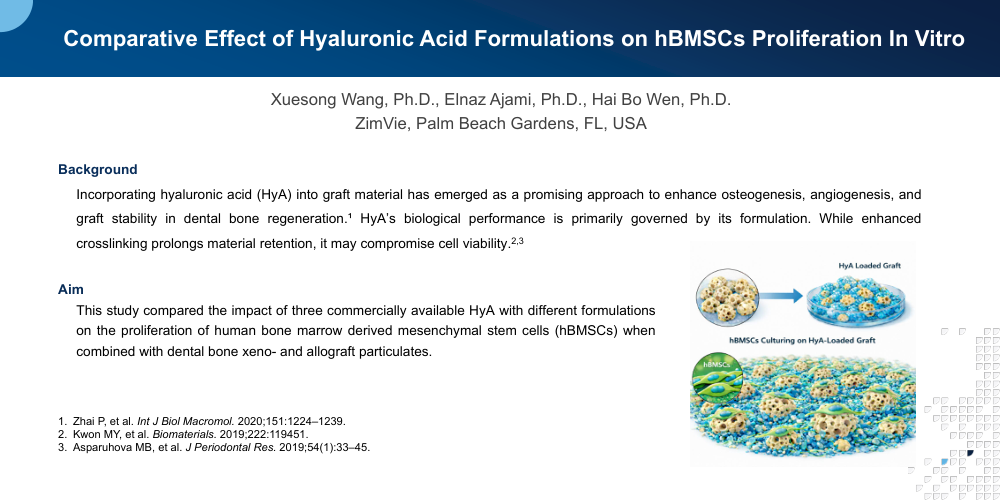
Incorporating hyaluronic acid (HyA) into graft material has emerged as a promising approach to enhance osteogenesis, angiogenesis, and graft stability in dental bone regeneration. HyA’s biological performance is primarily governed by its formulation. While enhanced crosslinking prolongs material retention, it may compromise cell viability.

Aim

This study compared the impact of three commercially available HyA with different formulations on the proliferation of human bone marrow derived mesenchymal stem cells (hBMSCs) when combined with dental bone xeno- and allograft particulates.

Materials & Methods

Characterization

•Three commercially available HyA with different formulations were evaluated.
•2×10⁵ hBMSCs were cultured on one solvent dehydrated allograft (SA), one porcine-derived (PX), and one bovine-derived xenograft (BX) pre-loaded with equal amounts of HyA, respectively. The graft-only samples were served as controls.
•hBMSCs proliferation across 12 groups was quantified with a cell counting kit (Dojindo® Molecular Technologies) at 1, 3, and 7 days (n=4).

Statistical analysis

•One-way ANOVA with Tukey multiple comparison tests was performed to determine statistical differences between groups (GraphPad Prism 10). The p<0.05 was considered significant.

Results

• On the SA, HyA-NC significantly enhanced hBMSCs growth from 1 day to 7 days (p < 0.001 vs control), whereas HyA-PN performed similarly to control, and HyA-CL markedly suppressed cell growth at all time points (p < 0.001).
•On PX, HyA started to show impact from day 3, with HyA-NC and HyA-PN significantly promoted cell proliferation. By day 7, cell proliferation in all HyA groups exceeded control (p < 0.001), indicating a delayed positive effect of HyA-CL.
•On BX, HyA-NC and HyA-PN significantly enhanced cell proliferation at all time points (p < 0.001), whereas HyA-CL showed no difference compared with control at 1 day, but significantly increased cell proliferation at 3 and 7 days (p < 0.001).
•The heatmap showed HyA-NC consistently yielded greatest hBMSCs proliferation across all graft types at 7 days.
•On the tested allograft (SA), HyA-NC markedly enhanced cell proliferation (129.35% vs control), whereas HyA-PN showed no improvement over control (100.00%), and HyA-CL substantially suppressed proliferation (69.91% vs control).
•On the xenografts (PX and BX), all HyA formulations enhanced cell proliferation relative to control. On PX, HyA-NC and HyA-PN promoted proliferation (131.82% and 121.54%, respectively), while HyA-CL showed a moderate increase (118.11%). On BX, HyA-NC exhibited the strongest effect (144.29%), followed by HyA-PN (129.99%) and HyA-CL (125.86%).
•Overall, the biological performance showed a consistent increasing trend in the following order: HyA-CL < HyA-PN < HyA-NC.

Discussion  & Conclusion

The biological performance of HyA is highly dependent on its formulation. Our pre-clinical data showed that Non-crosslinked HyA (HyA-NC) consistently produced the greatest enhancement of hBMSCs proliferation across the evaluated bone grafts, whereas crosslinked HyA (HyA-CL) markedly suppressed or delayed cell growth, particularly on the tested allograft.

This inhibitory effect on the tested allograft likely arises from its densely crosslinked network, which restricts molecular mobility, nutrient diffusion, and reduces the availability of binding sites necessary for cell attachment.

Within the limitations of this study, the findings indicate that optimizing HyA formulation is critical for maximizing cellular response, which may enhance its regenerative potential in dental applications.


osseo2026 banner
Copyright © 2015-2026, ePostersLive® SciGen is a registered trademark of SciGen Technologies S.A. Patent pending.

This website and third-party tools we use rely on cookies for the best user experience. By selecting "I agree", you agree to cookie usage as described in our Privacy Policy.