197 posters, 15 videos, 31 sessions, 510 authors
ePostersLive by SciGen Technologies S.A. All rights reserved.
2026 AO Annual Meeting
Conference ePosters

P188
Evaluating Coating and Connection Influence on Clamping Force and Reuse Potential of Prosthetic Implant Screws
Poster Presenter
Authors
Part of Topic
Evaluating Coating and Connection Influence on Clamping Force and Reuse Potential of Prosthetic Implant Screws
Matthew J. Turner DDS, LCDR/DC/USN; Justin R. Montenegro, DMD, MS, LCDR/DC/USN; Stacy L. Yu, DDS, FACP, CDR/DC/USN
Naval Postgraduate Dental School, Uniformed Services University of the Health Sciences
Walter Reed National Military Medical Center, Bethesda, MD
Mechanical complications remain a leading cause of failure in implant-supported restorations, with abutment screw loosening reported as the most frequent prosthetic complication in single-tooth implants. Loss of screw joint stability results in restoration mobility, occlusal discrepancies, patient discomfort, and mechanical complications.¹ Although screw loosening is commonly managed clinically by retightening the existing screw, limited objective evidence exists regarding whether this approach reliably maintains joint stability.²
When a screw is torqued, elastic elongation produces preload, which generates clamping force across the implant–abutment interface.³ This clamping force, rather than applied torque or removal torque, governs resistance to joint separation. Because friction varies widely between screw materials and implant systems, torque-based metrics may not accurately reflect the true mechanical stability of the joint.⁴
This study indirectly measured clamping force to evaluate how implant connection type, screw coating, and cyclic loading influence preload maintenance during screw reuse.
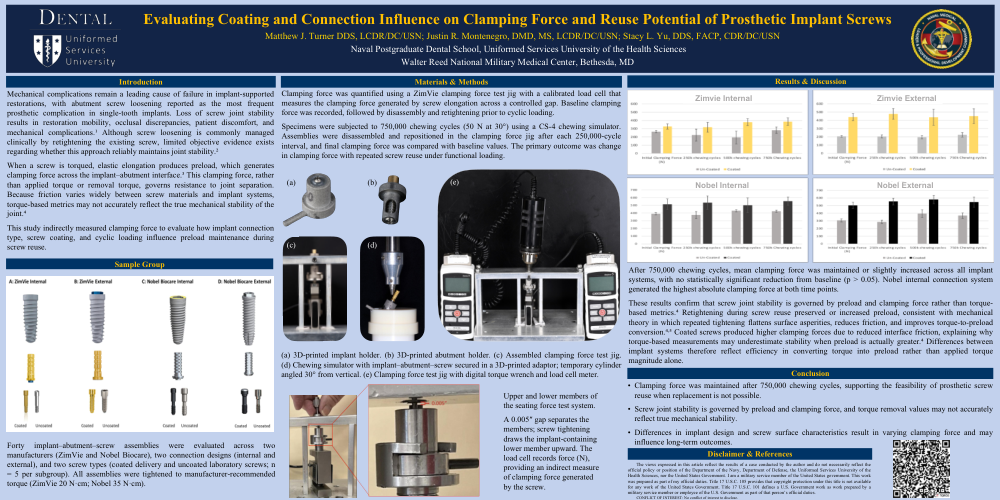
Forty implant–abutment–screw assemblies were evaluated across two manufacturers (ZimVie and Nobel Biocare), two connection designs (internal and external), and two screw types (coated delivery and uncoated laboratory screws; n = 5 per subgroup). All assemblies were tightened to manufacturer-recommended torque (ZimVie 20 N·cm; Nobel 35 N·cm).
Clamping force was quantified using a ZimVie clamping force test jig with a calibrated load cell that measures the clamping force generated by screw elongation across a controlled gap. Baseline clamping force was recorded, followed by disassembly and retightening prior to cyclic loading.
Specimens were subjected to 750,000 chewing cycles (50 N at 30°) using a CS-4 chewing simulator. Assemblies were disassembled and repositioned in the clamping force jig after each 250,000-cycle interval, and final clamping force was compared with baseline values. The primary outcome was change in clamping force with repeated screw reuse under functional loading.
(a) 3D-printed implant holder. (b) 3D-printed abutment holder. (c) Assembled clamping force test jig. (d) Chewing simulator with implant–abutment–screw secured in a 3D-printed adaptor; temporary cylinder angled 30° from vertical. (e) Clamping force test jig with digital torque wrench and load cell meter.
Upper and lower members of the seating force test system.
A 0.005″ gap separates the members; screw tightening draws the implant-containing lower member upward. The load cell records force (N), providing an indirect measure of clamping force generated by the screw.
After 750,000 chewing cycles, mean clamping force was maintained or slightly increased across all implant systems, with no statistically significant reduction from baseline (p > 0.05). Nobel internal connection system generated the highest absolute clamping force at both time points.
These results confirm that screw joint stability is governed by preload and clamping force rather than torque-based metrics.⁴ Retightening during screw reuse preserved or increased preload, consistent with mechanical theory in which repeated tightening flattens surface asperities, reduces friction, and improves torque-to-preload conversion.⁴,⁵ Coated screws produced higher clamping forces due to reduced interface friction, explaining why torque-based measurements may underestimate stability when preload is actually greater.⁴ Differences between implant systems therefore reflect efficiency in converting torque into preload rather than applied torque magnitude alone.
- Clamping force was maintained after 750,000 chewing cycles, supporting the feasibility of prosthetic screw reuse when replacement is not possible.
- Screw joint stability is governed by preload and clamping force, and torque removal values may not accurately reflect true mechanical stability.
- Differences in implant design and screw surface characteristics result in varying clamping force and may influence long-term outcomes.