197 posters, 15 videos, 31 sessions, 510 authors
ePostersLive by SciGen Technologies S.A. All rights reserved.
2026 AO Annual Meeting
Conference ePosters

P173
Rehabilitation of a Maxillectomy Patient Following Rhino-Mucormycosis using Patient-specific Implant
Poster Presenter
Authors
Part of Topic
TITLE: Rehabilitation of a Maxillectomy Patient Following Rhino-Mucormycosis using Patient-specific Implant
ABSTRACT BODY:
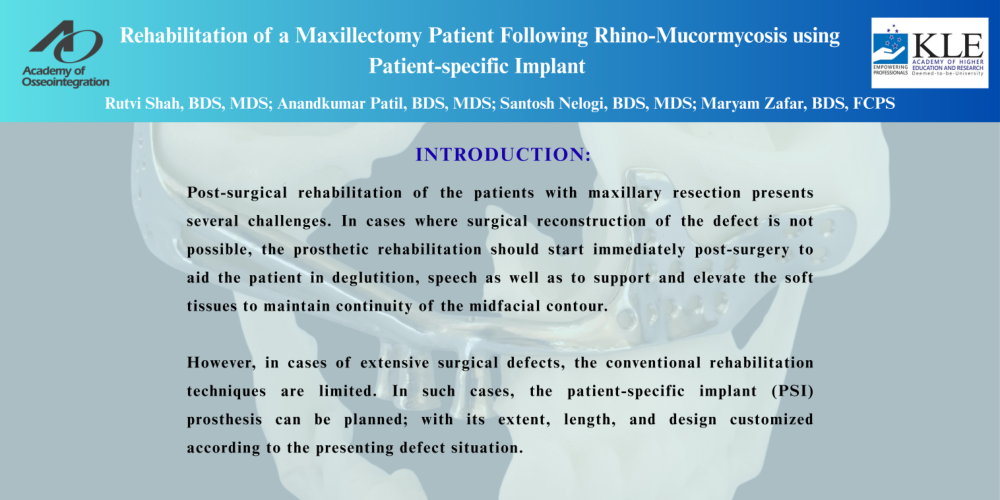
Introduction: In cases where surgical reconstruction of the defect is not possible, the prosthetic rehabilitation
should start immediately post-surgery to aid the patient in deglutition, speech as well as to support and elevate
the soft tissues to maintain continuity of the midfacial contour. However, in cases of extensive surgical defects,
the conventional rehabilitation techniques are limited. In such cases, the patient-specific implant prosthesis can
be planned; with its extent, length, and design customized according to the presenting defect situation.
Method: A 42-year-old patient presented after undergoing surgical debridement for SARS-CoV-2 associated
mucormycosis. The defect was classified as Aramany’s class I, encompassing the right palatine shelf, parts of
the hard and soft palate and extending to the right zygoma. The existing bone support was inadequate for the
placement of intra-osseous or zygomatic implants, and surgical repair of the defect was not feasible.
Therefore, the patient underwent rehabilitation using a titanium, patient-specific implant-supported (PSI)
prosthesis designed to restore speech and facial symmetry.
Results: The post-operative outcomes were positive, and the recovery was uneventful. Following one week,
the speech evaluation was satisfactory, and there was no nasal fluid leakage during swallowing with the
temporary prosthesis in situ. Two weeks post-surgery, the sutures were removed and oral examination
revealed no indications of inflammation or dehiscent bone surrounding the PSI framework. The final implant-
supported over-denture prosthesis was fabricated and delivered to the patient after three weeks. One-year
follow-up indicated that the soft tissues, prosthesis, and framework were in a good condition. The patient
indicated a notable improvement in his social life and restoration of his confidence as a major milestone.
Conclusion: The results suggest that a PSI-retained prosthesis is a viable alternative for restoring speech and
oral function in patients with largely compromised maxillary bone anatomy, alongside impaired aesthetics and
functionality, where conventional reconstruction methods are not viable. The easily removable patient specific
implant-supported obturator prosthesis is a major benefit, allowing for tissue examination and enabling patients
to independently maintain both the prosthesis and the peri-implant tissue.