197 posters, 15 videos, 31 sessions, 510 authors
ePostersLive by SciGen Technologies S.A. All rights reserved.
2026 AO Annual Meeting
Conference ePosters

P172
Antimicrobial Efficacy of Chlorhexidine Gel and Novel Herbal Gel Containing Tea Tree Oil, Peppermint Oil and Aloe Vera against Peri-implantitis Pathogens
Poster Presenter
Authors
Part of Topic
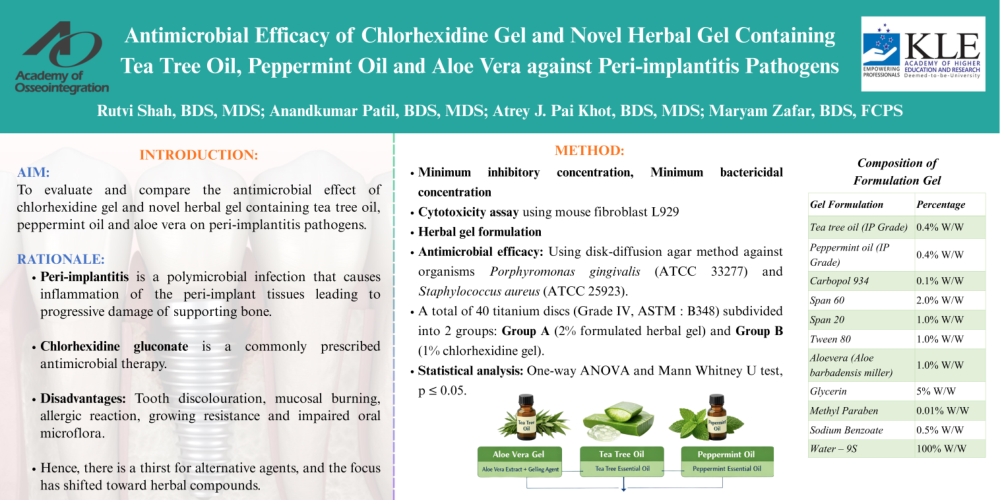
TITLE: Antimicrobial Efficacy of Chlorhexidine Gel and Novel Herbal Gel Containing Tea Tree Oil, Peppermint
Oil and Aloe Vera against Peri-implantitis Pathogens
ABSTRACT BODY:
Introduction: Peri-implantitis is characterized by progressive damage to the supporting bone. Chlorhexidine
gluconate is a commonly prescribed antimicrobial therapy for management of peri-implantitis. Nonetheless, it
presents adverse effects like tooth discolouration, mucosal burning, and allergic reactions. Hence, there is a
thirst for alternate herbal agents. Therefore, this study aimed to evaluate and compare the antimicrobial effect
of chlorhexidine gel and novel herbal gel containing tea tree oil, peppermint oil and aloevera on peri-implantitis
pathogens.
Method: The antimicrobial efficacy was assessed using the disk-diffusion agar method against organisms
Porphyromonas gingivalis and Staphylococcus aureus. A total of 40 titanium discs (Grade IV, ASTM : B348)
were subdivided into 2 groups: Group A (2% formulated herbal gel) and Group B (1% chlorhexidine gel).
Minimum inhibitory concentration, minimum bactericidal concentration, and cytotoxicity assay using mouse
fibroblast L929 were established, and the herbal gel was formulated. The results were tabulated and subjected
to statistical analysis using one-way ANOVA and Mann Whitney U test, p ≤ 0.05.
Results: The prepared herbal gel demonstrated a favorable cell viability of 92.12%. The minimum inhibitory
concentration and minimum bactericidal concentration, indicated a synergistic effect of tea tree oil and
peppermint oil, and furthermore revealed a prolonged antimicrobial efficacy against S. aureus at a 48-hour
interval compared to the individually tested components. Group B (1% chlorhexidine gel) exhibited a larger
zone of inhibition than Group A (2% herbal gel). The mean zone of inhibition seen with 1% chlorhexidine gel for
organism P. Gingivalis was 21.60 ± 3.185 mm, and with 2% herbal gel was 16.40 ± 1.729 mm. Whereas with
organism S. Aureus, chlorhexidine gel showed a mean zone of inhibition of 27.35 ± 1.137 mm and 18.45 ±
1.099 mm with the herbal gel. The difference between the groups was statistically significant, at the level of
significance of p < 0.01.
Conclusion: The formulated herbal gel exhibited antibacterial efficacy comparable to that of 1% chlorhexidine
gel, showed favorable cell viability, and may serve as an alternative for management of peri-implantitis. Future
studies should evaluate the antibacterial efficacy of herbal gel against other peri-implant pathogens.