197 posters, 15 videos, 31 sessions, 510 authors
ePostersLive by SciGen Technologies S.A. All rights reserved.
2026 AO Annual Meeting
Conference ePosters

P168
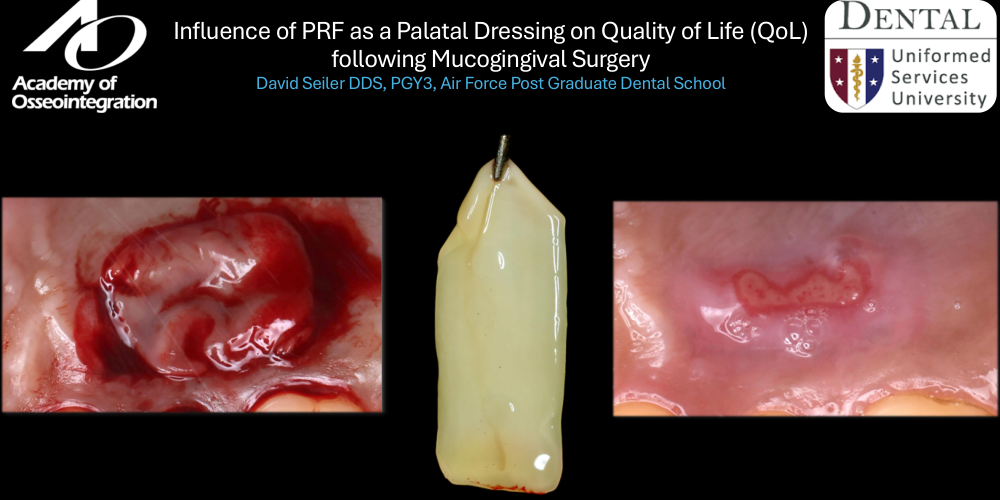
Influence of PRF as a Palatal Dressing on Quality of Life (QoL) Following Mucogingival Surgery
Poster Presenter
Part of Topic
Background: The primary aim of this two-armed randomized controlled trial was to compare patient-perceived quality of life (QoL) following the application of horizontally centrifuged platelet-rich fibrin (PRF) versus a commercially available dressing to palatal connective tissue harvest sites. Secondary outcomes included perceived palatal pain, analgesic consumption, and physiologic healing.
Methods: Seventy eight patients undergoing mucogingival surgery requiring palatal graft harvest were randomized to receive either horizontal PRF membranes (test) or a commercially available dressing (control) over the donor site. Patient-reported QoL was assessed using the Oral Health Impact Profile-14 (OHIP-14) prior to surgery and at 24 hours, 72 hours, 1 week, and 2 weeks postoperatively, with lower scores indicating better QoL. Palatal pain was recorded using an 11-point Numeric Rating Scale (NRS-11), and analgesic use was documented at each time point. Physiologic healing was evaluated at 1 and 2 weeks using the five-point Landry et al. Healing Index.
Results: The PRF group demonstrated consistently lower OHIP-14 scores (higher QoL) across all time points with a statistically significant difference at 2 weeks when utilizing a bivariate analysis. Due to patient variability, a mixed regression model was performed which showed PRF had no significant impact on QoL. However, all patients regardless of palatal wound dressing saw a significant increase in OHIP-14 scores (lower QoL) at 24-hours, 72 hours and 1 week. Significant contributors to QoL scores included time, harvest size, age, and harvest site pain. Analgesic consumption, pain, and physiologic healing all favored the PRF group, but no significant difference was found.
Conclusions: Use of horizontally centrifuged PRF as a palatal wound dressing showed trends towards improved QoL, reduced postoperative pain, decreased analgesic consumption, and expedited physiologic healing when compared to the use of a commercially available product. Factors which significantly impacted a patient’s QoL included time after surgery, graft size, patient age, and site-specific pain.
Regarding post-operative QoL, PRF used as a palatal wound dressing shows trends towards improvement, yet no statistical significance was found. With respect to mucogingival surgery, on average, patients experienced a decrease in QoL up to 1-week post surgery (p < 0.001). Pain (p < 0.001), age (p=0.015), and graft harvest size (p=0.019) had a significant impact on patients post operative QoL. Subjective pain, analgesic consumption, and physiologic healing all showed trends toward improved measurements with the use of PRF, however statistical significance was not reached. With recent findings suggesting keratinized tissue width and gingival thickness having a significant impact on peri-implant parameters, PRF may provide a clinical/therapeutic option to improve post-operative sequalae when utilizing autogenous tissue as the graft of choice.