197 posters, 15 videos, 31 sessions, 510 authors
ePostersLive by SciGen Technologies S.A. All rights reserved.
2026 AO Annual Meeting
Conference ePosters

P161
Osseodensified Crestal Sinus Window Augmentation: A Replacement Procedure to the Lateral Window Technique
Poster Presenter
Authors
Part of Topic
Osseodensified Crestal Sinus Window Augmentation: A Replacement Procedure To The Lateral Window Technique
Introduction:
If an implant does not “fit” a potential site due to a deficiency of hard or soft tissue, then the clinician and patient must commit to a bone, tissue, or sinus graft to augment that site.
An innovative transcrestal window sinus lift technique utilizing osseodensification, overcomes traditional limitations and drawbacks of crestal sinus augmentation and offers a safe and effective alternative, achieving vertical bone gain comparable to that of the conventional lateral window method, and may serve as a viable substitute in appropriate cases.
Methods:
A healthy patient presented with a partially edentulous posterior maxilla with large pneumatized maxillary sinus.
Preoperative radiographs and 3D CBCT imaging determined bone volume and ruled out sinus pathology prior to surgery.
A full-thickness flap was elevated with a periosteal releasing incision.
Two 5.0-mm osteotomy sites, position # 2.6 and # 2.7, were made through the sinus floor. A 3.0-mm diameter osseodensification bur in CCW mode (1100 RPM with copious irrigation) used to breach the sinus floor. The sinus membrane was visible and intact. The osteotomy diameters were increased with osseodensification burs 4.0 mm and 5.0 mm to achieve sinus membrane lift of 3 mm in 1-mm increments. Again, the sinus membrane was visible and intact.
The osteotomy sites were filled with hydrated mineralized cancellous allograft. An osseodensification Bur diameter 5.0 mm was used counterclockwise at low speed (150 RPM) and with no irrigation to gently propel the allograft into the sinus under the sinus membrane.
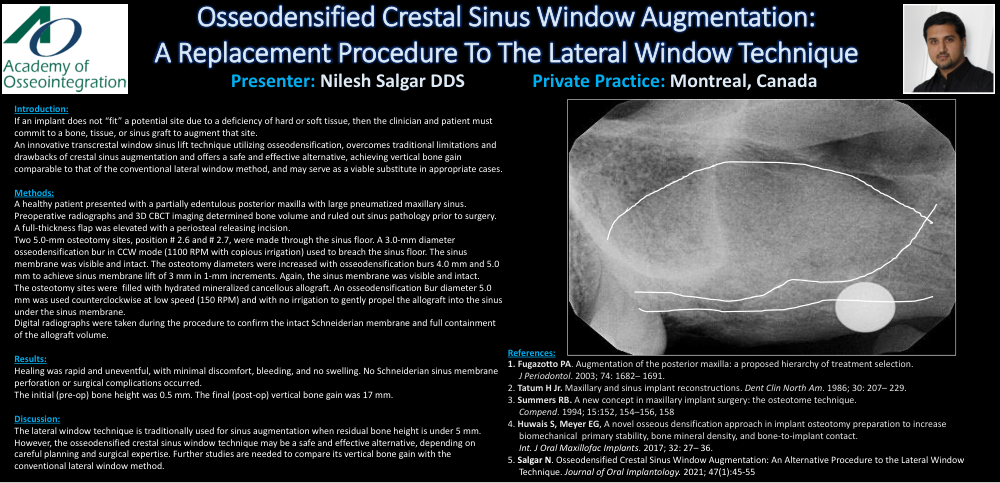
Digital radiographs were taken during the procedure to confirm the intact Schneiderian membrane and full containment of the allograft volume.
Results:
Healing was rapid and uneventful, with minimal discomfort, bleeding, and no swelling. No Schneiderian sinus membrane perforation or surgical complications occurred.
The initial (pre-op) bone height was 0.5 mm. The final (post-op) vertical bone gain was 16 mm.
Discussion:
The lateral window technique is traditionally used for sinus augmentation when residual bone height is under 5 mm. However, the osseodensified crestal sinus window technique may be a safe and effective alternative, depending on careful planning and surgical expertise. Further studies are needed to compare its vertical bone gain with the conventional lateral window method.