197 posters, 15 videos, 31 sessions, 510 authors
ePostersLive by SciGen Technologies S.A. All rights reserved.
2026 AO Annual Meeting
Conference ePosters

P145
Implant Placement in the Esthetic Zone with a Siebert Class III Ridge Deficiency
Poster Presenter
Authors
Part of Topic
Implant Placement in the Esthetic Zone with a Siebert Class III Ridge Deficiency
Georgios Pipis, BDS; Dumitru Gogarnoiu, DMD;
Department of Periodontics, University of Pennsylvania, School of Dental Medicine, Philadelphia, PA
Introduction
The physiological and anatomical changes following tooth loss
compromise the periodontal tissues, making them less favorable for
optimal 3D implant positioning. To address the Siebert Class III ridge
deficiency, a prosthetically driven implant placement combined with guided
bone regeneration was performed to establish adequate bony housing and
support for the future peri-implant soft tissues. This single surgical
approach, with delayed provisionalization, can be considered a reliable
pathway for successful functional and esthetic outcomes.
Methods
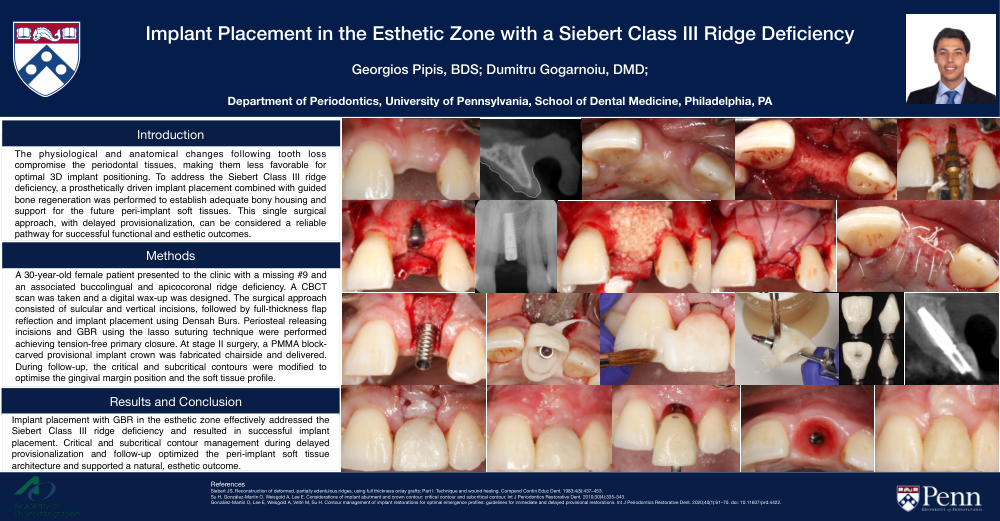
A 30-year-old female patient presented to the clinic with a missing #9 and
an associated buccolingual and apicocoronal ridge deficiency. A CBCT
scan was taken and a digital wax-up was designed. The surgical approach
consisted of sulcular and vertical incisions, followed by full-thickness flap
reflection and implant placement using Densah Burs. Periosteal releasing
incisions and GBR using the lasso suturing technique were performed
achieving tension-free primary closure. At stage II surgery, a PMMA block-
carved provisional implant crown was fabricated chairside and delivered.
During follow-up, the critical and subcritical contours were modified to
optimise the gingival margin position and the soft tissue profile.
Results and Conclusion
Implant placement with GBR in the esthetic zone effectively addressed the
Siebert Class III ridge deficiency and resulted in successful implant
placement. Critical and subcritical contour management during delayed
provisionalization and follow-up optimized the peri-implant soft tissue
architecture and supported a natural, esthetic outcome.