197 posters, 15 videos, 31 sessions, 510 authors
ePostersLive by SciGen Technologies S.A. All rights reserved.
2026 AO Annual Meeting
Conference ePosters

P144
Implant-based Fixed Rehabilitation of a Patient With a Gunshot Injury
Poster Presenter
Part of Topic
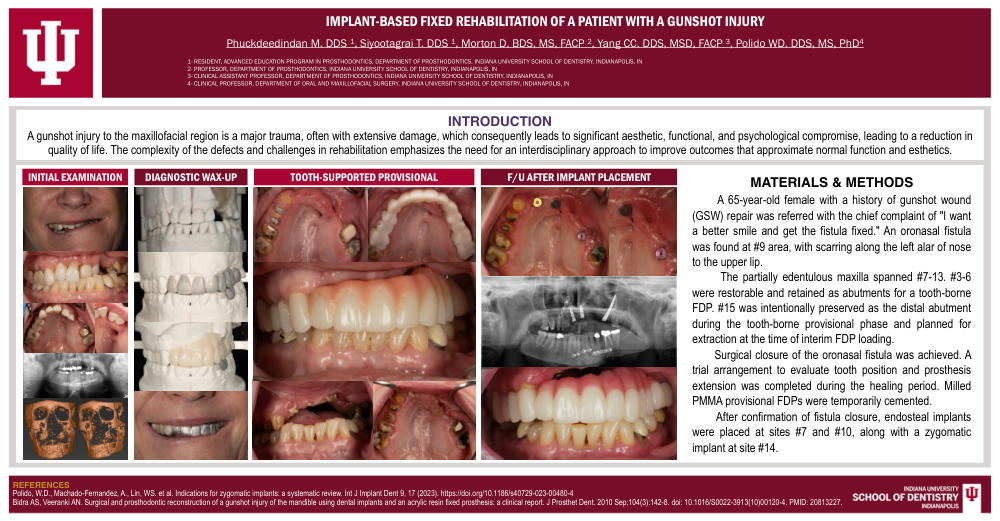
Introduction: A gunshot injury to the maxillofacial region is a major trauma, often with extensive damage, which consequently leads to significant aesthetic, functional, and psychological compromise, leading to a reduction in quality of life. The complexity of the defects and challenges in rehabilitation emphasizes the need for an interdisciplinary approach to improve outcomes that approximate normal function and esthetics.
Materials & Methods:
A 65-year-old female with a history of gunshot wound (GSW) repair was referred with the chief complaint of "I want a better smile and get the fistula fixed." An oronasal fistula was found at #9 area, with scarring along the left alar of nose to the upper lip. The partially edentulous maxilla spanned #7-13. #3-6 were restorable and retained as abutments for a tooth-borne FDP. #15 was intentionally preserved as the distal abutment during the tooth-borne provisional phase and planned for extraction at the time of interim FDP loading.
Surgical closure of the oronasal fistula was achieved. A trial arrangement to evaluate tooth position and prosthesis extension was completed during the healing period. Milled PMMA provisional FDPs were temporarily cemented.
After confirmation of fistula closure, endosteal implants were placed at sites #7 and #10, along with a zygomatic implant at site #14. After implant healing, the provisional prosthesis was sectioned into a 4-unit tooth-supported provisional FDP (#3-6) and a 9-unit implant-supported provisional FDP (#7-15).
During this phase, implant failure at site #10 was confirmed, necessitating explantation. #15 was extracted, and a pterygoid implant was placed. After healing, the pterygoid implant was uncovered, and digital impressions were made and articulation records obtained. With assessment and patient approval of esthetics, phonetics, and occlusion, the implant-supported provisional FDP was replaced with a new PMMA implant-supported prototype. The definitive zirconia prosthesis was then fabricated and successfully placed.
Results: Given the complexity of GSW cases, dental rehabilitation is challenging and requires an interdisciplinary approach. A favorable outcome was achieved, and the patient expressed satisfaction with the result.
Conclusions: For patients with major traumatic injuries, appropriately planned and positioned dental implants play an important role in restoring esthetics and function, thereby improving the patient’s quality of life.