197 posters, 15 videos, 31 sessions, 510 authors
ePostersLive by SciGen Technologies S.A. All rights reserved.
2026 AO Annual Meeting
Conference ePosters

P129
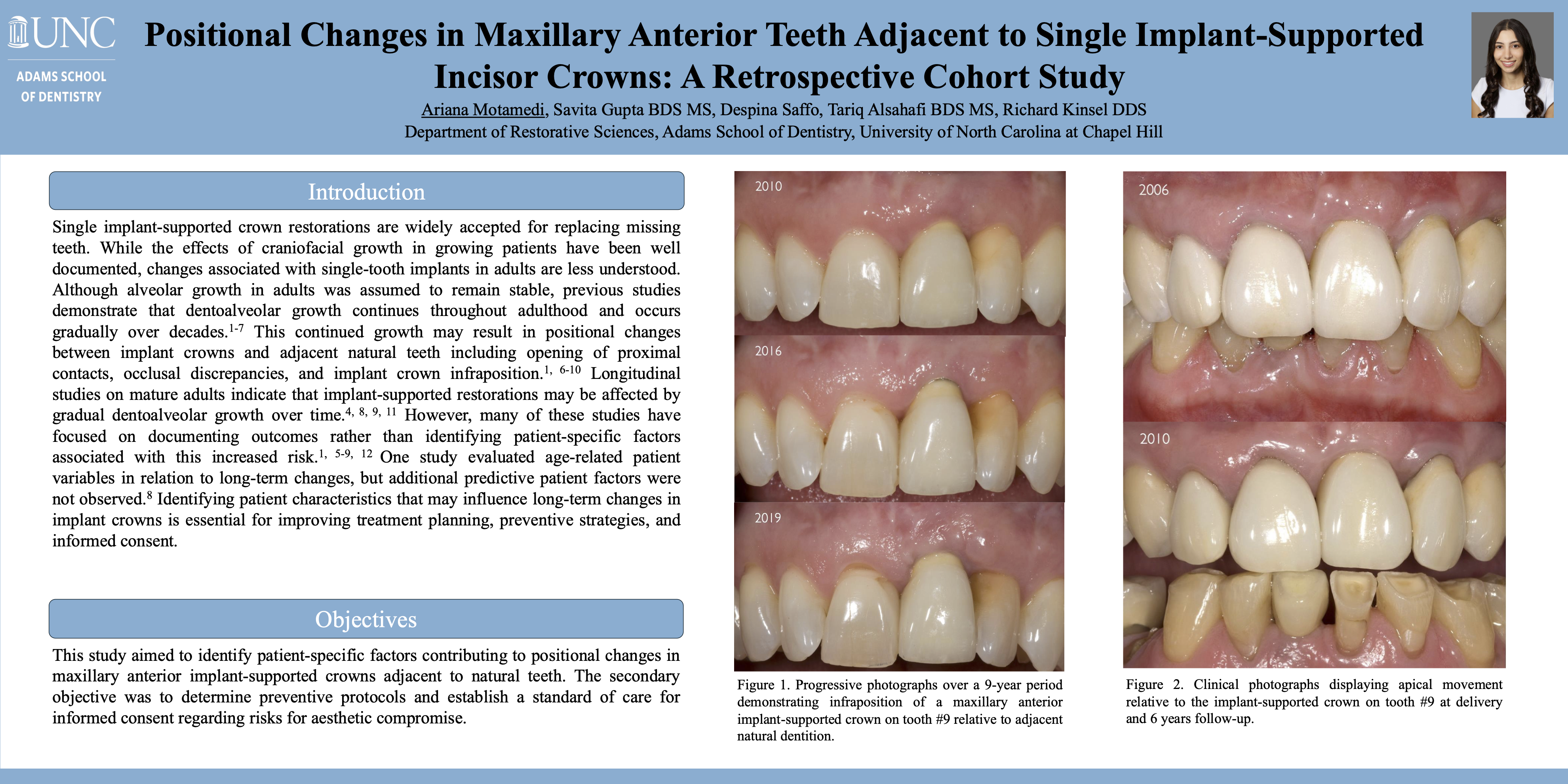
Positional Changes in Maxillary Anterior Teeth Adjacent to Single Implant-supported Incisor Crowns: A Retrospective Cohort Study
Poster Presenter
Authors
Part of Topic
Introduction: Single implant-supported crown restorations are widely accepted for replacing missing teeth. While the effects of craniofacial growth in growing patients have been well documented, changes associated with single-tooth implants in adults are less understood. Although alveolar growth in adults was assumed to remain stable, previous studies demonstrate that dentoalveolar growth continues throughout adulthood and occurs gradually over decades. 1-7 This continued growth may result in positional changes between implant crowns and adjacent natural teeth including opening of proximal contacts, occlusal discrepancies, and implant crown infraposition. 1, 6-10 Longitudinal studies on mature adults indicate that implant-supported restorations may be affected by gradual dentoalveolar growth over time. 4, 8, 9, 11 However, many of these studies have focused on documenting outcomes rather than identifying patient-specific factors associated with this increased risk. 1, 5-9, 12 One study evaluated age-related patient variables in relation to long-term changes, but additional predictive patient factors were not observed. 8 Identifying patient characteristics that may influence long-term changes in implant crowns is essential for improving treatment planning, preventive strategies, and informed consent.
Objectives: This study aimed to identify patient-specific factors contributing to positional changes in maxillary anterior implant-supported crowns adjacent to natural teeth. The secondary objective was to determine preventive protocols and establish a standard of care for informed consent regarding risks for aesthetic compromise
Methods: This retrospective clinical study was conducted at the University of North Carolina Adams School of Dentistry. A HIPAA- and IRBcompliant (IRB 25-0664) review of the UNC electronic health records identified 114 adults with maxillary implant-supported incisor crowns who met inclusion criteria. Preliminary screening was completed for 15 participants, with data collection currently ongoing. Participants provided informed consent and underwent clinical examination. Collected data included patient-related factors and predictors (Fig. 3). Standardized radiographs were analyzed to assess incisal height discrepancies (Fig. 4). Measurements (mm) were obtained using ImageJ and calibrated to implant body height. At implant placement (T0), the vertical discrepancy was considered zero. The apices of natural teeth were used as a proxy for incisal height changes. Discrepancies exceeding a 1.0-mm clinical threshold were evaluated. The data were assessed for normality using the Shapiro–Wilk test. No significant deviation from normality was found (W = 0.921, p= .198). Descriptive statistics were presented as means and standard deviations of change in implant position. Multiple independent t-tests and one-way analysis of variance (ANOVA) were performed for categorical variables. Pearson correlation analysis was conducted for continuous variables.
Results: Of the 15 patients analyzed, 60% were male, and 40% were female. A majority of patients (93.3%) had an Angle's Class 1 occlusion and (73.3%) straight facial profile. 66.7% of patients showed signs of bruxism, but 80% of patients reported not using an occlusal appliance. A majority (80%) showed healthy peri-implant probing depths (PPD) with good oral hygiene status. 80% of patients had contacts on the implant during centric occlusion, and 60% had contacts on the implant during mandibular border movements. Changes in implant positions were significantly associated with deep PPD (p=.038). Implants with PPD of 5 mm or more demonstrated higher positional differences (.84 mm) (Fig. 5). Results showed a weak, non-significant positive correlation between years of implant service and mean change in implant position (r=.117, p=.685) (Fig. 7). Implant length and diameter had no significant correlation to the mean change in implant position (r=.153, .127 respectively) (Fig. 8, Fig. 9).
Discussion: Preliminary findings indicate that positional changes to maxillary anterior implant-supported crowns occur in adult patients over time, supporting existing literature that dentoalveolar growth continues throughout adulthood. Although measurable changes were observed among patients, no statistically significant associations were observed between implant positional changes and the demographic, occlusal, or functional variables. Greater mean differences were observed in patients with convex facial profiles, males, older age groups, and those with clinical signs of bruxism. However, these findings were not statistically significant, likely due to the limited initial sample size. While most mean positional changes remained below the 1.0 mm clinical threshold, small discrepancies in the anterior maxilla may have esthetic implications over time. These preliminary findings emphasize the importance of comprehensive treatment planning and informed consent discussions regarding possible long-term positional changes in adults. As data collection continues, a larger sample size may determine protentional predictive factors.
Conclusions: 1. Patients with deeper PPD (≥ 5 mm) displayed higher average changes in implant position. 2. At averaged 9 years of clinical service, implant positional changes remained below clinical acceptable threshold of 1.0 mm. 3. The use of occlusal appliances did not significantly impact implant positional changes.
limitations: The relatively small preliminary sample data limit the statistical power and ability to establish strong correlations between changes in implant position and the tested variables and predictors. While calibration radiographic measurements software was utilized, the lack of clinical photos, and other measuring tools may introduce minor discrepancies in the obtained measurements.