197 posters, 15 videos, 31 sessions, 510 authors
ePostersLive by SciGen Technologies S.A. All rights reserved.
2026 AO Annual Meeting
Conference ePosters

P127
Effectiveness of Extra-Short (≤ 6 mm) Dental Implants After Ten Years: A Systematic Review
Poster Presenter
Part of Topic
Effectiveness of Extra-Short (≤ 6 mm) Dental Implants After Ten Years:
A Systematic Review with Quantitative Synthesis
Cristiano S. Moreira1; Armin Haghshenàs1 2; Debora R. Dias1; Serroni M1; Andrea Ravidà1
1 University of Pittsburgh, School of Dental Medicine, USA / 2 Tufts University, School of Dental Medicine, USA
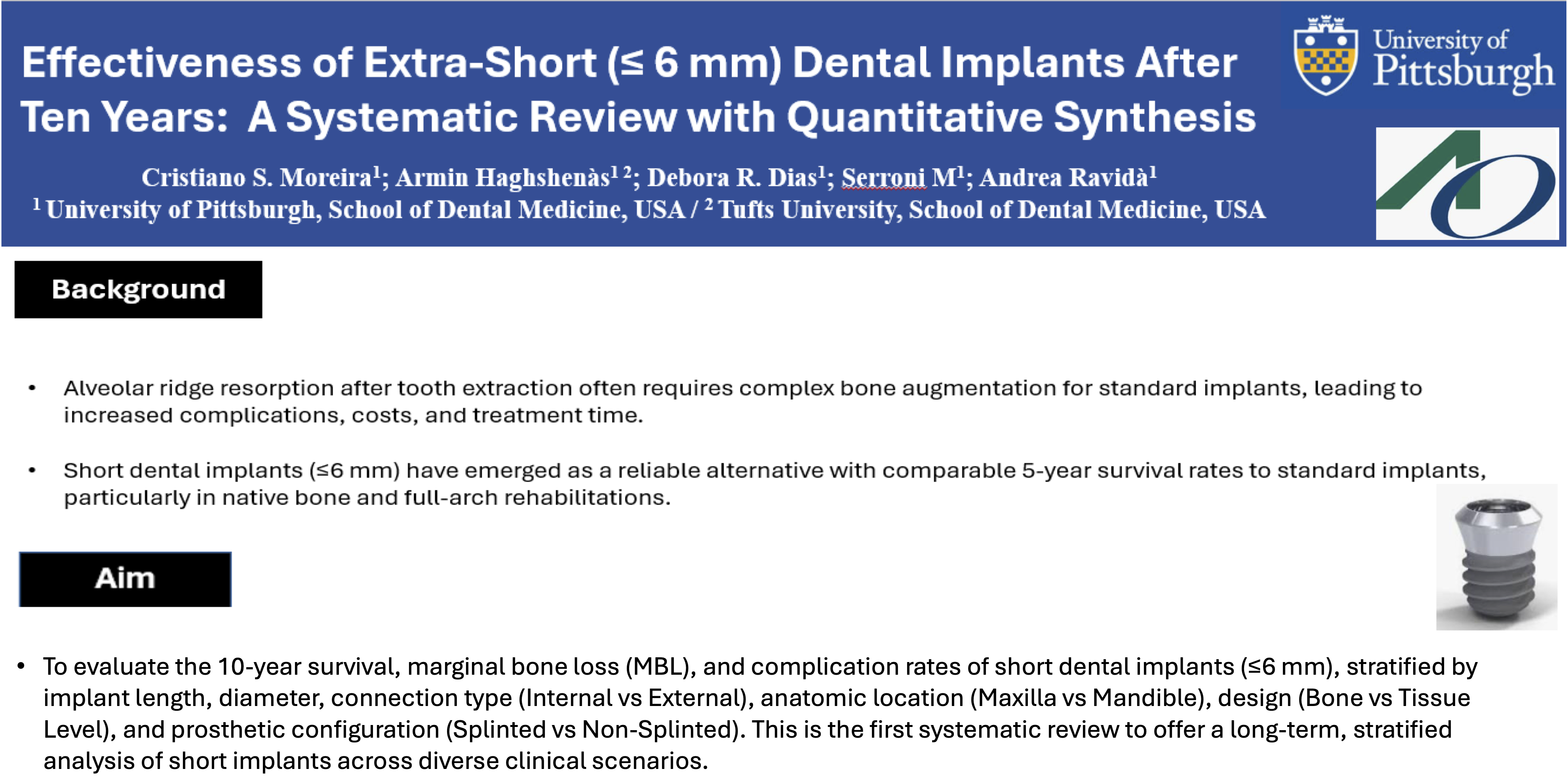
Aim: To evaluate the 10-year survival, marginal bone loss (MBL), and complication rates of short dental implants (≤6 mm), stratified by implant length, diameter, design (internal vs. external connection), anatomical location (maxilla vs. mandible), and prosthetic configuration (splinted vs. non-splinted). This is the first systematic review providing long-term, stratified analysis of short implants.
Materials and Methods: An electronic search of MEDLINE, EMBASE, and Cochrane Library was conducted up to May 2024. Included studies were randomized controlled trials and prospective cohorts reporting short implant (≤6 mm) survival with ≥12 months follow-up. Survival rates were analyzed using Kaplan–Meier estimates and weighted means; subgroup differences were assessed with t-tests and ANOVA. Annualized MBL and complication rates were evaluated with non-parametric tests.
Results: Sixty-five studies with 2,185 short implants were analyzed. At 10 years, overall survival was 95.0% ± 4.4%, with mandibular implants significantly higher than maxillary (97.2% ± 3.4% vs. 93.8% ± 4.2%, p < 0.001). Multiple models showed significantly higher survival for 6-mm implants, mandibular placement, bone-level implants, splinted restorations, and external connections. Mean MBL was 0.22 ± 0.21 mm. Higher annual MBL occurred in 4-mm implants, wider diameters, maxillary placement, external connections, and splinted prostheses. Prosthetic and biological complication rates were 2.15% ± 2.99% and 2.51% ± 3.98% per implant-year, respectively.
Conclusion: Short implants (≤6 mm) demonstrated high 10-year survival, minimal MBL, and low complications, representing a reliable alternative to bone augmentation for atrophic ridge rehabilitation.