197 posters, 15 videos, 31 sessions, 510 authors
ePostersLive by SciGen Technologies S.A. All rights reserved.
2026 AO Annual Meeting
Conference ePosters

P125
Immediate Functional Loading of Delayed Placement Nano-Hydroxyapatite-Coated Implants: Early Clinical and Radiographic Outcomes From a Prospective Trial
Poster Presenter
Authors
Joseph Montesano, David Kim, Chia Chen, Sang Lee, Jae-Hyun Lee
Part of Topic
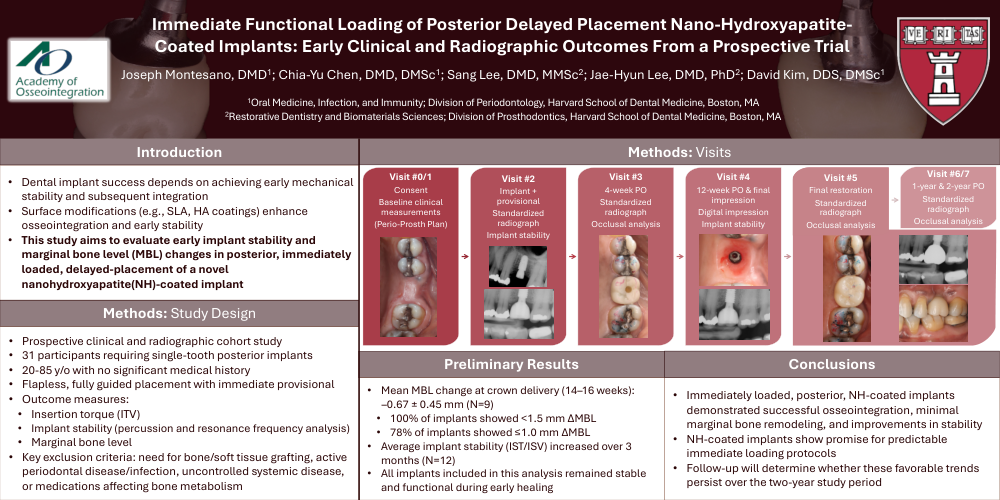
Immediate Functional Loading of Posterior Delayed Placement Nano-Hydroxyapatite-Coated Implants: Early Clinical and Radiographic Outcomes From a Prospective Trial
•Dental implant success depends on achieving early mechanical stability and subsequent integration
•Surface modifications (e.g., SLA, HA coatings) enhance osseointegration and early stability
•This study aims to evaluate early implant stability and marginal bone level (MBL) changes in posterior, immediately loaded, delayed-placement of a novel nanohydroxyapatite(NH)-coated implant
•Prospective clinical and radiographic cohort study
•31 participants requiring single-tooth posterior implants
•20-85 y/o with no significant medical history
•Flapless, fully guided placement with immediate provisional
•Outcome measures:
•Insertion torque (ITV)
•Implant stability (percussion and resonance frequency analysis)
•Marginal bone level
•Key exclusion criteria: need for bone/soft tissue grafting, active periodontal disease/infection, uncontrolled systemic disease, or medications affecting bone metabolism
•Mean MBL change at crown delivery (14–16 weeks):
–0.67 ± 0.45 mm (N=9)
•100% of implants showed <1.5 mm ΔMBL
•78% of implants showed ≤1.0 mm ΔMBL
•Average implant stability (IST/ISV) increased over 3 months (N=12)
•All implants included in this analysis remained stable and functional during early healing
•Immediately loaded, posterior, NH-coated implants demonstrated successful osseointegration, minimal marginal bone remodeling, and improvements in stability
•NH-coated implants show promise for predictable immediate loading protocols
•Follow-up will determine whether these favorable trends persist over the two-year study period