197 posters, 15 videos, 31 sessions, 510 authors
ePostersLive by SciGen Technologies S.A. All rights reserved.
2026 AO Annual Meeting
Conference ePosters

P117
Combined In-Silico and Animal Study on the Performance of a Novel Implant Design Reducing Cortical Bone Stress
Poster Presenter
Authors
Part of Topic
Introduction
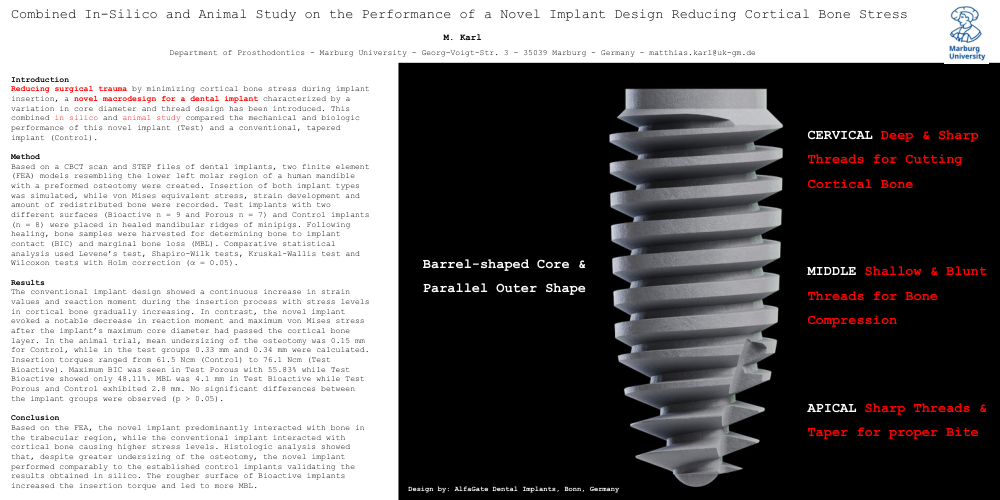
Reducing surgical trauma by minimizing cortical bone stress during implant insertion, a novel macrodesign for a dental implant characterized by a variation in core diameter and thread design has been introduced. This combined in silico and animal study compared the mechanical and biologic performance of this novel implant (Test) and a conventional, tapered implant (Control).
Method
Based on a CBCT scan and STEP files of dental implants, two finite element (FEA) models resembling the lower left molar region of a human mandible with a preformed osteotomy were created. Insertion of both implant types was simulated, while von Mises equivalent stress, strain development and amount of redistributed bone were recorded. Test implants with two different surfaces (Bioactive n = 9 and Porous n = 7) and Control implants (n = 8) were placed in healed mandibular ridges of minipigs. Following healing, bone samples were harvested for determining bone to implant contact (BIC) and marginal bone loss (MBL). Comparative statistical analysis used Levene’s test, Shapiro-Wilk tests, Kruskal-Wallis test and Wilcoxon tests with Holm correction (α = 0.05).
Results
The conventional implant design showed a continuous increase in strain values and reaction moment during the insertion process with stress levels in cortical bone gradually increasing. In contrast, the novel implant evoked a notable decrease in reaction moment and maximum von Mises stress after the implant’s maximum core diameter had passed the cortical bone layer. In the animal trial, mean undersizing of the osteotomy was 0.15 mm for Control, while in the test groups 0.33 mm and 0.34 mm were calculated. Insertion torques ranged from 61.5 Ncm (Control) to 76.1 Ncm (Test Bioactive). Maximum BIC was seen in Test Porous with 55.83% while Test Bioactive showed only 48.11%. MBL was 4.1 mm in Test Bioactive while Test Porous and Control exhibited 2.8 mm. No significant differences between the implant groups were observed (p > 0.05).
Conclusion
Based on the FEA, the novel implant predominantly interacted with bone in the trabecular region, while the conventional implant interacted with cortical bone causing higher stress levels. Histologic analysis showed that, despite greater undersizing of the osteotomy, the novel implant performed comparably to the established control implants validating the results obtained in silico. The rougher surface of Bioactive implants increased the insertion torque and led to more MBL.