197 posters, 15 videos, 31 sessions, 510 authors
ePostersLive by SciGen Technologies S.A. All rights reserved.
2026 AO Annual Meeting
Conference ePosters

P112
Risk Indicators Associated with the Prevalence of Peri-Implantitis: A 25-Year Retrospective Cross-Sectional Study with Cox Regression Modeling
Poster Presenter
Authors
Part of Topic
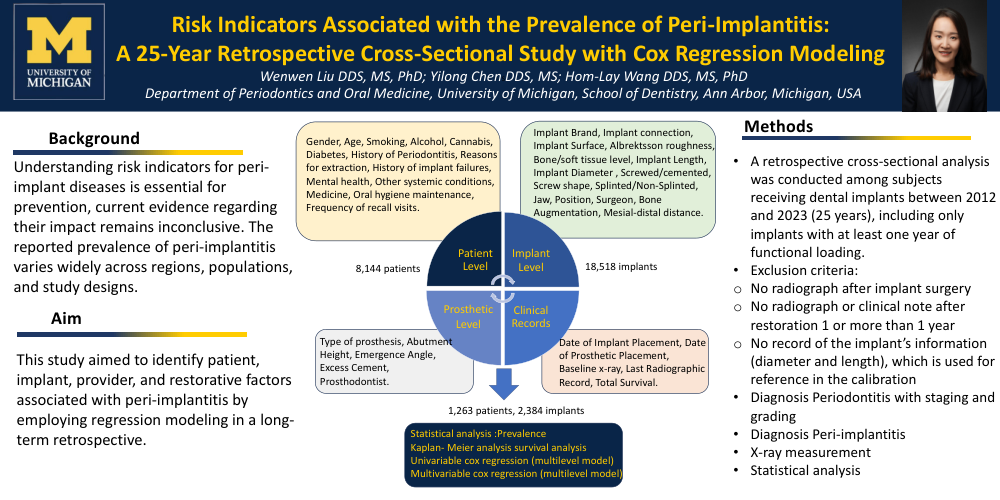
Background: Understanding risk indicators for peri-implant diseases is essential for prevention, current evidence regarding their impact remains inconclusive. The reported prevalence of peri-implantitis varies widely across regions, populations, and study designs。
Aim: Understanding risk indicators for peri-implant diseases is essential for prevention, current evidence regarding their impact remains inconclusive. The reported prevalence of peri-implantitis varies widely across regions, populations, and study designs.
Method:
Prevalence analysis: Peri-implantitis was 13.46% at the implant level and 11.87% at the patient level. The cumulative peri-implantitis-free rates were 99% at 1 year, 96.77% at 5 years, and 84.86% at 10 years post-implantation.
Kaplan-Meier analysis survival analysis: Among patient-level factors, a history of periodontitis, including disease staging and grading, as well as smoking history, was significantly associated with peri-implantitis. Implant-level factors including implant placement level (bone-level vs tissue-level), bone augmentation at the time of implant placement, provider experience, and prosthesis design also showed significant associations.
Kaplan-Meier analysis survival analysis: Among patient-level factors, a history of periodontitis, including disease staging and grading, as well as smoking history, was significantly associated with peri-implantitis. Implant-level factors including implant placement level (bone-level vs tissue-level), bone augmentation at the time of implant placement, provider experience, and prosthesis design also showed significant associations.
Conclusion:
Peri-implantitis risk is multifactorial, with patient periodontal status, prosthesis type, implant length, tissue levels, and provider experience all contributing to disease occurrence. Expert surgical technique and improved oral hygiene practices were protective against peri-implant disease. Comprehensive patient evaluation and individually tailored surgical and maintenance protocols are crucial to minimize peri-implantitis risk and optimize implant longevity.