226 posters, 5 topics, 20 sessions, 599 authors, 292 institutions
ePostersLive by SciGen Technologies S.A. All rights reserved.
Obstetric Anaesthesia Annual Scientific Meeting 2026
14-15 May 2026 | Liverpool Convention Centre

7163783
A case of Mirror Syndrome- distinct from pre-eclampsia?
Poster Presenter
Authors
Affiliations
Part of Topic
Case report
A case of Mirror Syndrome; distinct from pre-eclampsia?
Introduction
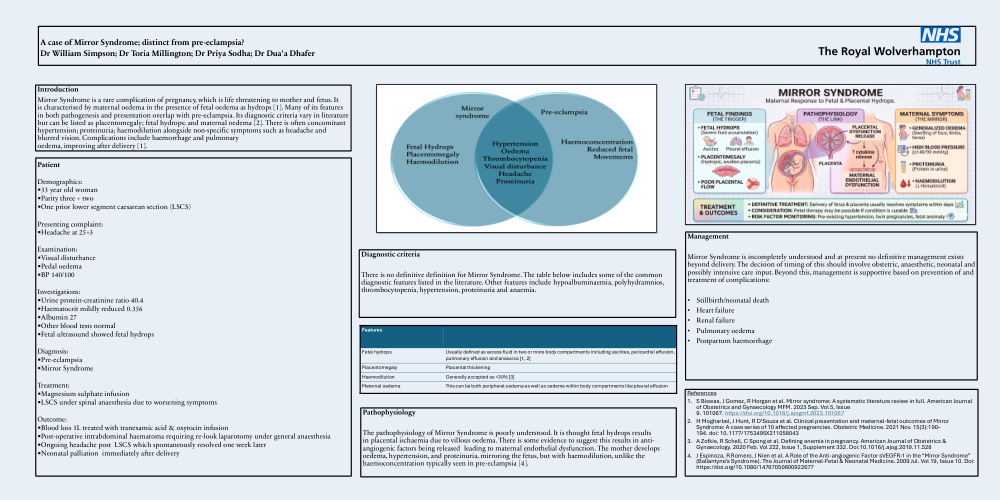
Mirror Syndrome is a rare complication of pregnancy, which is life threatening to mother and fetus. It is characterised by maternal oedema in the presence of fetal oedema as hydrops [1]. Many of its features in both pathogenesis and presentation overlap with pre-eclampsia. Its diagnostic criteria vary in literature but can be listed as placentomegaly; fetal hydrops; and maternal oedema [2]. There is often concomitant hypertension; proteinuria; haemodilution alongside non-specific symptoms such as headache and blurred vision. Complications include haemorrhage and pulmonary oedema, improving after delivery [1].
Patient
Demographics:
- 33 year old woman
- Parity three + two
- One prior lower segment caesarean section (LSCS)
Presenting complaint:
- Headache at 25+3
Examination:
- Visual disturbance
- Pedal oedema
- BP 140/100
Investigations:
- Urine protein-creatinine ratio 40.4
- Haematocrit mildly reduced 0.356
- Albumin 27
- Other blood tests normal
- Fetal ultrasound showed fetal hydrops
Diagnosis:
- Pre-eclampsia
- Mirror Syndrome
Treatment:
- Magnesium sulphate infusion
- LSCS under spinal anaesthesia due to worsening symptoms
Outcome:
- Blood loss 1L treated with tranexamic acid & oxytocin infusion
- Post-operative intrabdominal haematoma requiring re-look laparotomy under general anaesthesia
- Ongoing headache post LSCS which spontaneously resolved one week later
- Neonatal palliation immediately after delivery
Diagnostic criteria
There is no definitive definition for Mirror Syndrome. The table below includes some of the common diagnostic features listed in the literature. Other features include hypoalbuminaemia, polyhydramnios, thrombocytopenia, hypertension, proteinuria and anaemia.
Pathophysiology
The pathophysiology of Mirror Syndrome is poorly understood. It is thought fetal hydrops results in placental ischaemia due to villous oedema. There is some evidence to suggest this results in anti-angiogenic factors being released leading to maternal endothelial dysfunction. The mother develops oedema, hypertension, and proteinuria, mirroring the fetus, but with haemodilution, unlike the haemoconcentration typically seen in pre-eclampsia [4].
Management
Mirror Syndrome is incompletely understood and at present no definitive management exists beyond delivery. The decision of timing of this should involve obstetric, anaesthetic, neonatal and possibly intensive care input. Beyond this, management is supportive based on prevention of and treatment of complications:
- Stillbirth/neonatal death
- Heart failure
- Renal failure
- Pulmonary oedema
- Postpartum haemorrhage
References
- S Biswas, J Gomez, R Horgan et al. Mirror syndrome: A systematic literature review in full. American Journal of Obstetrics and Gynaecology MFM. 2023 Sep. Vol 5, Issue 9. 101067. https://doi.org/10.1016/j.ajogmf.2023.101067
- H Mogharbel, J Hunt, R D’Souza et al. Clinical presentation and maternal-fetal outcomes of Mirror Syndrome: A case series of 10 affected pregnancies. Obstetric Medicine. 2021 Nov. 15(3):190–194. doi: 10.1177/1753495X211058043
- A Zofkie, R Schell, C Spong et al. Defining anemia in pregnancy. American Journal of Obstetrics & Gynaecology. 2020 Feb. Vol 222, Issue 1, Supplement 332. Doi:10.1016/j.ajog.2019.11.528
- J Espinoza, R Romero, J Nien et al. A Role of the Anti-angiogenic Factor sVEGFR-1 in the “Mirror Syndrome” (Ballantyne’s Syndrome). The Journal of Maternal-Fetal & Neonatal Medicine. 2009 Jul. Vol 19, Issue 10. Doi: https://doi.org/10.1080/14767050600922677