226 posters, 5 topics, 20 sessions, 599 authors, 292 institutions
ePostersLive by SciGen Technologies S.A. All rights reserved.
Obstetric Anaesthesia Annual Scientific Meeting 2026
14-15 May 2026 | Liverpool Convention Centre

7162737
Anaesthetic management of an implanted vagal nerve stimulator during elective caesarean section: a case report
Poster Presenter
Part of Topic
Case report
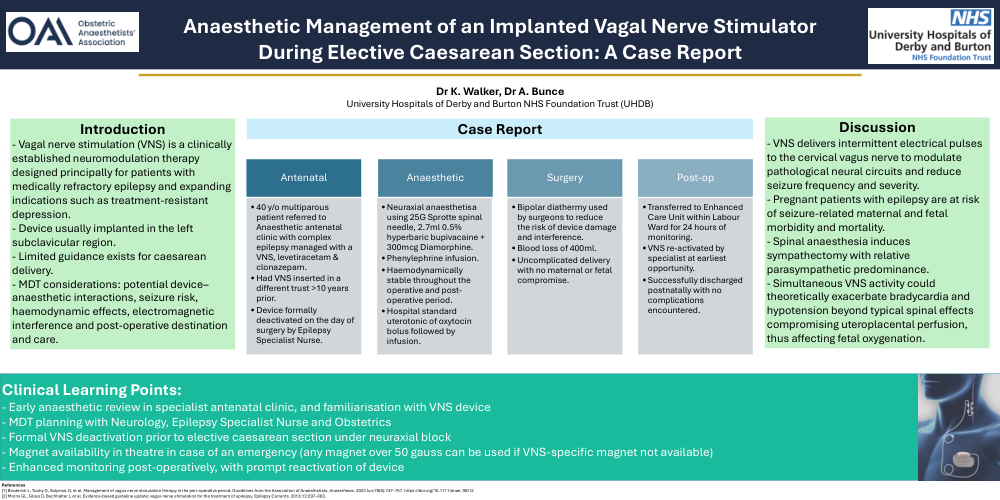
Anaesthetic Management of an Implanted Vagal Nerve Stimulator During Elective Caesarean Section: A Case Report
Dr K. Walker, Dr A. Bunce
University Hospitals of Derby and Burton NHS Foundation Trust (UHDB)
Introduction
- Vagal nerve stimulation (VNS) is a clinically established neuromodulation therapy designed principally for patients with medically refractory epilepsy and expanding indications such as treatment-resistant depression.
- Device usually implanted in the left subclavicular region.
- Limited guidance exists for caesarean delivery.
- MDT considerations: potential device–anaesthetic interactions, seizure risk, haemodynamic effects, electromagnetic interference and post-operative destination and care.
Case Report
Discussion
- VNS delivers intermittent electrical pulses to the cervical vagus nerve to modulate pathological neural circuits and reduce seizure frequency and severity.
- Pregnant patients with epilepsy are at risk of seizure-related maternal and fetal morbidity and mortality.
- Spinal anaesthesia induces sympathectomy with relative parasympathetic predominance.
- Simultaneous VNS activity could theoretically exacerbate bradycardia and hypotension beyond typical spinal effects compromising uteroplacental perfusion, thus affecting fetal oxygenation.
Clinical Learning Points:
- Early anaesthetic review in specialist antenatal clinic, and familiarisation with VNS device
- MDT planning with Neurology, Epilepsy Specialist Nurse and Obstetrics
- Formal VNS deactivationprior to elective caesarean section under neuraxial block
- Magnet availability in theatre in case of an emergency (any magnet over 50 gauss can be used if VNS-specific magnet not available)
- Enhanced monitoring post-operatively, with prompt reactivation of device
References
[1] Broderick L, Tuohy G, Solymos O, et al. Management of vagus nerve stimulation therapy in the peri-operative period: Guidelines from the Association of Anaesthetists. Anaesthesia. 2023 Jun;78(6):747–757. https://doi.org/10.1111/anae.16012
[2] Morris GL, Gloss D, Buchhalter J, et al. Evidence-based guideline update: vagus nerve stimulation for the treatment of epilepsy. Epilepsy Currents. 2013;13:297–303.