226 posters, 5 topics, 20 sessions, 599 authors, 292 institutions
ePostersLive by SciGen Technologies S.A. All rights reserved.
Obstetric Anaesthesia Annual Scientific Meeting 2026
14-15 May 2026 | Liverpool Convention Centre

7162169
Case of a successful caesarean birth under neuraxial anaesthesia in a patient with factor XI deficiency
Poster Presenter
Part of Topic
Case report
INTRODUCTION
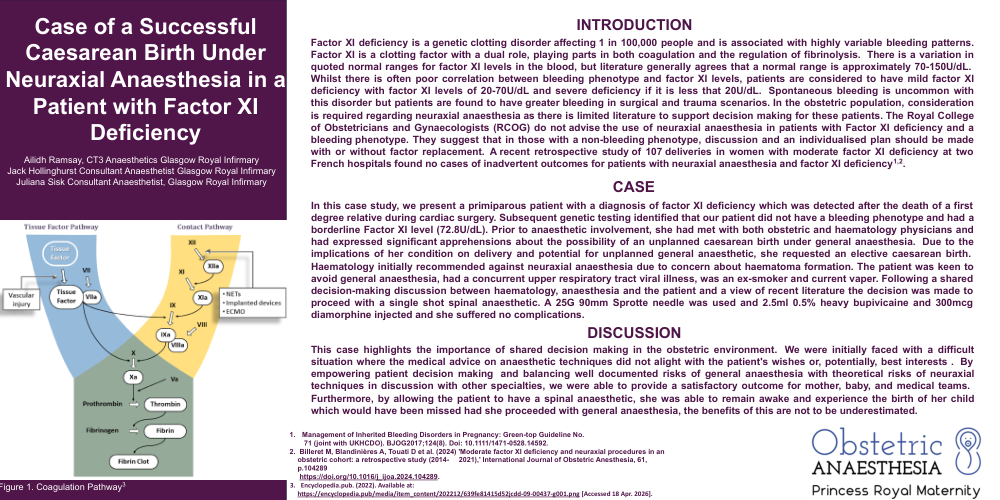
Factor XI deficiency is a genetic clotting disorder affecting 1 in 100,000 people and is associated with highly variable bleeding patterns.
Factor XI is a clotting factor with a dual role, playing parts in both coagulation and the regulation of fibrinolysis. There is a variation in
quoted normal ranges for factor XI levels in the blood, but literature generally agrees that a normal range is approximately 70-150U/dL.
Whilst there is often poor correlation between bleeding phenotype and factor XI levels, patients are considered to have mild factor XI
deficiency with factor XI levels of 20-70U/dL and severe deficiency if it is less that 20U/dL. Spontaneous bleeding is uncommon with
this disorder but patients are found to have greater bleeding in surgical and trauma scenarios. In the obstetric population, consideration
is required regarding neuraxial anaesthesia as there is limited literature to support decision making for these patients. The Royal College
of Obstetricians and Gynaecologists (RCOG) do not advise the use of neuraxial anaesthesia in patients with Factor XI deficiency and a
bleeding phenotype. They suggest that in those with a non-bleeding phenotype, discussion and an individualised plan should be made
with or without factor replacement. A recent retrospective study of 107 deliveries in women with moderate factor XI deficiency at two
French hospitals found no cases of inadvertent outcomes for patients with neuraxial anaesthesia and factor XI deficiency1,2.
CASE
In this case study, we present a primiparous patient with a diagnosis of factor XI deficiency which was detected after the death of a first
degree relative during cardiac surgery. Subsequent genetic testing identified that our patient did not have a bleeding phenotype and had a
borderline Factor XI level (72.8U/dL). Prior to anaesthetic involvement, she had met with both obstetric and haematology physicians and
had expressed significant apprehensions about the possibility of an unplanned caesarean birth under general anaesthesia. Due to the
implications of her condition on delivery and potential for unplanned general anaesthetic, she requested an elective caesarean birth.
Haematology initially recommended against neuraxial anaesthesia due to concern about haematoma formation. The patient was keen to
avoid general anaesthesia, had a concurrent upper respiratory tract viral illness, was an ex-smoker and current vaper. Following a shared
decision-making discussion between haematology, anaesthesia and the patient and a view of recent literature the decision was made to
proceed with a single shot spinal anaesthetic. A 25G 90mm Sprotte needle was used and 2.5ml 0.5% heavy bupivicaine and 300mcg
diamorphine injected and she suffered no complications.
DISCUSSION
This case highlights the importance of shared decision making in the obstetric environment. We were initially faced with a difficult
situation where the medical advice on anaesthetic techniques did not alight with the patient's wishes or, potentially, best interests . By
empowering patient decision making and balancing well documented risks of general anaesthesia with theoretical risks of neuraxial
techniques in discussion with other specialties, we were able to provide a satisfactory outcome for mother, baby, and medical teams.
Furthermore, by allowing the patient to have a spinal anaesthetic, she was able to remain awake and experience the birth of her child
which would have been missed had she proceeded with general anaesthesia, the benefits of this are not to be underestimated.
1. Management of Inherited Bleeding Disorders in Pregnancy: Green-top Guideline No. 71 (joint with UKHCDO). BJOG2017;124(8). Doi: 10.1111/1471-0528.14592. 2. Billeret M, Blandinières A, Touati D et al. (2024) 'Moderate factor XI deficiency and neuraxial procedures in an obstetric cohort: a retrospective study (2014- 2021),' International Journal of Obstetric Anesthesia, 61, p.104289https://doi.org/10.1016/j_ijoa.2024.104289.
3. Encyclopedia.pub. (2022). Available at: https://encyclopedia.pub/media/item_content/202212/639fe81415d52jcdd-09-00437-g001.png [Accessed 18 Apr. 2026].