226 posters, 5 topics, 20 sessions, 599 authors, 292 institutions
ePostersLive by SciGen Technologies S.A. All rights reserved.
Obstetric Anaesthesia Annual Scientific Meeting 2026
14-15 May 2026 | Liverpool Convention Centre

7160497
Reverse Takotsubo Cardiomyopathy in peri-partum period: A case report.
Part of Topic
Case report
Reverse Takotsubo Cardiomyopathy in peri-partum period: A case report.
Rasika Jagtap, Suganya Sukumaran, Damayantha Watthuhewa, Manoj Ravindran.
Introduction
Takotsubo cardiomyopathy is a form of Left Ventricular dysfunction with distinct wall motion abnormalities in the absence of coronary artery disease1. It is precipitated by excessive emotional or physical stress and usually has a complete resolution within weeks of diagnosis1. The condition’s broad spectrum of presentation can make it challenging to differentiate from other common peripartum complications.
Case report
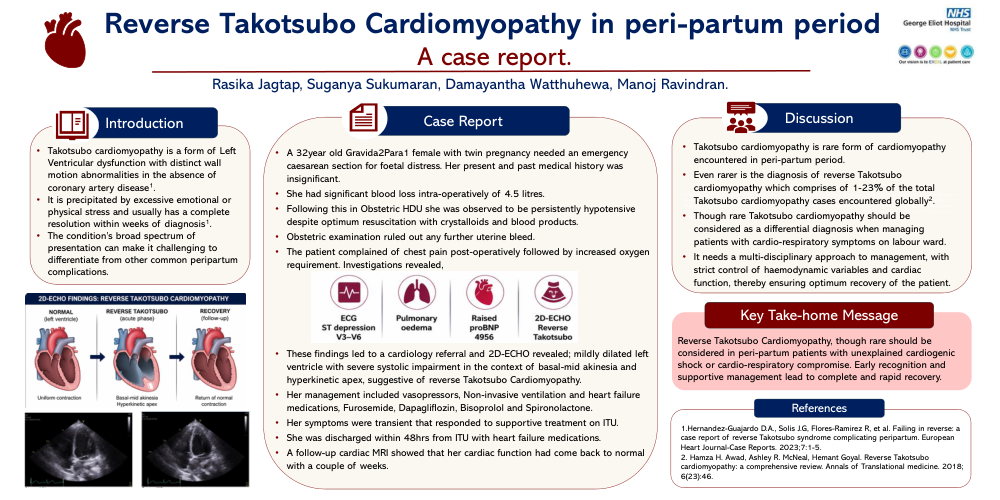
A 32year old Gravida2Para1 female with twin pregnancy needed an emergency caesarean section for foetal distress. Her present and past medical history was insignificant. She had significant blood loss intra-operatively of 4.5 litres and major obstetric protocol was activated. She was later transferred to Obstetric HDU and was observed to be persistently hypotensive despite optimum resuscitation with crystalloids and blood products. Obstetric examination ruled out any further uterine bleed. The patient complained of chest pain post-operatively followed by increased oxygen requirement. ECG following this event revealed mild ST segment depression in leads V3-V6. Patient was subsequently shifted to ITU. Preliminary blood investigations revealed raised proBNP(4956). Also, there was evidence of pulmonary oedema on chest X-ray. These findings led to a cardiology referral and 2D-ECHO revealed; mildly dilated left ventricle with severe systolic impairment in the context of basal-mid akinesia and hyperkinetic apex, suggestive of reverse Takotsubo Cardiomyopathy. Her management included vasopressors, Non-invasive ventilation and heart failure medications, Furosemide, Dapagliflozin, Bisoprolol and Spironolactone. Her symptoms were transient that responded to supportive treatment on ITU. She was discharged within 48hrs from ITU with heart failure medications. A follow-up cardiac MRI showed that her cardiac function had come back to normal with a couple of weeks.
Discussion
Takotsubo cardiomyopathy is rare form of cardiomyopathy encountered in peri-partum period. Even rarer is the diagnosis of reverse Takotsubo cardiomyopathy which comprises of 1-23% of the total Takotsubo cardiomyopathy cases encountered globally2. Though rare Takotsubo cardiomyopathy should be considered as a differential diagnosis when managing patients with cardio-respiratory symptoms on labour ward. It needs a multi-disciplinary approach to management, with strict control of haemodynamic variables and cardiac function, thereby ensuring optimum recovery of the patient.
References
1.Hernandez-Guajardo D.A., Solis J.G, Flores-Ramirez R, et al. Failing in reverse: a case report of reverse Takotsubo syndrome complicating peripartum. European Heart Journal-Case Reports. 2023;7:1-5.
2. Hamza H. Awad, Ashley R. McNeal, Hemant Goyal. Reverse Takotsubo cardiomyopathy: a comprehensive review. Annals of Translational medicine. 2018; 6(23):46.