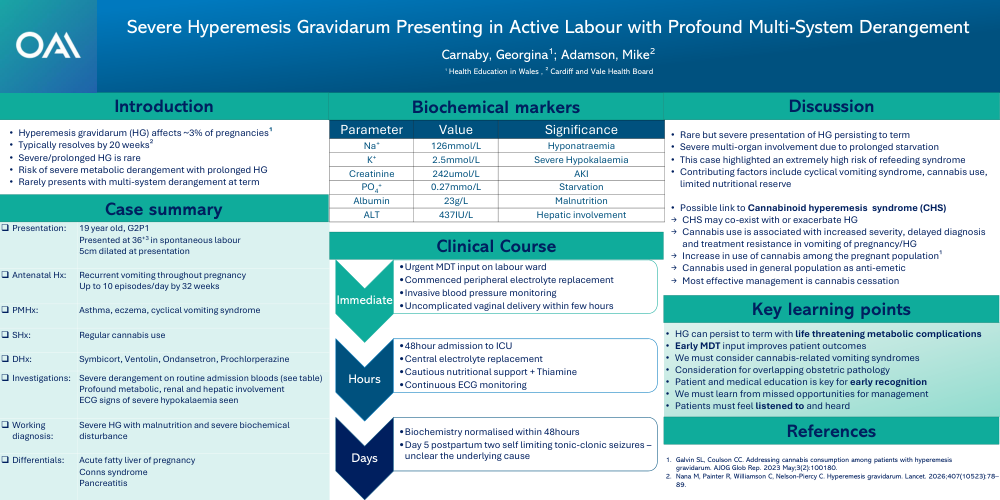
Severe Hyperemesis Gravidarum Presenting in Active Labour with Profound Multi-System Derangement
Carnaby, Georgina1; Adamson, Mike2
1 Health Education in Wales , ² Cardiff and Vale Health Board
Introduction
•Hyperemesis gravidarum (HG) affects ~3% of pregnancies¹
•Typically resolves by 20 weeks²
•Severe/prolonged HG is rare
•Risk of severe metabolic derangement with prolonged HG
•Rarely presents with multi-system derangement at term
Case Summary
Presentation :
19 year old, G2P1
Presented at 36+3 in spontaneous labour
5cm dilated at presentation
Antenatal Hx:
Recurrent vomiting throughout pregnancy
Up to 10 episodes/day by 32 weeks
PMHx:
Asthma, eczema, cyclical vomiting syndrome
SHx:
Regular cannabis use
DHx:
Symbicort, Ventolin, Ondansetron, Prochlorperazine
Investigations:
Severe derangement on routine admission bloods (see table)
Profound metabolic, renal and hepatic involvement
ECG signs of severe hypokalaemia seen
Woring diagnosis:
Severe HG with malnutrition and severe biochemical disturbance
Differentials:
Acute fatty liver of pregnancy
Conns syndrome
Pancreatitis
Biochemical markers:
|
Parameter
|
Value
|
Significance
|
|
Na+
|
126mmol/L
|
Hyponatraemia
|
|
K+
|
2.5mmol/L
|
Severe Hypokalaemia
|
|
Creatinine
|
242umol/L
|
AKI
|
|
PO4+
|
0.27mmo/L
|
Starvation
|
|
Albumin
|
23g/L
|
Malnutrition
|
|
ALT
|
437IU/L
|
Hepatic involvement
|
Clinical course
Immediate:
•Urgent MDT input on labour ward
•Commenced peripheral electrolyte replacement
•Invasive blood pressure monitoring
•Uncomplicated vaginal delivery within few hours
Hours:
•48hour admission to ICU
•Central electrolyte replacement
•Cautious nutritional support + Thiamine
•Continuous ECG monitoring
Days:
•Biochemistry normalised within 48hours
•Day 5 postpartum two self limiting tonic-clonic seizures – unclear the underlying cause
Discussion
•Rare but severe presentation of HG persisting to term
•Severe multi-organ involvement due to prolonged starvation
•This case highlighted an extremely high risk of refeeding syndrome
•Contributing factors include cyclical vomiting syndrome, cannabis use, limited nutritional reserve
•
•Possible link to Cannabinoid hyperemesis syndrome (CHS)
→CHS may co-exist with or exacerbate HG
→Cannabis use is associated with increased severity, delayed diagnosis and treatment resistance in vomiting of pregnancy/HG
→Increase in use of cannabis among the pregnant population¹
→Cannabis used in general population as anti-emetic
→Most effective management is cannabis cessation
Key learning points
•HG can persist to term with life threatening metabolic complications
•Early MDT input improves patient outcomes
•We must consider cannabis-related vomiting syndromes
•Consideration for overlapping obstetric pathology
•Patient and medical education is key for early recognition
•We must learn from missed opportunities for management
•Patients must feel listened to and heard
References
1.Galvin SL, Coulson CC. Addressing cannabis consumption among patients with hyperemesis gravidarum. AJOG Glob Rep. 2023 May;3(2):100180.
2.Nana M, Painter R, Williamson C, Nelson-Piercy C. Hyperemesis gravidarum. Lancet. 2026;407(10523):78–89.