226 posters, 5 topics, 20 sessions, 599 authors, 292 institutions
ePostersLive by SciGen Technologies S.A. All rights reserved.
Obstetric Anaesthesia Annual Scientific Meeting 2026
14-15 May 2026 | Liverpool Convention Centre

7159330
Case report: subdural haematoma requiring neurosurgical intervention after accidental dural puncture during lumbar epidural catheter insertion
Poster Presenter
Part of Topic
Case report
Introduction
Subdural haematoma (SDH) is a rare complication of epidural catheter insertion. We report a case of significant SDH following labour epidural analgesia that ultimately required surgical intervention with burr holes.
A 33-year-old primigravida had an induction of labour at 39+1 weeks. She had a history of well controlled asthma and a BMI of 35. During labour she requested an epidural for analgesia. The first anaesthetist attempted to site the epidural twice at separate levels but met with bony obstruction both times. A second anaesthetist made a further attempt using ultrasound to identify the L3/4 space and achieved loss of resistance on first pass of the Tuohy needle. On removing the syringe there was slow dripping of clear colourless fluid raising the question of dural puncture, however the flow was low and there had been a reasonable volume of saline injected. The catheter was threaded and functioned as expected for an epidural, with a falling meniscus and no aspiration possible through the catheter. It provided effective analgesia for vaginal delivery. Postnatal anaesthetic review was unremarkable and she was discharged. Of note the patient was deemedlow riskfor venous thromboembolism (VTE) and therefore was not prescribed anticoagulation by the obstetricians.
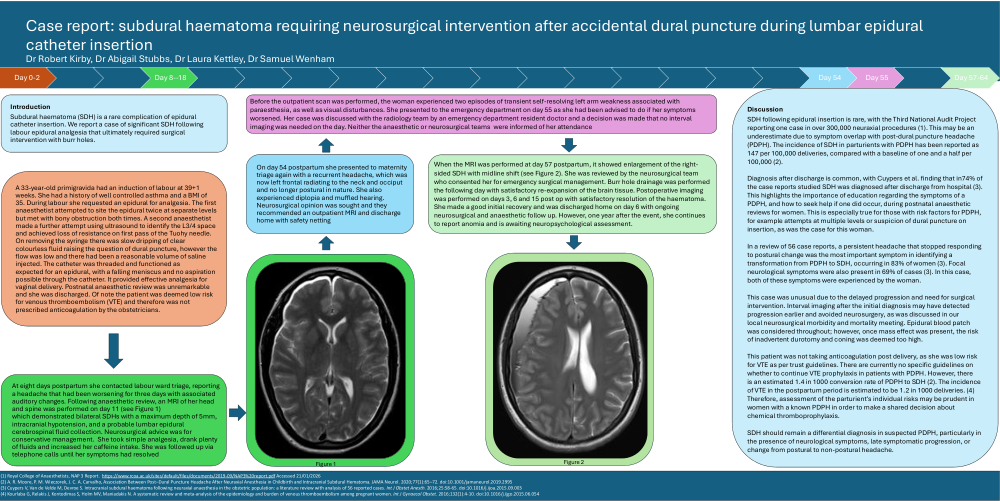
At eight days postpartum she contacted labour ward triage, reporting a headache that had been worsening for three days with associated auditory changes. Following anaesthetic review, an MRI of her head and spine was performed on day 11 (see Figure 1) which demonstrated bilateral SDHs with a maximum depth of 5mm, intracranial hypotension, and a probable lumbar epidural cerebrospinal fluid collection. Neurosurgical advice was for conservative management. She took simple analgesia, drank plenty of fluids and increased her caffeine intake. She was followed up via telephone calls until her symptoms had resolved
On day 54 postpartum she presented to maternity triage again with a recurrent headache, which was now left frontal radiating to the neck and occiput and no longer postural in nature. She also experienced diplopia and muffled hearing. Neurosurgical opinion was sought and they recommended an outpatient MRI and discharge home with safety netting
Before the outpatient scan was performed, the woman experienced two episodes of transient self-resolving left arm weakness associated with paraesthesia, as well as visual disturbances. She presented to the emergency department on day 55 as she had been advised to do if her symptoms worsened. Her case was discussed with the radiology team by an emergency department resident doctor and a decision was made that no interval imaging was needed on the day. Neither the anaesthetic or neurosurgical teams were informed of her attendance
When the MRI was performed at day 57 postpartum, it showed enlargement of the right-sided SDH with midline shift (see Figure 2). She was reviewed by the neurosurgical team who consented her for emergency surgical management. Burr hole drainage was performed the following day with satisfactory re-expansion of the brain tissue. Postoperative imaging was performed on days 3, 6 and 15 post op with satisfactory resolution of the haematoma. She made a good initial recovery and was discharged home on day 6 with ongoing neurosurgical and anaesthetic follow up. However, one year after the event, she continues to report anomia and is awaiting neuropsychological assessment.
Discussion
SDH following epidural insertion is rare, with the Third National Audit Project reporting one case in over 300,000 neuraxial procedures (1). This may be an underestimate due to symptom overlap with post-dural puncture headache (PDPH). The incidence of SDH in parturients with PDPH has been reported as 147 per 100,000 deliveries, compared with a baseline of one and a half per 100,000 (2).
Diagnosis after discharge is common, with Cuypers et al. finding that in74% of the case reports studied SDH was diagnosed after discharge from hospital (3). This highlights the importance of education regarding the symptoms of a PDPH, and how to seek help if one did occur, during postnatal anaesthetic reviews for women. This is especially true for those with risk factors for PDPH, for example attempts at multiple levels or suspicion of dural puncture on insertion, as was the case for this woman.
In a review of 56 case reports, a persistent headache that stopped responding to postural change was the most important symptom in identifying a transformation from PDPH to SDH, occurring in 83% of women (3). Focal neurological symptoms were also present in 69% of cases (3). In this case, both of these symptoms were experienced by the woman.
This case was unusual due to the delayed progression and need for surgical intervention. Interval imaging after the initial diagnosis may have detected progression earlier and avoided neurosurgery, as was discussed in our local neurosurgical morbidity and mortality meeting. Epidural blood patch was considered throughout; however, once mass effect was present, the risk of inadvertent durotomy and coning was deemed too high.
This patient was not taking anticoagulation post delivery, as she was low riskfor VTE as per trust guidelines. There are currently no specific guidelines on whether to continue VTE prophylaxis in patients with PDPH. However, there is an estimated 1.4 in 1000 conversion rate of PDPH to SDH (2). The incidence of VTE in the postpartum period is estimated to be 1.2 in 1000 deliveries. (4) Therefore, assessment of the parturient's individual risks may be prudent in women with a known PDPH in order to make a shared decision about chemical thromboprophylaxis.
SDH should remain a differential diagnosis in suspected PDPH, particularly in the presence of neurological symptoms, late symptomatic progression, or change from postural to non-postural headache.