226 posters, 5 topics, 20 sessions, 599 authors, 292 institutions
ePostersLive by SciGen Technologies S.A. All rights reserved.
Obstetric Anaesthesia Annual Scientific Meeting 2026
14-15 May 2026 | Liverpool Convention Centre

7157493
Intrapartum management of a patient with a vagal nerve stimulator: anaesthetic challenges
Poster Presenter
Part of Topic
Case report
Introduction
Vagus nerve stimulation (VNS) is an established adjunctive therapy for drug-resistant epilepsy [1]. Despite increasing numbers of women of child-bearing age with implanted devices, evidence guiding peripartum management is limited.
Reported risks include VNS-associated bradyarrhythmias or hypotension, inappropriate autostimulation, and device interference during surgery or electrocautery [2].
Current guidance recommends multidisciplinary planning with obstetric, neurology, and anaesthetic teams, including an individualised labour and delivery plan [2].
Case Report
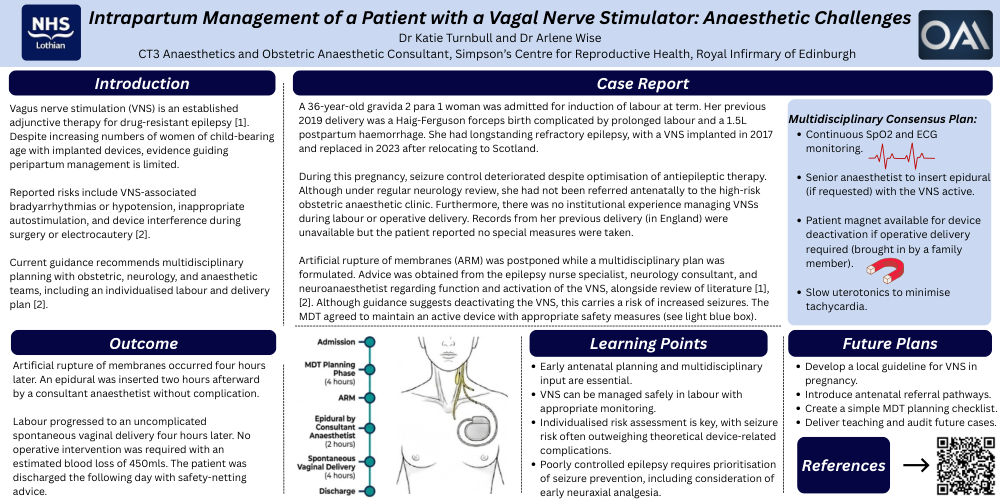
A 36-year-old gravida 2 para 1 woman was admitted for induction of labour at term. Her previous 2019 delivery was a Haig-Ferguson forceps birth complicated by prolonged labour and a 1.5L postpartum haemorrhage. She had longstanding refractory epilepsy, with a VNS implanted in 2017 and replaced in 2023 after relocating to Scotland.
During this pregnancy, seizure control deteriorated despite optimisation of antiepileptic therapy. Although under regular neurology review, she had not been referred antenatally to the high-risk obstetric anaesthetic clinic. Furthermore, there was no institutional experience managing VNSs during labour or operative delivery. Records from her previous delivery (in England) were unavailable but the patient reported no special measures were taken.
Artificial rupture of membranes (ARM) was postponed while a multidisciplinary plan was formulated. Advice was obtained from the epilepsy nurse specialist, neurology consultant, and neuroanaesthetist regarding function and activation of the VNS, alongside review of literature [1], [2]. Although guidance suggests deactivating the VNS, this carries a risk of increased seizures. The MDT agreed to maintain an active device with appropriate safety measures (see light blue box).
Multidisciplinary Consensus Plan
- Continuous SpO2 and ECG monitoring.
- Senior anaesthetist to insert epidural (if requested) with the VNS active.
- Patient magnet available for device deactivation if operative delivery required (brought in by a family member).
- Slow uterotonics to minimise tachycardia.
Outcome
Artificial rupture of membranes occurred four hours later. An epidural was inserted two hours afterward by a consultant anaesthetist without complication.
Labour progressed to an uncomplicated spontaneous vaginal delivery four hours later. No operative intervention was required with an estimated blood loss of 450mls. The patient was discharged the following day with safety-netting advice.
Learning Points
- Early antenatal planning and multidisciplinary input are essential.
- VNS can be managed safely in labour with appropriate monitoring.
- Individualised risk assessment is key, with seizure risk often outweighing theoretical device-related complications.
- Poorly controlled epilepsy requires prioritisation of seizure prevention, including consideration of early neuraxial analgesia.
Future Plans
- Develop a local guideline for VNS in pregnancy.
- Introduce antenatal referral pathways.
- Create a simple MDT planning checklist.
- Deliver teaching and audit future cases.
References
1. Tuohy G, Chalissery AJ, Murphy CJ et al. Anaesthetic Considerations for Patients with a Vagal Nerve Stimulator. Journal of Clinical Anesthesia and Pain Management. 2020;4(1):114–122. doi:10.36959/377/340.
2. Broderick L, Tuohy G, Solymos O et al. Management of vagus nerve stimulation therapy in the peri-operative period: Guidelines from the Association of Anaesthetists. Anaesthesia. 2023;78(6):747-757. doi:10.1111/anae.16012.