226 posters, 5 topics, 20 sessions, 599 authors, 292 institutions
ePostersLive by SciGen Technologies S.A. All rights reserved.
Obstetric Anaesthesia Annual Scientific Meeting 2026
14-15 May 2026 | Liverpool Convention Centre

7157239
Elective Lower segment Caesarean Section (LSCS) at 32 weeks in a patient with Langerhans Cell Histiocytosis due to worsening respiratory function
Poster Presenter
Authors
Affiliations
Part of Topic
Case report
Elective Lower Segment Caesarean Section (LSCS) at 32 weeks in a patient with
Langerhans Cell Histiocytosis due to worsening respiratory function
Dr Amy Bhatia (ST6 Anaesthetics) and Dr Paul Sharpe (Consultant Anaesthetist)
Leicester Royal Infirmary
Introduction
Langerhans Cell Histiocytosis (LCH) is a rare neoplastic disorder of unknown aetiology which manifests as cystic interstitial disease, diagnosed by lung biopsy [1]. Treatment is with chemotherapy or lung transplant in severe cases [2].
Case Report
We present a 43-year-old, para 4 female with known LCH. She was reviewed in a high-risk anaesthetic clinic as she had previous bronchiolitis, deep vein thrombosis, pneumothorax, asthma, COPD, pregnancy induced hypertension, substance misuse (on long term Methadone) and was awaiting a lung transplant. Her pulmonary function tests showed severely reduced lung capacity (see table) with oxygen saturations of 94% on room air. Her echo showed a normal size left and right ventricle with an ejection fraction of more than 55%. Her medications include Carbocictein 750mg (TDS), Nifedipine 20mg (OD), Lufebec MDI inhaler, Methadone 70mg (OD) and Enoxaparin 20mg (OD). Her exercise tolerance was poor, she was getting short of breath at rest and unable to walk up a flight of stairs.
Prior obstetric history was unremarkable; three vaginal deliveries and one emergency LSCS. Her last delivery was 18 years ago, prior to diagnosis. She presented at 29 weeks with worsening shortness of breath, treated with antibiotics and her usual inhalers. She was discussed in a multidisciplinary team meeting and was for planned LSCS aiming to avoid general anaesthesia (GA).
At 32 weeks gestation an elective LSCS was carried out under sequential combined spinal epidural anaesthetic with invasive arterial monitoring. A low dose spinal of 1.5mls of heavy Bupivacaine 0.5% was given along with Morphine 100mcg and Fentanyl 15mcg, which achieved a bilateral block to T7/8. This was topped up with 2% Lidocaine with Adrenaline, 13mls in aliquots, in a 40-degree ramped position. Remifentanil TCI was used to treat additional pain. Neonatal Apgar scores were 9 &10 at 1 & 10mins of life. Post delivery analgesic doses of ketamine (15mg) were also given. Offer of GA was declined. Respiratory parameters were maintained throughout with high flow oxygen therapy. Total estimated blood loss was 400ml. Post-operatively she was happy with her care and glad to have avoided a GA. The epidural was kept in for post-op pain relief and patient was monitored in HDU on delivery suite. Due to pain a PCA she was switched to a morphine PCA with 2mg boluses.
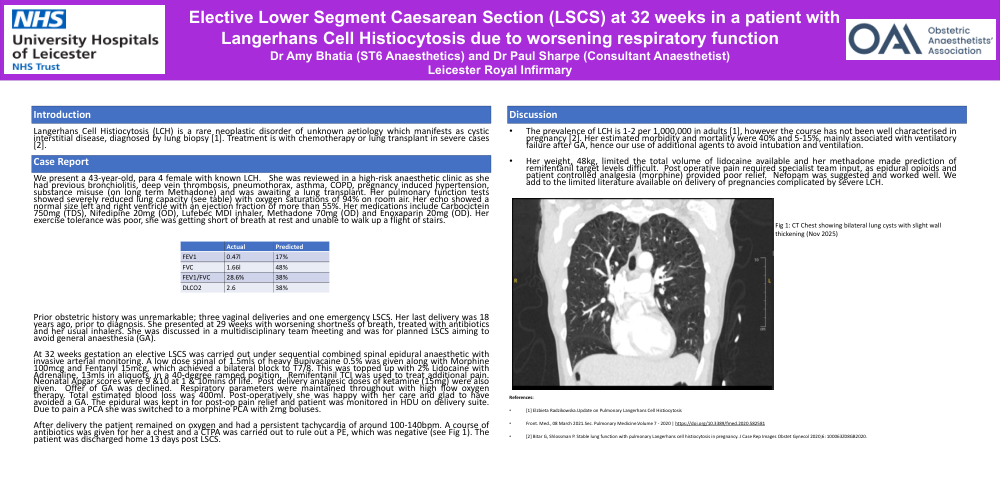
After delivery the patient remained on oxygen and had a persistent tachycardia of around 100-140bpm. A course of antibiotics was given for her a chest and a CTPA was carried out to rule out a PE, which was negative (see Fig 1). The patient was discharged home 13 days post LSCS.
Discussion