226 posters, 5 topics, 20 sessions, 599 authors, 292 institutions
ePostersLive by SciGen Technologies S.A. All rights reserved.
Obstetric Anaesthesia Annual Scientific Meeting 2026
14-15 May 2026 | Liverpool Convention Centre

7155768
Breakage of an epidural catheter with retained fragment inserted for labour analgesia
Poster Presenter
Authors
Affiliations
Part of Topic
Case report
Abstract title:
Breakage of an epidural catheter with retained fragment inserted for labour analgesia
Abstract text:
Introduction and Background
Epidural catheter breakage is a rare but challenging complication, with an incidence of approximately 0.002%. It can occur during placement or
removal and presents a management dilemma due to the lack of consensus. We report a case of catheter breakage with retained fragment during
labor analgesia, managed conservatively in a tertiary care center in Italy.
Case Report
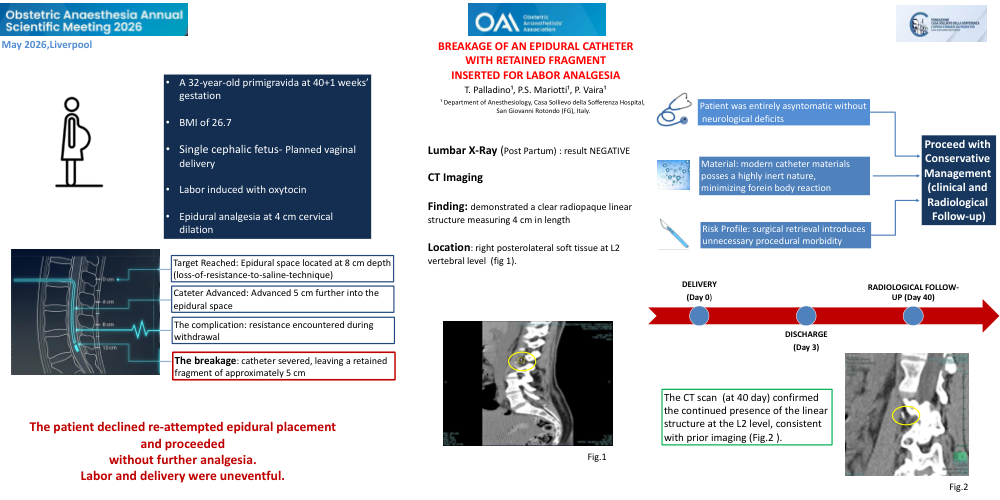
A 32-year-old primigravida woman (BMI 26.7, ASA II) at 40+1 weeks’ gestation was admitted for labor induction and requested epidural analgesia at 4 cm cervical dilatation. Under aseptic conditions and in a sitting position, the epidural space was located at 8cm using the loss-of-resistance-to-saline technique, and a Portex catheter was advanced 5 cm further. Resistance was encountered, and during withdrawal, the catheter broke, leaving approximately 5 cm retained.
The patient was informed and declined re-insertion. Neurosurgical consultation was requested, and a lumbar X-ray post-delivery failed to detect the fragment. A CT scan revealed a 4 cm radiopaque tubular structure in the right posterolateral epidural space at L2, extending into the adjacent soft tissue. (Fig.1)
As the patient remained asymptomatic, conservative management was chosen. She was discharged three days postpartum and scheduled for follow-up imaging.
At 40 days, a lumbar CT confirmed the retained fragment, with no changes or symptoms reported.
Conclusions
Epidural catheter breakage is a rare but significant complication. In asymptomatic patients, conservative management with follow-up imaging is
generally preferred. Surgical removal is usually reserved for symptomatic cases. Prompt communication with the patient and multidisciplinary evaluation are essential for appropriate management.
References
M.S.Hajnour, R.S. Khokhar, et al, Difficulty in the removal of epidural catheter for labor analgesia, Saudi Journal of Anesthesia, 2017; Vol 2, Issue 1
N.Brogly,I.V.Gomez, et al ESAIC focused guidelines for the management of the falling epidural during labour epidural analgesia,European Journal
of Anaesthesiology, 2025; 42:96-112