226 posters, 5 topics, 20 sessions, 599 authors, 292 institutions
ePostersLive by SciGen Technologies S.A. All rights reserved.
Obstetric Anaesthesia Annual Scientific Meeting 2026
14-15 May 2026 | Liverpool Convention Centre

7148685
Dodging bullets: Emergency spinal anaesthesia in a patient with a spinal bullet fragment
Poster Presenter
Authors
Affiliations
Part of Topic
Case report
INTRODUCTION
•Retained spinal bullet fragments are rare
•No clear guidance or much experience on neuraxial anaesthesia safety
•Obstetric anaesthesia frequently requires time-critical decision-making
•Management therefore depends on individualized risk–benefit assessment in the absence of clear guidance
CASE SUMMARY
•33-year-old, primigravida, 37+4 weeks, gestational diabetes
•Limited English language proficiency
•Not referred for anaesthetic assessment
•Presented in spontaneous labour
•Foetal distress → category 2 emergency LSCS called
•History obtained via telephone translator: gunshot wound to her back 16 years prior, with a retained bullet in her spine (no records available)
•No neurological signs / symptoms
KEY DECISION POINT - SPINAL VS GENERAL?
Why spinal anaesthesia?
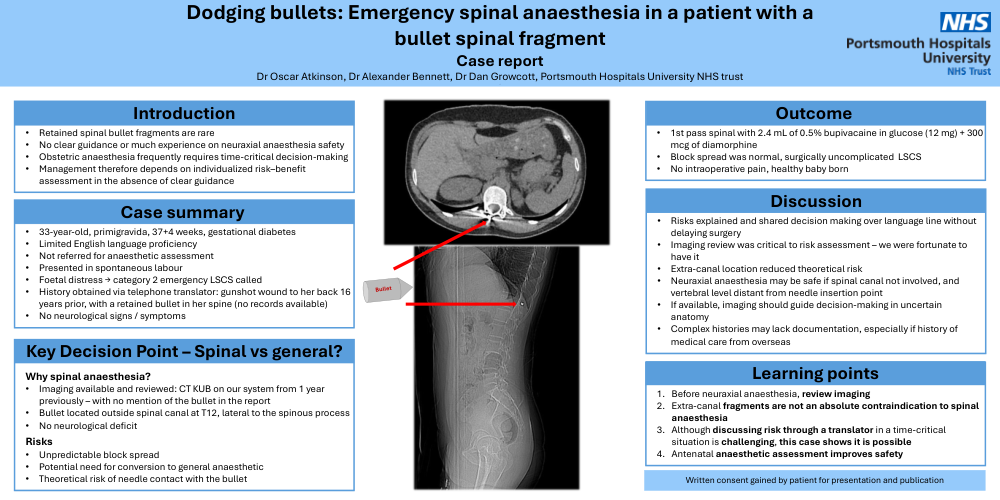
•Imaging available and reviewed: CT KUB on our system from 1 year previously – with no mention of the bullet in the report
•Bullet located outside spinal canal at T12, lateral to the spinous process
•No neurological deficit
Risks
•Unpredictable block spread
•Potential need for conversion to general anaesthetic
•Theoretical risk of needle contact with the bullet
OUTCOME
•1st pass spinal with 2.4 mL of 0.5% bupivacaine in glucose (12 mg) + 300 mcg of diamorphine
•Block spread was normal, surgically uncomplicated LSCS
•No intraoperative pain, healthy baby born
DISCUSSION
•Risks explained and shared decision making over language line without delaying surgery
•Imaging review was critical to risk assessment – we were fortunate to have it
•Extra-canal location reduced theoretical risk
•Neuraxial anaesthesia may be safe if spinal canal not involved, and vertebral level distant from needle insertion point
•If available, imaging should guide decision-making in uncertain
anatomy
anatomy
•Complex histories may lack documentation, especially if history of medical care from overseas
LEARNING POINTS
1.Before neuraxial anaesthesia, review imaging
2.Extra-canal fragments are not an absolute contraindication to spinal anaesthesia
3.Although discussing risk through a translator in a time-critical situation is challenging, this case shows it is possible
4.Antenatal anaesthetic assessment improves safety
Written consent gained by patient for presentation and publication