215 posters, 5 topics, 22 sessions, 596 authors, 283 institutions
ePostersLive by SciGen Technologies S.A. All rights reserved.
Obstetric Anaesthesia Annual Scientific Meeting 2025
May 15 - 16, 2025 | ICC, 2 Lanyon Place, Belfast BT1 3WH

6780411
Obstetric patients on hybrid closed loop systems during labour and birth: a retrospective cohort study
Part of Topic
Original Research
Obstetric Patients on Hybrid Closed Loop Systems During Labour and Birth: A Retrospective Cohort Study
Dr Stephanie MacDonald, ST7 Resident Anaesthetist
Dr Rahat Maitland, Consultant Physician in Diabetes and Endocrinology
The Queen Elizabeth University Hospital, Glasgow
Introduction
The use of hybrid closed loop (HCL) systems in pregnant women with type 1 diabetes mellitus (T1DM) is increasing and its use is expected to rise further following its recommendation in national guidelines.1-2 Often referred to as an ‘artificial pancreas’, this system connects an insulin pump to a continuous glucose monitor (CGM) using a computer algorithm. Insulin delivery is continuously adjusted based on glucose monitor readings to achieve pre-set glucose targets. Randomised controlled trials have shown that HCL therapy significantly improves maternal glycemic control during pregnancy and observational studies have demonstrated that continuation of subcutaneous insulin via a pump during labour and delivery appears safe and efficacious with no serious adverse events, and may even lead to improved glycaemic control over those that switch to a variable rate intravenous insulin infusion (VRIII).3-5
In our hospital it is standard practice to allow women the choice of remaining on their HCL system or switching to a VRIII during labour and birth. However, there is no standard practice regarding HCL systems and caesarean birth (CB), nor any departmental guidance on how to safely continue a HCL in the event of a CB and decisions are often made on a case-by-case basis. Currently, manufactures of HCL systems do not recommend their use in the presence of diathermy or imaging devices, but this advice is based on perceived rather than actual risk of damage and continued use of a HCL during CB may lead to better glucose control and improved patient satisfaction.1 Moreover, switching a patient from a HCL to a VRIII in a timely manner in the setting of an unplanned caesarean birth can be challenging.
Aims
The objectives of this study were twofold: firstly, to assess current practice and outcomes in patients using HCL systems during labour and birth; secondly, to identify any issues with this novel technology to inform guideline development on the use of HCL systems during labour and birth, including caesarean birth, such that we can facilitate continued use of this technology safely if this is the patient’s wishes.
Methodology
A retrospective observational cohort study of all women with T1DM using HCL systems who gave birth between November 2023 and November 2024 was undertaken at our tertiary centre hospital. Data including age, parity, gestational age at delivery, mode of delivery, use of antenatal steroids, peripartum glycaemic control and fetal outcomes were obtained from medical notes and analysed using Microsoft excel. Ethical approval was granted by the Caldicott Guardian.
Results
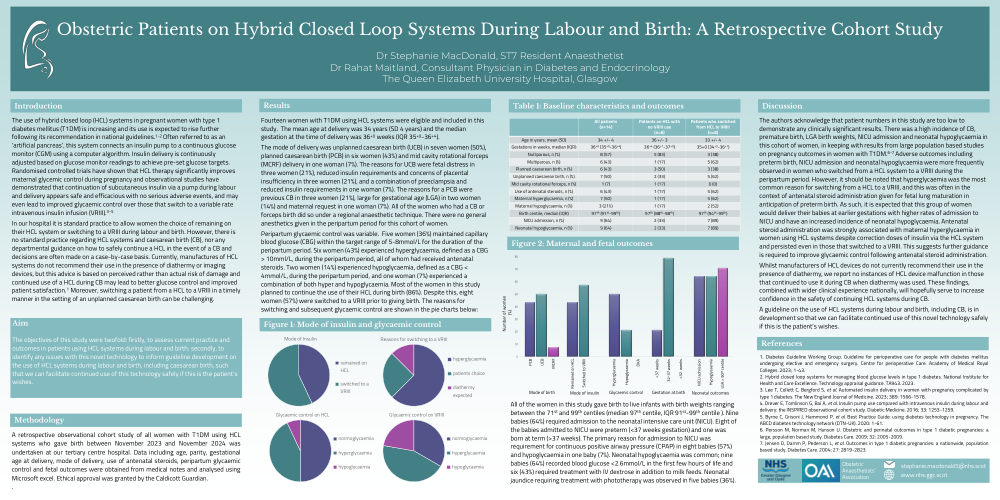
Fourteen women with T1DM using HCL systems were eligible and included in this study. The mean age at delivery was 34 years (SD 4 years) and the median gestation at the time of delivery was 36+0 weeks (IQR 35+0-36+4).
The mode of delivery was unplanned caesarean birth (UCB) in seven women (50%), planned caesarean birth (PCB) in six women (43%) and mid cavity rotational forceps (MCRF) delivery in one woman (7%). The reasons for UCB were fetal distress in three women (21%), reduced insulin requirements and concerns of placental insufficiency in three women (21%), and a combination of preeclampsia and reduced insulin requirements in one woman (7%). The reasons for a PCB were previous CB in three women (21%), large for gestational age (LGA) in two women (14%) and maternal request in one woman (7%). All of the women who had a CB or forceps birth did so under a regional anaesthetic technique. There were no general anesthetics given in the peripartum period for this cohort of women.
Peripartum glycaemic control was variable. Five women (36%) maintained capillary blood glucose (CBG) within the target range of 5-8mmol/L for the duration of the peripartum period. Six women (43%) experienced hyperglycaemia, defined as a CBG > 10mml/L, during the peripartum period, all of whom had received antenatal steroids. Two women (14%) experienced hypoglycaemia, defined as a CBG < 4mmol/L, during the peripartum period, and one woman (7%) experienced a combination of both hyper and hypoglycaemia. Most of the women in this study planned to continue the use of their HCL during birth (86%). Despite this, eight women (57%) were switched to a VRIII prior to giving birth. The reasons for switching and subsequent glycaemic control are shown in the pie charts below:
All of the women in this study gave birth to live infants with birth weights ranging between the 71st and 99th centiles (median 97th centile, IQR 91st-99th centile ). Nine babies (64%) required admission to the neonatal intensive care unit (NICU). Eight of the babies admitted to NICU were preterm (<37 weeks gestation) and one was born at term (>37 weeks). The primary reason for admission to NICU was requirement for continuous positive airway pressure (CPAP) in eight babies (57%) and hypoglycaemia in one baby (7%). Neonatal hypoglycaemia was common; nine babies (64%) recorded blood glucose <2.6mmol/L in the first few hours of life and six (43%) required treatment with IV dextrose in addition to milk feeds. Neonatal jaundice requiring treatment with phototherapy was observed in five babies (36%).
Discussion
The authors acknowledge that patient numbers in this study are too low to demonstrate any clinically significant results. There was a high incidence of CB, premature birth, LGA birth weights, NICU admission and neonatal hypoglycaemia in this cohort of women, in keeping with results from large population based studies on pregnancy outcomes in women with T1DM.6-7 Adverse outcomes including preterm birth, NICU admission and neonatal hypoglycaemia were more frequently observed in women who switched from a HCL system to a VRIII during the peripartum period. However, it should be noted that hyperglycaemia was the most common reason for switching from a HCL to a VRIII, and this was often in the context of antenatal steroid administration given for fetal lung maturation in anticipation of preterm birth. As such, it is expected that this group of women would deliver their babies at earlier gestations with higher rates of admission to NICU and have an increased incidence of neonatal hypoglycaemia. Antenatal steroid administration was strongly associated with maternal hyperglycaemia in women using HCL systems despite correction doses of insulin via the HCL system and persisted even in those that switched to a VRIII. This suggests further guidance is required to improve glycaemic control following antenatal steroid administration.
Whilst manufacturers of HCL devices do not currently recommend their use in the presence of diathermy, we report no instances of HCL device malfunction in those that continued to use it during CB when diathermy was used. These findings, combined with wider clinical experience nationally, will hopefully serve to increase confidence in the safety of continuing HCL systems during CB.
A guideline on the use of HCL systems during labour and birth, including CB, is in development so that we can facilitate continued use of this novel technology safely if this is the patient’s wishes.
References
1. Diabetes Guideline Working Group. Guideline for perioperative care for people with diabetes mellitus undergoing elective and emergency surgery. Centre for perioperative Care. Academy of Medical Royal Colleges. 2023; 1-43.
2. Hybrid closed loop systems for managing blood glucose levels in type 1 diabetes. National Institute for Health and Care Excellence. Technology appraisal guidance. TA943. 2023.
3. Lee T, Collett C, Bergford S, et al. Automated insulin delivery in women with pregnancy complicated by type 1 diabetes. The New England Journal of Medicine. 2023; 389: 1566-1578.
4. Drever E, Tomlinson G, Bai A, et al. Insulin pump use compared with intravenous insulin during labour and delivery: the INSPIRED observational cohort study. Diabetic Medicine. 2016; 33: 1253-1259.
5. Byrne C, Grisoni J, Hammond P, et al. Best Practice Guide: using diabetes technology in pregnancy. The ABCD diabetes technology network (DTN-UK). 2020: 1-61.
6. Persson M, Norman M, Hanson U. Obstetric and perinatal outcomes in type 1 diabetic pregnancies: a large, population based study. Diabetes Care. 2009; 32: 2005-2009.
7. Jensen D, Damm P, Pederson L, et al. Outcomes in type 1 diabetic pregnancies: a nationwide, population based study. Diabetes Care. 2004; 27: 2819-2823.