215 posters, 5 topics, 22 sessions, 596 authors, 283 institutions
ePostersLive by SciGen Technologies S.A. All rights reserved.
Obstetric Anaesthesia Annual Scientific Meeting 2025
May 15 - 16, 2025 | ICC, 2 Lanyon Place, Belfast BT1 3WH

6779931
The Effect of Early Fibrinogen Correction and Recombinant Factor VII on Obstetric Hemorrhage Outcomes
Poster Presenter
Authors
Farah AlShammari, Fatemah Qasim, Ibrahim AbdelRady, Roohaldeen Najat, Abeer Alkanderi, Mariam Ayed, Waleed Effat
Affiliations
Department of Anesthesia and ICU, Maternity Hospital, Kuwait, Kuwait Board of Anesthesia, Kuwait institute of Medical Specialization, Kuwait Board of Anesthesia, Kuwait institute of Medical Specialization and Department of Anesthesia and ICU, Maternity Hospital, Department of Clinical and Laboratory Hematology, Maternity Hospital, Kuwait., Department Of Obstetrics and Gynecology, Maternity Hospital, Kuwait., Department of NICU, Maternity Hospital, Kuwait.
Part of Topic
Original Research
The Effect of Early Fibrinogen Correction on Obstetric Hemorrhage Outcomes
Farah AlShammari1 , Fatemah Qasem1,2 , AbdelRady Ibrahim2 , Abeer Alkanderi3, Waleed Effat3, Mariam Ayed5, Najat Roohaldeen6
-
Kuwait Board of Anesthesia, Kuwait institute of Medical Specialization, Kuwait.
-
Department of Anesthesia and ICU, Maternity Hospital, Kuwait
-
Department Of Obstetrics and Gynecology, Maternity Hospital, Kuwait.
-
Kuwait Board of Obstetrics and Gynecology , Kuwait institute of Medical Specialization, Kuwait.
-
Department of NICU, Maternity Hospital, Kuwait.
-
Department of Clinical and Laboratory Hematology, Maternity Hospital, Kuwait.
Background:
-
Massive Obstetric hemorrhage (MOH) is blood loss > 1L or any bleeding with signs of shock.
-
MOH is a leading cause of mortality (2% - WHO, 2017) & morbidity including postpartum hysterectomy, organ failure, and coagulopathy including hypofibrinogenemia.
-
Fibrinogen concentrate is relatively new intervention, implicated in massive transfusion protocols.
Objective:
-
To evaluates the effectiveness of early fibrinogen concentrate administration on maternal outcomes.
Methods:
-
It is a retrospective descriptive study.
-
We collected the data 381 patients who experienced MOH, irrespective of the mode of delivery between 2016 and 2024.
-
Patients received fibrinogen concentrate (n= 208) vs patients who did not fibrinogen concentrate (n= 183).
-
Exclusion criteria included pre-existing bleeding disorders and anticoagulant therapy.
-
Data from medical records were assessed for the following outcomes: hysterectomy rates, ICU admissions, hospital length of stay, and amount of blood transfusion.
-
Ethical approval was granted by the Ministry of Health in Kuwait.
Results:
-
We used Statistical Package for the Social Sciences (SPSS) for data analysis.
-
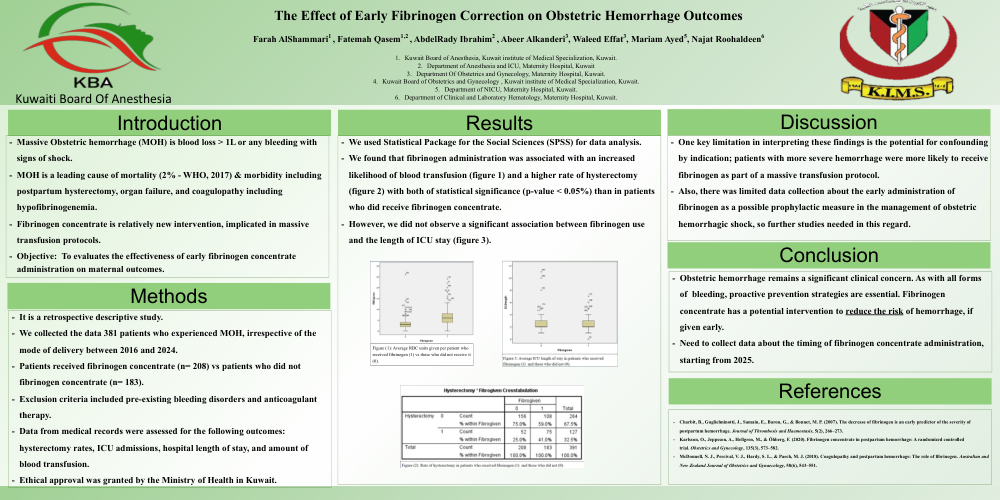
We found that fibrinogen administration was associated with an increased likelihood of blood transfusion (figure 1) and a higher rate of hysterectomy (figure 2) with both of statistical significance (p-value < 0.05%) than in patients who did receive fibrinogen concentrate.
-
However, we did not observe a significant association between fibrinogen use and the length of ICU stay (figure 3).
Discussion:
-
One key limitation in interpreting these findings is the potential for confounding by indication; patients with more severe hemorrhage were more likely to receive fibrinogen as part of a massive transfusion protocol.
-
Also, there was limited data collection about the early administration of fibrinogen as a possible prophylactic measure in the management of obstetric hemorrhagic shock, so further studies needed in this regard.
Conclusions:
-
Obstetric hemorrhage remains a significant clinical concern. As with all forms of bleeding, proactive prevention strategies are essential. Fibrinogen concentrate has a potential intervention to reduce the risk of hemorrhage, if given early.
-
Need to collect data about the timing of fibrinogen concentrate administration, starting from 2025
References:
-
Charbit, B., Guglielminotti, J., Samain, E., Baron, G., & Bonnet, M. P. (2007). The decrease of fibrinogen is an early predictor of the severity of postpartum hemorrhage. Journal of Thrombosis and Haemostasis, 5(2), 266–273.
-
Karlsson, O., Jeppsson, A., Hellgren, M., & Öhberg, F. (2020). Fibrinogen concentrate in postpartum hemorrhage: A randomized controlled trial. Obstetrics and Gynecology, 135(3), 573–582.
-
McDonnell, N. J., Percival, V. J., Hardy, S. L., & Paech, M. J. (2018). Coagulopathy and postpartum hemorrhage: The role of fibrinogen. Australian and New Zealand Journal of Obstetrics and Gynaecology, 58(6), 543–551.