215 posters, 5 topics, 22 sessions, 596 authors, 283 institutions
ePostersLive by SciGen Technologies S.A. All rights reserved.
Obstetric Anaesthesia Annual Scientific Meeting 2025
May 15 - 16, 2025 | ICC, 2 Lanyon Place, Belfast BT1 3WH

6779706
Lumbar ultrasound measurements are imprecise when compared with MRI: Is it more than tissue compression?
Part of Topic
Original Research
Lumbar Ultrasound Measurements are Imprecise when Compared with MRI: Is it more than Soft Tissue Compression?
Sue Lawrence1,2,3, Nicole Atcheson1, David Reutens1,2,3, David Sturgess2,4
Introduction
Preprocedural lumbar sonography may be used to plan epidural and spinal insertion and so increase first pass success, procedural success and patient satisfaction. Measurements assist in interspace and needle selection.[1] How accurate are these measurements, particularly measurements of interlaminar space dimensions or depth?[2]
Methods
Ethics approval was obtained for examination and imaging using ultrasound and magnetic resonance imaging (MRI) of the lumbar spines of healthy young adults (18 – 20 years). Multiple equivalent measurements were taken (T12 - S1). Minimal force was used during ultrasound. Ultrasound measurements were recorded from paramedian oblique and transverse probe orientations. Maximal ultrasound measurement values were used for depth observations and mean for all other multiple planned sequential observations. A single set of MRI measurements were taken from a midline, mid-interspinous space/mid-spinous process axis for each vertebral/interspace level.
Results
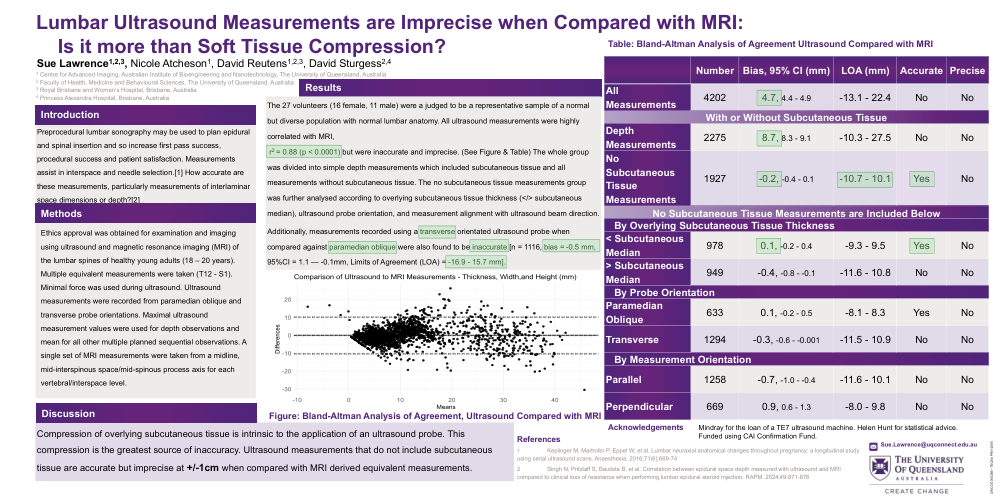
The 27 volunteers (16 female, 11 male) were a judged to be a representative sample of a normal but diverse population with normal lumbar anatomy. All ultrasound measurements were highly correlated with MRI,
r2 = 0.88 (p < 0.0001) but were inaccurate and imprecise. (See Figure & Table) The whole group was divided into simple depth measurements which included subcutaneous tissue and all measurements without subcutaneous tissue. The no subcutaneous tissue measurements group was further analysed according to overlying subcutaneous tissue thickness (</> subcutaneous median), ultrasound probe orientation, and measurement alignment with ultrasound beam direction.
Additionally, measurements recorded using a transverse orientated ultrasound probe when compared against paramedian oblique were also found to be inaccurate [n = 1116, bias = -0.5 mm, 95%CI = 1.1 — -0.1mm, Limits of Agreement (LOA) = -16.9 - 15.7 mm].
Discussion
Compression of overlying subcutaneous tissue is intrinsic to the application of an ultrasound probe. This compression is the greatest source of inaccuracy. Ultrasound measurements that do not include subcutaneous tissue are accurate but imprecise at +/-1cm when compared with MRI derived equivalent measurements.
Acknowledgements
Mindray for the loan of a TE7 ultrasound machine. Helen Hunt for statistical advice. Funded using CAI Confirmation Fund.
References
1 Keplinger M, Marhofer P, Eppel W, et al. Lumbar neuraxial anatomical changes throughout pregnancy: a longitudinal study using serial ultrasound scans. Anaesthesia. 2016;71(6):669-74
2 Singh N, Pritzlaff S, Bautista B, et al. Correlation between epidural space depth measured with ultrasound and MRI compared to clinical loss of resistance when performing lumbar epidural steroid injection. RAPM. 2024;49:871-876