191 posters, 5 topics, 20 sessions, 393 authors, 116 institutions
ePostersLive by SciGen Technologies S.A. All rights reserved.
Obstetric Anaesthesia Annual Scientific Meeting 2023
18 - 19 May, 2023 | EICC Edinburgh

5814395
Do online search results contribute to racial bias and play a role in epidural uptake in women?
Poster Presenter
Authors
Part of Topic
Quality Improvement
Do online search results contribute to racial bias and play a role in epidural uptake in women? S.Sundaram1 , K.Ooi 1 , S Quasim* 2 Specialty Trainee 1 , Consultant Anaesthetist 2 , Department of Anaesthesia University Hospitals Coventry and Warwickshire
Introduction
The latest MBRRACE report [1] highlighted that black and Asian women are at a greater risk of maternal mortality and morbidity compared to white women.
Racial disparity in maternal care has been highlighted by multiple studies [2]. The internet is a source of readily available information and it is not uncommon for women to search online for further information about birth and pain relief .We wanted to investigate if there was a bias introduced at this stage of information gathering from the woman’s perspective.
Aim
To analyse image results of popular search terms relating to epidural and labour analgesia in various search engines and investigate the distribution.
Methods
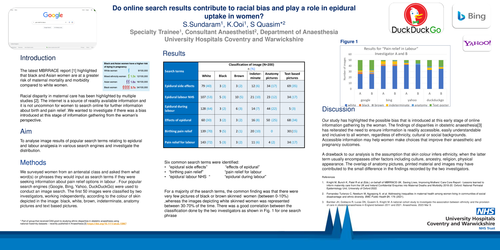
We surveyed women from an antenatal class and asked them what word(s) or phrases they would input as search terms if they were seeking information about pain relief options in labour . Four popular search engines (Google, Bing, Yahoo, DuckDuckGo) were used to conduct an image search. The first 50 images were classified by two investigators, working independently, according to the colour of skin depicted in the image: black, white, brown, indeterminate, anatomy pictures and text based pictures.
Results
Six common search terms were identified:
For a majority of the search terms, the common finding was that there were very few pictures of black or brown skinned women (between 0-10%) ,whereas the images depicting white skinned women was represented between 30-70% of the time. There was a good correlation between the classification done by the two investigators as shown in Fig. 1 for one search phrase
Discussion
Our study has highlighted the possible bias that is introduced at this early stage of online information gathering by the woman. The findings of disparities in obstetric anaesthesia[3] has reiterated the need to ensure information is readily accessible, easily understandable and inclusive to all women, regardless of ethnicity, cultural or social backgrounds. Accessible information may help women make choices that improve their anaesthetic and pregnancy outcomes.
A drawback to our analysis is the assumption that skin colour infers ethnicity, when the latter term usually encompasses other factors including culture, ancestry, religion, physical appearance. The overlap of anatomy pictures, printed material and images may have contributed to the small difference in the findings recorded by the two investigators.
References