191 posters, 5 topics, 20 sessions, 393 authors, 116 institutions
ePostersLive by SciGen Technologies S.A. All rights reserved.
Obstetric Anaesthesia Annual Scientific Meeting 2023
18 - 19 May, 2023 | EICC Edinburgh

5814380
Reducing prolonged fasting times by implementing a 'Sip Til Send' policy for category 3 and 4 Caesarean sections at Whipps Cross
Poster Presenter
Authors
Jeveria Raja, Colum McGrady, Phaneendra Bandikallu, Natasha Kennedy, Mona Behravesh
Affiliations
null,
Part of Topic
Quality Improvement
Sip til Send: Improving Pre-operative Fasting Times in Elective Caesarean section patients at Whipps Cross Hospital
Why are we undertaking this project?
- Current international guidelines only allow consumption of clear fluids for a minimum of 2 hours prior to a procedure. (1)
- Due to the unpredictable and complex nature of theatre, the reality is that patients fast for fluids for much longer than this.
- Prolonged fasting causes patient anxiety, dehydration and increase rates of post operative nausea and vomiting.
- Many centres in the UK have safely moved to more liberal fasting policies.
What did we do?
- To establish the current duration of pre-operative fasting, an anonymous patient survey was completed for twelve patients undergoing a category 4 section over two weeks in October 2022.
- An estimated fasting time was calculated using the time of last drink and the time the patient entered theatre.
- A bespoke policy was created for Whipps Cross after discussion within the department. The team were not in favour of including drinks with 15ml of milk before 07:00.
- We repeated our patient survey over 6 weeks from December 2022 and collected data for twenty-nine patients undergoing an elective caesarean section.
- Negative events were reported and monitored via datix.
New pre-operative fasting guideline:
170ml/hour of clear fluids including black coffe/tea and juice until patients are sent for their caesarean section under regional anaesthesia.
What did we find?
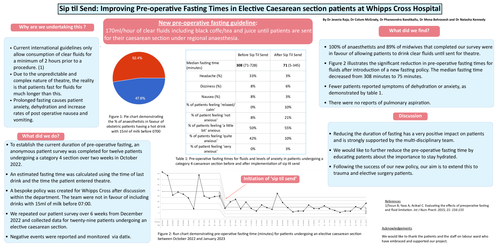
- 100% of anaesthetists and 89% of midwives that completed our survey were in favour of allowing patients to drink clear fluids until sent for theatre.
- Figure 2 illustrates the significant reduction in pre-operative fasting times for fluids after introduction of a new fasting policy. The median fasting time decreased from 308 minutes to 75 minutes.
- Fewer patients reported symptoms of dehydration or anxiety, as demonstrated by table 1.
- There were no reports of pulmonary aspiration.
Discussion
- Reducing the duration of fasting has a very positive impact on patients and is strongly supported by the multi-disciplinary team.
- We would like to further reduce the pre-operative fasting time by educating patents about the importance to stay hydrated.
- Following the success of our new policy, our aim is to extend this to trauma and elective surgery patients.