191 posters, 5 topics, 20 sessions, 393 authors, 116 institutions
ePostersLive by SciGen Technologies S.A. All rights reserved.
Obstetric Anaesthesia Annual Scientific Meeting 2023
18 - 19 May, 2023 | EICC Edinburgh

5809947
Recovery Post-Discharge Following Elective Caesarean Section
Poster Presenter
Authors
Part of Topic
Quality Improvement
Introduction
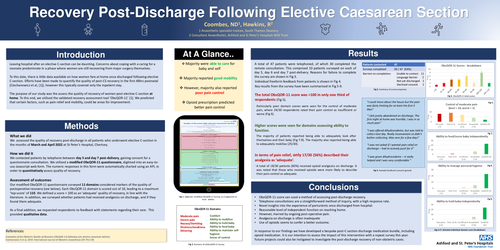
Leaving hospital after an elective C-section can be daunting. Concerns about coping with a caring for a neonate predominate in a phase where women are still recovering from major surgery themselves.
To this date, there is little data available on how women fare at home once discharged following elective
C-section. Efforts have been made to quantify the quality of post-CS recovery in the first 48hrs postnatal (Ciechanowicz et al, [1]), however this typically covered only the inpatient stay.
The purpose of our study was the assess the quality of recovery of women post elective C-section at home. To this end, we utilised the validated recovery assessment tool ‘ObsQOR-11’ [1]. We predicted that certain factors, such as pain relief and mobility, could be areas for improvement.
Methods
What we did
We assessed the quality of recovery post-discharge in all patients who underwent elective C-section in the months of March and April 2022 at St Peter’s Hospital, Chertsey.
How we did it
We contacted patients by telephone between day 5 and day 7 post-delivery, gaining consent for a questionnaire consultation. We utilised a modified ObsQOR-11 questionnaire, digitised into an easy-to-use Javascript web form. The numeric responses in this form were automatically charted using an API, in order to quantitatively assess quality of recovery.
Assessment of outcomes
Our modified ObsQOR-11 questionnaire surveyed 11 domains considered markers of the quality of postoperative recovery (see below). Each ObsQOR-11 domain is scored out of 10, leading to a maximum ‘top-score’ of 110. We defined a score > 100 as an ‘adequate’ quality of recovery, in line with the literature. In addition, we surveyed whether patients had received analgesics on discharge, and if they found them adequate.
As a final addition, we requested respondents to feedback with statements regarding their care. This
provided qualitative data.
Results
A total of 47 patients were telephoned, of which 30 completed the
remote consultation. This comprised 10 patients surveyed on each of
day 5, day 6 and day 7 post-delivery. Reasons for failure to complete the survey are shown in Fig 3.
Individual freeform feedback from patients is shown in Fig 4.
Key results from the survey have been summarised in Fig 5-9.
The total ObsQOR-11 score was >100 in only one third of respondents (Fig 5).
Particularly poor domain scores were seen for the control of moderate pain, where 24/30 respondents rated their pain control as insufficient or worse (Fig 6).
Higher scores were seen for domains assessing ability to function.
The majority of patients reported being able to adequately look after themselves and their baby (Fig 7-9). The majority also reported being able to adequately mobilise (25/30).
In terms of pain relief, only 17/30 (56%) described their analgesia as ‘adequate’.
A total of 18/30 patients (60%) received opioid analgesics on discharge. It was noted that those who received opioids were more likely to describe their pain control as adequate.
Conclusions
In response to our findings we have developed a bespoke post-C section discharge medication bundle, including opioid medication. It is our intention to assess the impact of this intervention with a repeat survey this year. Future projects could also be instigated to investigate the post-discharge recovery of non-obstetric cases.