191 posters, 5 topics, 20 sessions, 393 authors, 116 institutions
ePostersLive by SciGen Technologies S.A. All rights reserved.
Obstetric Anaesthesia Annual Scientific Meeting 2023
18 - 19 May, 2023 | EICC Edinburgh

5809882
Does the use of prilocaine for spinal anaesthesia improve recovery times compared to bupivacaine in women undergoing caesarean section?
Poster Presenter
Authors
Affiliations
Part of Topic
Quality Improvement
DOES THE USE OF PRILOCAINE FOR SPINAL ANAESTHESIA IMPROVE RECOVERY TIMES COMPARED TO BUPIVACAINE IN WOMEN UNDERGOING CAESAREAN SECTION?
Yore P, Calpin P
Department of Anaesthesia, The National Maternity Hospital, Dublin, Ireland
Introduction
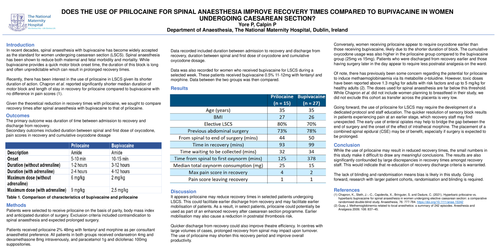
In recent decades, spinal anaesthesia with bupivacaine has become widely accepted as the standard for women undergoing caesarean section (LSCS). Spinal anaesthesia has been shown to reduce both maternal and fetal morbidity and mortality. While bupivacaine provides a quick motor block onset time, the duration of this block is long and often unpredictable which can result in prolonged recovery times. Recently, there has been interest in the use of prilocaine in LSCS given its shorter duration of action. Chapron et al. reported significantly shorter median duration of motor block and length of stay in recovery for prilocaine compared to bupivacaine with no difference in pain scores (1). Given the theoretical reduction in recovery times with prilocaine, we sought to compare recovery times after spinal anaesthesia with bupivacaine to that of prilocaine. Methods Patients were selected to receive prilocaine on the basis of parity, body mass index and anticipated duration of surgery. Exclusion criteria included contraindication to spinal anaesthesia and expected prolonged surgery. Patients received prilocaine 2% 48mg with fentanyl and morphine as per consultant anaesthetist preference. All patients in both groups received ondansetron 4mg and dexamethasone 8mg intravenously, and paracetamol 1g and diclofenac 100mg suppositories.
Outcomes
The primary outcome was duration of time between admission to recovery and discharge from recovery. Secondary outcomes included duration between spinal and first dose of oxycodone, pain scores in recovery and cumulative oxycodone dosage
Methods
Patients were selected to receive prilocaine on the basis of parity, body mass index and anticipated duration of surgery. Exclusion criteria included contraindication to spinal anaesthesia and expected prolonged surgery. Patients received prilocaine 2% 48mg with fentanyl and morphine as per consultant anaesthetist preference. All patients in both groups received ondansetron 4mg and dexamethasone 8mg intravenously, and paracetamol 1g and diclofenac 100mg suppositories.
Data recorded included duration between admission to recovery and discharge from recovery, duration between spinal and first dose of oxycodone and cumulative oxycodone dosage. Data was also recorded for women who received bupivacaine for LSCS during a selected week. These patients received bupivacaine 0.5% 11-12mg with fentanyl and morphine. Data between the two groups was then compared.
Discussion
It appears prilocaine may reduce recovery times in selected patients undergoing LSCS. This could facilitate earlier discharge from recovery and may facilitate earlier mobilisation of patients. As a result, in select patients, prilocaine could potentially be used as part of an enhanced recovery after caesarean section programme. Earlier mobilisation may also cause a reduction in postnatal thrombosis risk. Quicker discharge from recovery could also improve theatre efficiency. In centres with large volumes of cases, prolonged recovery from spinal may impact upon turnover. The use of prilocaine may shorten this recovery period and improve overall productivity.
Conversely, women receiving prilocaine appear to require oxycodone earlier than those receiving bupivacaine, likely due to the shorter duration of block. The cumulative oxycodone usage was also higher in the prilocaine group compared to the bupivacaine group (25mg vs 15mg). Patients who were discharged from recovery earlier and those having surgery later in the day appear to require less postnatal analgesia on the ward. Of note, there has previously been some concern regarding the potential for prilocaine to induce methaemoglobinaemia via its metabolite o-toluidine. However, toxic doses have been reported above 1.3 mg/kg for adults with risk factors and up to 5 mg/kg for healthy adults (2). The doses used for spinal anaesthesia are far below this threshold. While Chapron et al. did not include women planning to breastfeed in their study, we did not exclude this cohort as transfer across the placenta is very low. Going forward, the use of prilocaine for LSCS may require the development of a dedicated protocol and staff education. The quicker resolution of sensory block results in patients experiencing pain at an earlier stage, which recovery staff may find unexpected. The early use of enteral opiates may help to bridge the gap between the end of surgery and the onset of the effect of intrathecal morphine. The placement of a combined spinal epidural (CSE) may be of benefit, especially if surgery is expected to be prolonged.
Conclusion
While the use of prilocaine may result in reduced recovery times, the small numbers in this study make it difficult to draw any meaningful conclusions. The results are also significantly confounded by large discrepancies in recovery times amongst recovery staff. This would indicate that re-education of recovery discharge criteria is warranted. The lack of blinding and randomisation means bias is likely in this study. Going forward, research with larger patient cohorts, randomisation and blinding is required.
References (1) Chapron, K., Sleth, J.-.-C., Capdevila, X., Bringuier, S. and Dadure, C. (2021), Hyperbaric prilocaine vs. hyperbaric bupivacaine for spinal anaesthesia in women undergoing elective caesarean section: a comparative randomised double-blind study. Anaesthesia, 76: 777-784. https://doi.org/10.1111/anae.15342 (2) Guay J. Methemoglobinemia related to local anesthetics: a summary of 242 episodes. Anesthesia and Analgesia 2009; 108: 837–45