191 posters, 5 topics, 20 sessions, 393 authors, 116 institutions
ePostersLive by SciGen Technologies S.A. All rights reserved.
Obstetric Anaesthesia Annual Scientific Meeting 2023
18 - 19 May, 2023 | EICC Edinburgh

5809841
Supply exceeds demand: Evaluation of pure nitrous oxide use in the delivery suite of a teaching hospital
Poster Presenter
Part of Topic
Quality Improvement
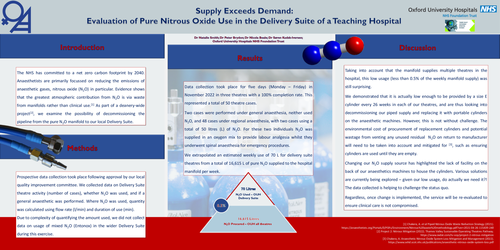
Supply Exceeds Demand: Evaluation of Pure Nitrous Oxide Use in the Delivery Suite of a Teaching Hospital
Dr Natalie Smith; Dr Peter Brydon; Dr Nicola Beale; Dr Søren Kudsk-Iversen; Oxford University Hospitals NHS Foundation Trust
Introduction
The NHS has committed to a net zero carbon footprint by 2040. Anaesthetists are primarily focussed on reducing the emissions of anaesthetic gases, nitrous oxide (N2O) in particular. Evidence shows that the greatest atmospheric contribution from N2O is via waste from manifolds rather than clinical use.[1] As part of a deanery-wide project[2], we examine the possibility of decommissioning the pipeline from the pure N2O manifold to our local DeliverySuite.
Methods
Prospective data collection took place following approval by our local quality improvement committee. We collected data on Delivery Suite theatre activity (number of cases), whether N2O was used, and if a general anaesthetic was performed. Where N2O was used, quantity was calculated using flow rate (l/min) and duration of use (min).
Due to complexity of quantifying the amount used, we did not collect data on usage of mixed N2O (Entonox) in the wider Delivery Suite during this exercise.
Results
Data collection took place for five days (Monday – Friday) in November 2022 in three theatres with a 100% completion rate. This represented a total of 50 theatre cases.
Two cases were performed under general anaesthesia, neither used N2O, and 48 cases under regional anaesthesia, with two cases using a total of 50 litres (L) of N2O. For these two individuals N2O was supplied in an oxygen mix to provide labour analgesia whilst they underwent spinal anaesthesia for emergency procedures.
We extrapolated an estimated weekly use of 70 L for delivery suite theatres from a total of 16,615 L of pure N2O supplied to the hospital manifold per week.
Discussion
Taking into account that the manifold supplies multiple theatres in the hospital, this low usage (less than 0.5% of the weekly manifold supply) was still surprising.
We demonstrated that it is actually low enough to be provided by a size E cylinder every 26 weeks in each of our theatres, and are thus looking into decommissioning our piped supply and replacing it with portable cylinders on the anaesthetic machines. However, this is not without challenge. The environmental cost of procurement of replacement cylinders and potential wastage from venting any unused residual N2O on return to manufacturer will need to be taken into account and mitigated for [3], such as ensuring cylinders are used until they are empty.
Changing our N2O supply source has highlighted the lack of facility on the back of our anaesthetics machines to house the cylinders. Various solutions are currently being explored – given our low usage, do actually we need it?! The data collected is helping to challenge the status quo.
Regardless, once change is implemented, the service will be re-evaluated to ensure clinical care is not compromised.